Square Root Chart Generator

Generate a custom square root chart for any number range instantly. Choose your decimal precision, view perfect squares only, and print or copy the result for free.

Custom Ranges 2 to 4 Decimal Precision Copy CSV & Print 100% Free

Square Root Chart Generator

Generate custom printable reference tables for any range of numbers

Quick Presets:
The lowest value in your generated table (e.g. 1, 0, or 100).
The highest value in your table (up to 1,000 items per generation).
Interval between consecutive numbers (e.g., 1 for whole integers, 0.5 for half steps).
Number of decimal places shown for irrational square roots.
Custom Table Builder

Square Root Chart Generator: Build, Customize, and Print Tables

Most square root charts online are stuck at a fixed range, usually 1 to 100, printed once and never customizable. This tool allows you to pick any range you need, choose decimal precision, filter perfect squares, and generate a clean, ready-to-use table in seconds.

Whether you need a quick study guide for algebra homework, a printable classroom poster for students, or an engineering lookup table up to 1000, our generator builds clean reference charts instantly.

√25 = 5.000 Rational Whole Root (Perfect Square)
√50 ≈ 7.071 Irrational Root (3 Decimal Precision)
√100 = 10.000 Century Milestone Benchmark

Anatomy of Square Root Notation

  • Radical Symbol (√): Introduced by Christoff Rudolff in 1525, this symbol denotes root extraction.
  • Radicand: The positive number or expression located under the radical bar (for example, 49 in √49).
  • Principal Square Root: While every positive number has two roots, the radical symbol specifically denotes the positive value (+7).
  • Inverse of Squaring: Finding a square root is the direct inverse mathematical operation of squaring a number (n²).
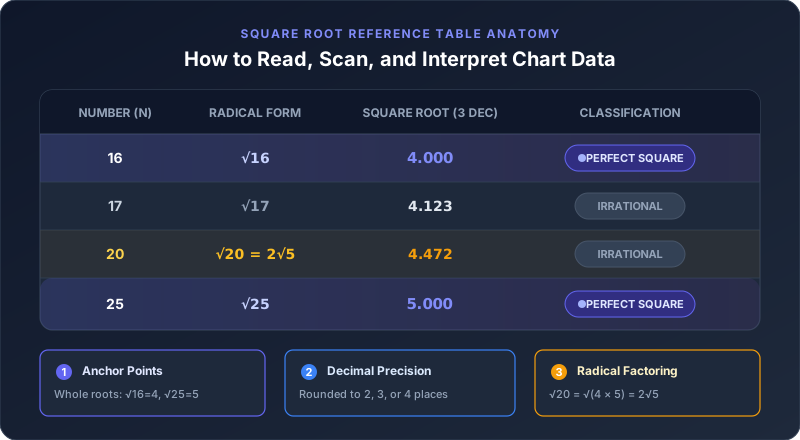
Anatomy of square root notation: The radical sign (√), radicand (the number inside), and decimal value.
Quick Instructions

How to Use the Square Root Chart Generator

Building a custom square root reference table takes only a few quick steps:

1

Set your range

Enter a starting number and an ending number (for example, 1 to 100 for school reference, or 100 to 1000 for advanced projects).

2

Choose step interval and decimal precision

Pick increments of 1, 2, 5, or 10, and select 2, 3, or 4 decimal places for non-perfect square approximations.

3

Filter perfect squares only (optional)

Toggle this option if you only want integer square roots like 4, 9, 16, and 25 for fast memorization practice.

4

Copy, export, or print

Copy your custom table to the clipboard, download as a CSV file for Excel and Google Sheets, or print a clean study sheet.

No sign-up or software installation required

Generate and export high-precision tables directly in your browser, completely free with no usage limits or watermarks.

Interactive Reference

Complete Square Root Table from 1 to 100

Explore the complete reference table of square roots from 1 to 100. Use the search box and quick filter chips below to locate specific numbers, perfect squares, or irrational values instantly.

Showing 100 of 100 rows
Number (N) Radical Form Square Root (√N) Classification
1 √1 1.000 Perfect Square
2 √2 1.414 Irrational
3 √3 1.732 Irrational
4 √4 2.000 Perfect Square
5 √5 2.236 Irrational
6 √6 2.449 Irrational
7 √7 2.646 Irrational
8 √8 2.828 Irrational
9 √9 3.000 Perfect Square
10 √10 3.162 Irrational
11 √11 3.317 Irrational
12 √12 3.464 Irrational
13 √13 3.606 Irrational
14 √14 3.742 Irrational
15 √15 3.873 Irrational
16 √16 4.000 Perfect Square
17 √17 4.123 Irrational
18 √18 4.243 Irrational
19 √19 4.359 Irrational
20 √20 4.472 Irrational
21 √21 4.583 Irrational
22 √22 4.690 Irrational
23 √23 4.796 Irrational
24 √24 4.899 Irrational
25 √25 5.000 Perfect Square
26 √26 5.099 Irrational
27 √27 5.196 Irrational
28 √28 5.292 Irrational
29 √29 5.385 Irrational
30 √30 5.477 Irrational
31 √31 5.568 Irrational
32 √32 5.657 Irrational
33 √33 5.745 Irrational
34 √34 5.831 Irrational
35 √35 5.916 Irrational
36 √36 6.000 Perfect Square
37 √37 6.083 Irrational
38 √38 6.164 Irrational
39 √39 6.245 Irrational
40 √40 6.325 Irrational
41 √41 6.403 Irrational
42 √42 6.481 Irrational
43 √43 6.557 Irrational
44 √44 6.633 Irrational
45 √45 6.708 Irrational
46 √46 6.782 Irrational
47 √47 6.856 Irrational
48 √48 6.928 Irrational
49 √49 7.000 Perfect Square
50 √50 7.071 Irrational
51 √51 7.141 Irrational
52 √52 7.211 Irrational
53 √53 7.280 Irrational
54 √54 7.348 Irrational
55 √55 7.416 Irrational
56 √56 7.483 Irrational
57 √57 7.550 Irrational
58 √58 7.616 Irrational
59 √59 7.681 Irrational
60 √60 7.746 Irrational
61 √61 7.810 Irrational
62 √62 7.874 Irrational
63 √63 7.937 Irrational
64 √64 8.000 Perfect Square
65 √65 8.062 Irrational
66 √66 8.124 Irrational
67 √67 8.185 Irrational
68 √68 8.246 Irrational
69 √69 8.307 Irrational
70 √70 8.367 Irrational
71 √71 8.426 Irrational
72 √72 8.485 Irrational
73 √73 8.544 Irrational
74 √74 8.602 Irrational
75 √75 8.660 Irrational
76 √76 8.718 Irrational
77 √77 8.775 Irrational
78 √78 8.832 Irrational
79 √79 8.888 Irrational
80 √80 8.944 Irrational
81 √81 9.000 Perfect Square
82 √82 9.055 Irrational
83 √83 9.110 Irrational
84 √84 9.165 Irrational
85 √85 9.220 Irrational
86 √86 9.274 Irrational
87 √87 9.327 Irrational
88 √88 9.381 Irrational
89 √89 9.434 Irrational
90 √90 9.487 Irrational
91 √91 9.539 Irrational
92 √92 9.592 Irrational
93 √93 9.644 Irrational
94 √94 9.695 Irrational
95 √95 9.747 Irrational
96 √96 9.798 Irrational
97 √97 9.849 Irrational
98 √98 9.899 Irrational
99 √99 9.950 Irrational
100 √100 10.000 Perfect Square
Perfect Squares

The 10 Perfect Squares from 1 to 100

A square root chart cleanly differentiates between rational numbers (integers) and irrational numbers (non-terminating decimal roots).

n n × n n² √n²
11 × 111.000
22 × 242.000
33 × 393.000
44 × 4164.000
55 × 5255.000
66 × 6366.000
77 × 7497.000
88 × 8648.000
99 × 9819.000
1010 × 1010010.000

Testing whether a specific number is an exact square? Check if any number is a perfect square with our instant checker →

Non-Perfect Squares & Radical Simplification

Number Radical Simplified Decimal (6 Dec) Chart (3 Dec)
2 √2 √2 1.414214 1.414
3 √3 √3 1.732051 1.732
5 √5 √5 2.236068 2.236
10 √10 √10 3.162278 3.162
50 √50 5√2 7.071068 7.071
75 √75 5√3 8.660254 8.660

Need the complete step-by-step factorization proof for an individual root? Calculate individual square roots with exact step-by-step proofs →

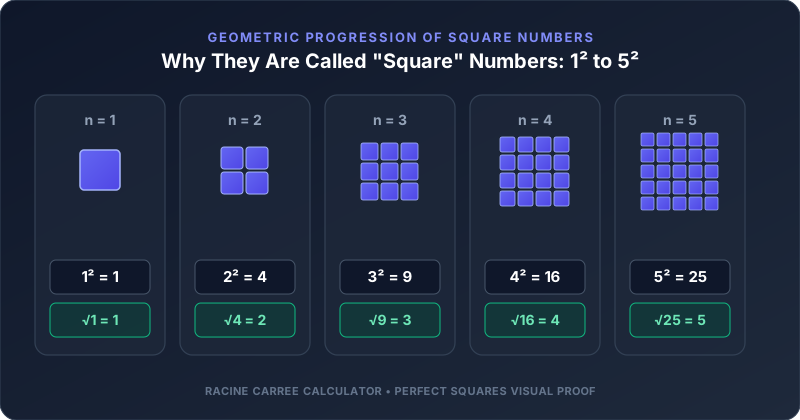
Visual progression of perfect squares: Geometric squares where area equals the square of side length.
1 – 1000 Range

Extended Range: 1 to 1000 Patterns, Benchmarks, and Milestones

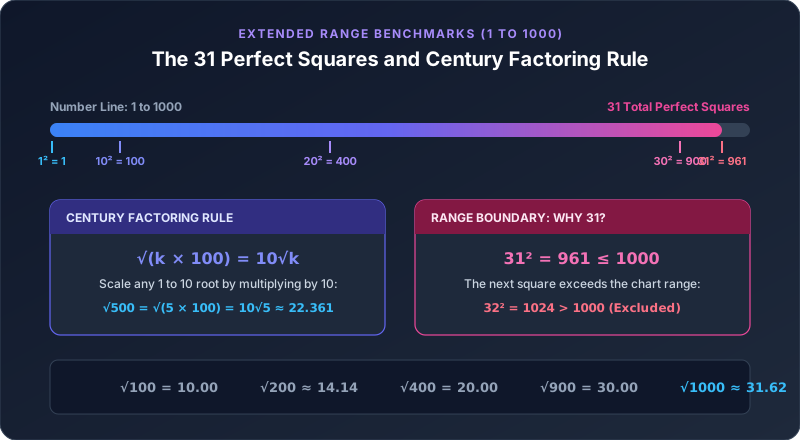
Across the numbers 1 through 1000, there are exactly 31 perfect squares, because 31² = 961 while 32² = 1024 exceeds 1000.

All 31 Perfect Squares Up to 1000

nn² nn² nn²
11 12144 23529
24 13169 24576
39 14196 25625
416 15225 26676
525 16256 27729
636 17289 28784
749 18324 29841
864 19361 30900
981 20400 31961
10100 21441 --
11121 22484 --

Century Benchmarks (100 to 1000)

Every century marker factors using √(k × 100) = 10√k. Multiply the known root of k by 10:

Number Radical Factored Form Root Value Logic
100 √100 10 10.000 10 × 1
200 √200 10√2 14.142 10 × 1.414
300 √300 10√3 17.320 10 × 1.732
400 √400 20 20.000 20 × 1
500 √500 10√5 22.361 10 × 2.236
600 √600 10√6 24.495 10 × 2.449
700 √700 10√7 26.457 10 × 2.646
800 √800 20√2 28.284 20 × 1.414
900 √900 30 30.000 30 × 1
1000 √1000 10√10 31.623 10 × 3.162
The 31 perfect squares from 1 to 1000 and the century factoring rule: √(k × 100) = 10√k.
Mathematical Foundation

How Square Root Values Are Calculated

Every value in a square root table satisfies the foundational algebraic definition: the principal square root of x is the non-negative number y such that y × y = x.

For numbers that are not perfect squares, the square root is an irrational number with an endless, non-repeating decimal expansion. The generator rounds these values to your chosen precision:

  • √10 ≈ 3.162 (rounded from 3.16227766...)
  • √50 ≈ 7.071 (rounded from 7.07106781...)
  • √75 ≈ 8.660 (rounded from 8.66025403...)

In contrast, perfect squares yield exact whole integers with zero approximation error, such as √49 = 7 and √100 = 10.

How to Calculate Square Roots Manually: Three Proven Methods

1

Prime Factorization

Best for evaluating large perfect squares by pairing identical prime factors.

2

Long Division Method

Calculates digit-by-digit accuracy for non-perfect square irrational roots.

3

Babylonian / Newton-Raphson Method

Fast iterative formula: x_(n+1) = 0.5 × (x_n + S / x_n) that rapidly doubles decimal precision.

Exploring three-dimensional powers? Solve cube roots and explore cubic reference tables →

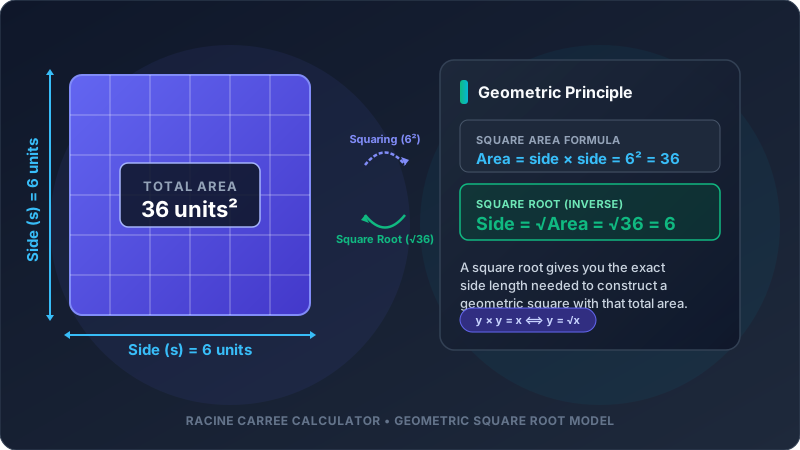
Geometric concept: The square root represents the side length of a square with a known area.
Excel & Sheets

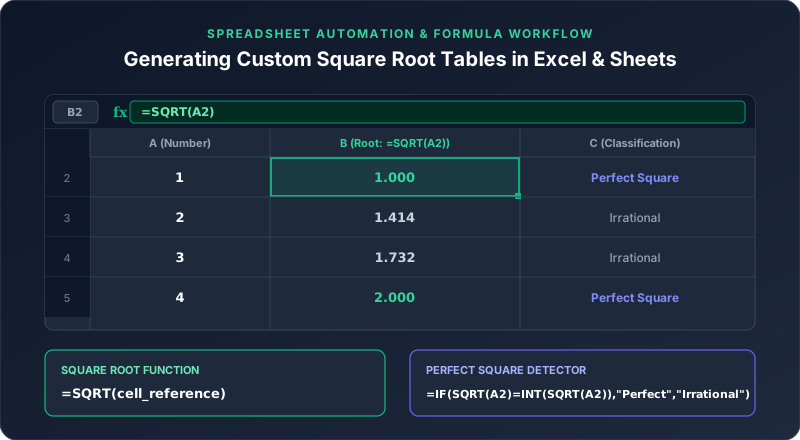
How to Generate a Square Root Table in Spreadsheets (Excel & Google Sheets)

1

Populate Numbers in Column A

Type 1 in cell A2 and 2 in cell A3, then drag the fill handle down to row 101.

2

Enter the Square Root Formula

In cell B2, enter the formula below and double-click the fill handle:

=SQRT(A2)
3

Add Automated Perfect Square Labels

In cell C2, enter this logical formula to label perfect squares automatically:

=IF(SQRT(A2)=INT(SQRT(A2)), "Perfect Square", "Irrational")
Generating square root charts in Excel and Google Sheets using the SQRT formula.
Tool Comparison

Square Root Chart vs. Square Root Calculator: When to Use Each

Both tools solve root problems, but they serve different mathematical workflows:

Square Root Calculator (Single Value)

A calculator is best when you need an immediate answer for a single number, along with step-by-step radical simplification and prime factor trees.

Square Root Chart Generator (Panoramic Table)

A chart generator provides an entire numerical sequence simultaneously, allowing you to compare adjacent values, spot patterns, and print full reference tables.

Use the single calculator when solving a specific homework equation. Use the chart generator when studying a number range, building a cheat sheet, or preparing engineering tables.

Practical Advice

How to Read and Memorize Your Chart

To maximize your learning efficiency, apply these three core study principles:

Anchor around the 10 perfect squares

Memorize the core anchors (1, 4, 9, 16, 25, 36, 49, 64, 81, 100). Every other number falls between two consecutive squares, giving you an immediate mental estimate.

Memorize key irrational benchmarks

Remember that √2 is approximately 1.414, √3 is approximately 1.732, and √5 is approximately 2.236. These three values help simplify radical expressions across algebra.

Select appropriate precision for your task

Use 2 decimal places for fast mental estimation, and switch to 3 or 4 decimal places for physics, geometry, and engineering computations.

ISO 80000-1

International Mathematical Conventions: US, UK, Canada, Australia, Germany, and France

US, UK, Canada & Australia

Uses a period (.) as the decimal separator (for example, √2 ≈ 1.414). Aligned with US Common Core and UK GCSE.

Germany & France

Uses a comma (,) as the decimal separator (for example, √2 ≈ 1,414). Aligned with DIN 1333 and AFNOR standards.

STEM

Real-World Applications of Square Root Tables and Values

1. Construction & Geometry

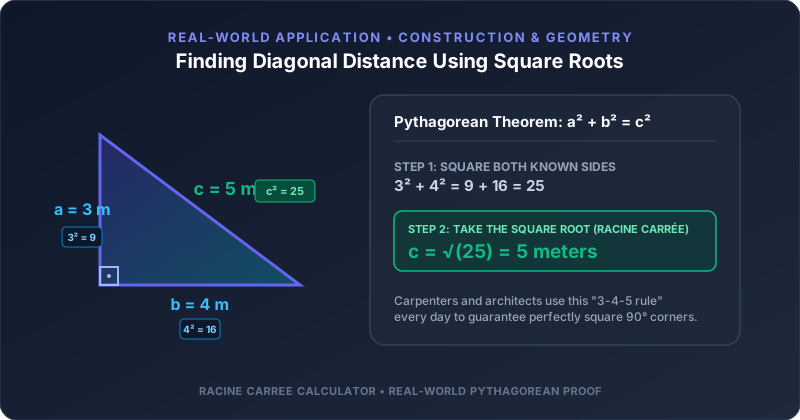
Carpenters calculate diagonal spans and rafter lengths using the Pythagorean theorem: c = √(a² + b²).

2. Electrical Engineering & RMS

AC electricity (120V / 230V) is rated by Root-Mean-Square voltage: V_RMS = V_peak / √2.

3. Computer Graphics & Game Engines

Game engines calculate 2D and 3D distances using Euclidean distance and lookup tables (LUT) for O(1) performance.

Practical application: Calculating diagonal distances and right-angle foundations using the Pythagorean theorem.
Common Pitfalls

Common Mistakes to Avoid with Square Root Charts

#1

Treating rounded decimals as exact numbers

Values like √2 ≈ 1.414 are rounded approximations. In pure algebra, keep the exact radical form (√2) to prevent cumulative rounding errors.

#2

Forgetting the principal root convention

While (-5) × (-5) = 25, the radical symbol √25 strictly denotes the principal (non-negative) root, which is +5.

#3

Attempting to find real roots of negative numbers

In real-number mathematics, negative radicands have no real solution. Square roots of negative numbers belong to the complex number system using the imaginary unit i.

Common Questions

Frequently Asked Questions

What is the principal square root?

The principal square root is the non-negative square root of a positive real number. While an equation such as x² = 36 has two valid algebraic solutions (6 and -6), the radical symbol √36 strictly denotes the principal non-negative root: +6.

How do you find the square root of a non-perfect square without a calculator?

You can use the manual long division method for exact digit-by-digit accuracy, or the Babylonian (Newton-Raphson) approximation formula: x_{n+1} = 0.5 * (x_n + S / x_n). Alternatively, identify the two nearest perfect squares to estimate the root.

Why are the square roots of non-perfect squares irrational numbers?

If an integer is not a perfect square, its root cannot be represented as a simple fraction a/b where a and b are integers. Its decimal expansion continues indefinitely without repeating a predictable sequence of digits, requiring rounded approximations on charts.

How many perfect squares are there between 1 and 100?

There are exactly 10 perfect squares between 1 and 100 inclusive: 1, 4, 9, 16, 25, 36, 49, 64, 81, and 100.

How many perfect squares are there between 1 and 1000?

There are exactly 31 perfect squares between 1 and 1000 inclusive, starting with 1² = 1 and ending with 31² = 961. The next square, 32² = 1024, exceeds 1000.

Can a negative number have a square root in a standard chart?

In real-number arithmetic, negative numbers do not have real square roots because multiplying any real number by itself always yields a non-negative result. Negative roots require complex imaginary numbers (i), so standard charts list real numbers only (x ≥ 0).

Can I generate and print a square root chart up to 1000 on this website?

Yes. Use the controls at the top of the page, set the starting value to 1 and the ending value to 1000, choose your desired decimal precision, and click Print or Copy to CSV. The tool generates the full table instantly without any downloads or fees.

How do I create a square root table in Excel or Google Sheets?

Enter numbers 1 to 100 in column A, then in cell B2 enter the formula =SQRT(A2). Drag the fill handle down to apply the formula across the entire column, and format the numbers to your desired decimal places.

Review

Summary & Key Takeaways

Key Takeaways

A square root chart provides a structured, panoramic view of square roots across any interval. Memorizing perfect squares, understanding irrational decimal approximations, and using our custom generator allows you to create print-ready tables tailored to any academic or professional need.