Cube Root Calculator
Find ∛x for any number, including negatives
Enter any number (positive or negative) to find its cube root. Unlike square roots, cube roots work with negative numbers too.
∛
Calculate the cube root of any number (positive or negative) instantly. Get the exact decimal result, simplified radical form, and step-by-step workings. 100% free.
Racine cubique is the French word for cube root, and just like its cousin "racine carrée," it's a term people search in English all the time. If you landed here looking for a fast answer, the racine cubique calculator above will give you one instantly. Everything below explains what a cube root actually is, how to find one by hand, and where it shows up outside the classroom.
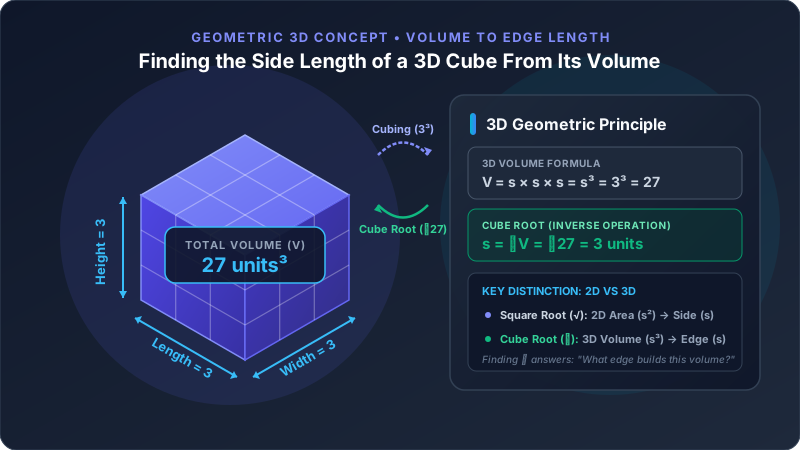
A cube root is a number that, when multiplied by itself three times, gives you another number. Multiply 3 by itself three times (3 × 3 × 3) and you get 27. So we say the cube root of 27 is 3.
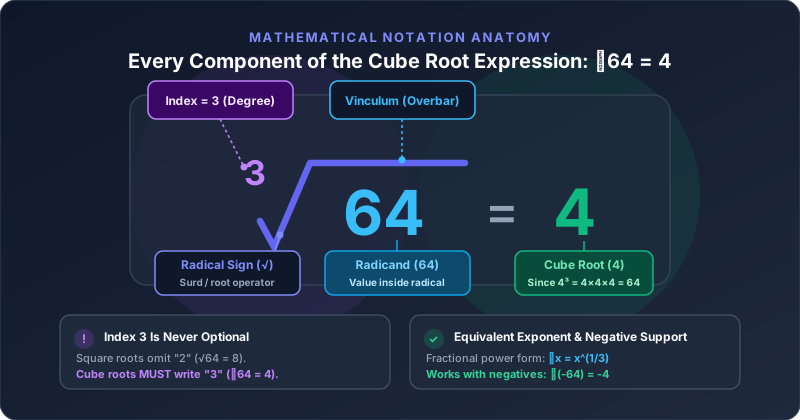
The small number 3 in the upper-left of the radical sign. It indicates you are finding the 3rd root (cube root) rather than a square root (index 2).
The mathematical sign ∛ denoting the extraction of the cube root. In Unicode, it is character U+221B.
The number underneath the radical sign whose cube root is being calculated. It can be positive, negative, or zero.
The real value that, when multiplied by itself three times (y × y × y), equals the radicand.
That's the entire idea. Everything else on this page just builds on it.
Get your answer in three simple steps:
Type your number into the box above.
Hit the Calculate button to process your number.
The calculator shows the cube root instantly, including a simplified form when one's available and correct handling of negative numbers.
No formulas needed to use the tool itself. The rest of this guide is for anyone who wants to understand what's happening behind that one click.
The symbol ∛ is the cube root sign. It's built from the same radical symbol used for square roots, but with a small "3" (called the index) tucked into the notch.
Standard mathematical radical notation using index 3 and radical sign.
Fractional power representation: raising any number to 1/3 equals its cube root.
Standard in JavaScript, Python (64 ** (1/3)), C, Java, and modern runtimes.
Excel and Google Sheets formula. Alternatively use =A1^(1/3).
LaTeX mathematical typesetting command for academic papers and documents.
On Windows: type 221B then press Alt+X. On Mac: Cmd+Ctrl+Space. HTML: ∛.
You'll also see cube roots written as a fractional exponent:
Both forms mean the same thing: the exponent version is often used in calculators, spreadsheets, and programming because the ∛ symbol isn't always easy to type.
So whether you write ∛x or x^(1/3), the operation is identical.
Like square roots, there's no single plug-and-play formula: a cube root is defined by a relationship:
In plain words: whatever answer you get, multiplying it by itself three times has to bring you back to your starting number.
These five rules mirror the foundational square root rules you may already know, but adapted for the third degree:
Just like with simplifying square roots, you can break a complicated cube root into simpler pieces. Instead of computing ∛216 directly, factor it as 8 × 27, compute each cube root separately, and multiply.
The mirror of the product rule: take the cube root of a fraction by rooting the numerator and denominator separately.
Unlike square roots, which only return non-negative values, the power rule for cube roots works for all real numbers (positive, negative, and zero). ∛((-3)³) = -3.
This is the definition of cube root stated in reverse. If ∛a is "the number that, when cubed, gives a," then cubing ∛a must give you a back.
These are the fixed points of the cube root function. ∛1 = 1 because 1³ = 1, and ∛0 = 0 because 0³ = 0.
Working with higher degree root indices beyond 3? Compute 4th, 5th, and general nth roots online →
Four reliable ways to find cube roots:
Type in your number, click Calculate, done. This is the method most people reach for once they know it exists, especially for decimals or large numbers.
This method breaks a number into its prime factors and groups them in sets of three.
Place the number between two known cubes:
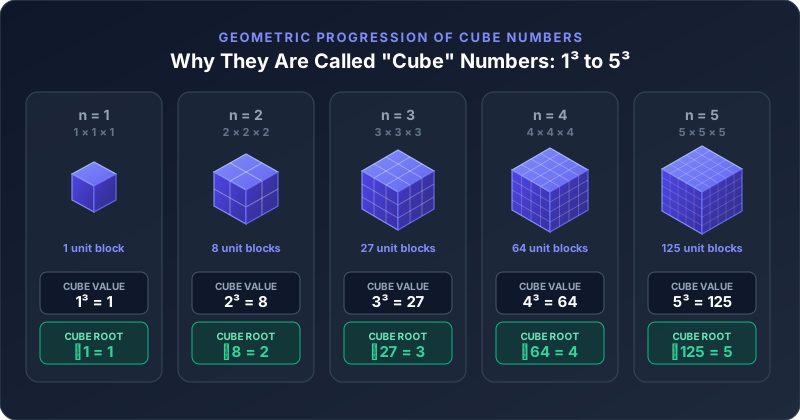
A perfect cube is a number you get by multiplying a whole number by itself three times. Cubes grow much faster than squares, which is why this list stops at 10.
Scroll to browse table ↓
| Number (n) | Cube (n³) | Cube Root (∛n³) | Quick Test |
|---|---|---|---|
| 1 | 1 | 1 | |
| 2 | 8 | 2 | |
| 3 | 27 | 3 | |
| 4 | 64 | 4 | |
| 5 | 125 | 5 | |
| 6 | 216 | 6 | |
| 7 | 343 | 7 | |
| 8 | 512 | 8 | |
| 9 | 729 | 9 | |
| 10 | 1,000 | 10 | |
| 11 | 1,331 | 11 | |
| 12 | 1,728 | 12 | |
| 15 | 3,375 | 15 | |
| 20 | 8,000 | 20 | |
| 25 | 15,625 | 25 | |
| 50 | 125,000 | 50 | |
| 100 | 1,000,000 | 100 |
Here's the single most important thing that separates cube roots from square roots: you can take the cube root of a negative number, and the answer is a normal, real number.
Why does this work when it doesn't for square roots? Because multiplying three negative numbers together gives you a negative result: negative × negative = positive, then positive × negative = negative.
Requires the imaginary unit i (±4i) because squaring any real number produces a non-negative result.
100% Real solution! Multiplying three negative numbers gives a negative product: (-4) × (-4) × (-4) = -64.
∛(−64) = −4, because (−4) × (−4) × (−4) = −64
That's the full answer. No "i," no imaginary unit, nothing extra needed.
Square roots of negative numbers require the imaginary unit i, but cube roots handle negatives just fine on their own.
To find the cube root of a decimal, convert it into a fraction or power of ten, simplify, and evaluate the root.
Apply the quotient property by taking the cube root of the numerator and denominator separately: ∛(a/b) = ∛a / ∛b.
Not every cube root is a perfect cube, but many can still be simplified by pulling out any perfect-cube factors.
| Expression | Simplified Form | Why | Actions |
|---|---|---|---|
| ∛16 | 2∛2 | 16 = 2³ × 2 = 8 × 2 | |
| ∛24 | 2∛3 | 24 = 2³ × 3 = 8 × 3 | |
| ∛32 | 2∛4 | 32 = 2³ × 4 = 8 × 4 | |
| ∛40 | 2∛5 | 40 = 2³ × 5 = 8 × 5 | |
| ∛48 | 2∛6 | 48 = 2³ × 6 = 8 × 6 | |
| ∛54 | 3∛2 | 54 = 3³ × 2 = 27 × 2 | |
| ∛56 | 2∛7 | 56 = 2³ × 7 = 8 × 7 | |
| ∛72 | 2∛9 | 72 = 2³ × 9 = 8 × 9 | |
| ∛108 | 3∛4 | 108 = 3³ × 4 = 27 × 4 | |
| ∛128 | 4∛2 | 128 = 4³ × 2 = 64 × 2 | |
The trick: find the largest perfect cube that divides evenly into your number, pull it out, and the rest stays under the radical.
A quick side-by-side comparison of 2D vs 3D radicals:
| Property / Feature | Cube Root | Square Root |
|---|---|---|
| Symbol | ∛ (Index 3) | √ (Index 2) |
| Exponent Form | x^(1/3) | x^(1/2) |
| Negative numbers | Real answer exists (∛-64 = -4) | No real answer (needs "i") |
| Multiplications | 3 (x × x × x) | 2 (x × x) |
| Number of Real Roots | Exactly 1 for all real numbers | 1 for positive / 0 for negative |
| Graph Symmetry | Odd function (symmetric about origin) | Defined only for x ≥ 0 |
| Output Sign | Always matches input sign (∛(-8) = -2) | Always non-negative (principal root) |
| Example | ∛64 = 4 (4×4×4=64) | √64 = 8 (8×8=64) |
Need to evaluate square roots instead? Calculate square roots with exact decimals and simplified radicals →
Bookmark this section for quick lookups. Perfect cubes are highlighted in bold with a badge. Values are rounded to three decimal places.
Scroll to see all 100 values ↓
| Number (n) | Cube Root (∛n) | Simplified Radical | Type | Quick Test |
|---|---|---|---|---|
| 1 | 1 | 1 | Perfect Cube | |
| 2 | 1.2599 | ∛2 | Irrational | |
| 3 | 1.4422 | ∛3 | Irrational | |
| 4 | 1.5874 | ∛4 | Irrational | |
| 5 | 1.7100 | ∛5 | Irrational | |
| 6 | 1.8171 | ∛6 | Irrational | |
| 7 | 1.9129 | ∛7 | Irrational | |
| 8 | 2 | 2 | Perfect Cube | |
| 9 | 2.0801 | ∛9 | Irrational | |
| 10 | 2.1544 | ∛10 | Irrational | |
| 11 | 2.2240 | ∛11 | Irrational | |
| 12 | 2.2894 | ∛12 | Irrational | |
| 13 | 2.3513 | ∛13 | Irrational | |
| 14 | 2.4101 | ∛14 | Irrational | |
| 15 | 2.4662 | ∛15 | Irrational | |
| 16 | 2.5198 | 2∛2 | Irrational | |
| 17 | 2.5713 | ∛17 | Irrational | |
| 18 | 2.6207 | ∛18 | Irrational | |
| 19 | 2.6684 | ∛19 | Irrational | |
| 20 | 2.7144 | ∛20 | Irrational | |
| 21 | 2.7589 | ∛21 | Irrational | |
| 22 | 2.8020 | ∛22 | Irrational | |
| 23 | 2.8439 | ∛23 | Irrational | |
| 24 | 2.8845 | 2∛3 | Irrational | |
| 25 | 2.9240 | ∛25 | Irrational | |
| 26 | 2.9625 | ∛26 | Irrational | |
| 27 | 3 | 3 | Perfect Cube | |
| 28 | 3.0366 | ∛28 | Irrational | |
| 29 | 3.0723 | ∛29 | Irrational | |
| 30 | 3.1072 | ∛30 | Irrational | |
| 31 | 3.1414 | ∛31 | Irrational | |
| 32 | 3.1748 | 2∛4 | Irrational | |
| 33 | 3.2075 | ∛33 | Irrational | |
| 34 | 3.2396 | ∛34 | Irrational | |
| 35 | 3.2711 | ∛35 | Irrational | |
| 36 | 3.3019 | ∛36 | Irrational | |
| 37 | 3.3322 | ∛37 | Irrational | |
| 38 | 3.3620 | ∛38 | Irrational | |
| 39 | 3.3912 | ∛39 | Irrational | |
| 40 | 3.4200 | 2∛5 | Irrational | |
| 41 | 3.4482 | ∛41 | Irrational | |
| 42 | 3.4760 | ∛42 | Irrational | |
| 43 | 3.5034 | ∛43 | Irrational | |
| 44 | 3.5303 | ∛44 | Irrational | |
| 45 | 3.5569 | ∛45 | Irrational | |
| 46 | 3.5830 | ∛46 | Irrational | |
| 47 | 3.6088 | ∛47 | Irrational | |
| 48 | 3.6342 | 2∛6 | Irrational | |
| 49 | 3.6593 | ∛49 | Irrational | |
| 50 | 3.6840 | ∛50 | Irrational | |
| 51 | 3.7084 | ∛51 | Irrational | |
| 52 | 3.7325 | ∛52 | Irrational | |
| 53 | 3.7563 | ∛53 | Irrational | |
| 54 | 3.7798 | 3∛2 | Irrational | |
| 55 | 3.8030 | ∛55 | Irrational | |
| 56 | 3.8259 | 2∛7 | Irrational | |
| 57 | 3.8485 | ∛57 | Irrational | |
| 58 | 3.8709 | ∛58 | Irrational | |
| 59 | 3.8930 | ∛59 | Irrational | |
| 60 | 3.9149 | ∛60 | Irrational | |
| 61 | 3.9365 | ∛61 | Irrational | |
| 62 | 3.9579 | ∛62 | Irrational | |
| 63 | 3.9791 | ∛63 | Irrational | |
| 64 | 4 | 4 | Perfect Cube | |
| 65 | 4.0207 | ∛65 | Irrational | |
| 66 | 4.0412 | ∛66 | Irrational | |
| 67 | 4.0615 | ∛67 | Irrational | |
| 68 | 4.0817 | ∛68 | Irrational | |
| 69 | 4.1016 | ∛69 | Irrational | |
| 70 | 4.1213 | ∛70 | Irrational | |
| 71 | 4.1408 | ∛71 | Irrational | |
| 72 | 4.1602 | 2∛9 | Irrational | |
| 73 | 4.1793 | ∛73 | Irrational | |
| 74 | 4.1983 | ∛74 | Irrational | |
| 75 | 4.2172 | ∛75 | Irrational | |
| 76 | 4.2358 | ∛76 | Irrational | |
| 77 | 4.2543 | ∛77 | Irrational | |
| 78 | 4.2727 | ∛78 | Irrational | |
| 79 | 4.2908 | ∛79 | Irrational | |
| 80 | 4.3089 | 2∛10 | Irrational | |
| 81 | 4.3267 | 3∛3 | Irrational | |
| 82 | 4.3445 | ∛82 | Irrational | |
| 83 | 4.3621 | ∛83 | Irrational | |
| 84 | 4.3795 | ∛84 | Irrational | |
| 85 | 4.3968 | ∛85 | Irrational | |
| 86 | 4.4140 | ∛86 | Irrational | |
| 87 | 4.4310 | ∛87 | Irrational | |
| 88 | 4.4480 | 2∛11 | Irrational | |
| 89 | 4.4647 | ∛89 | Irrational | |
| 90 | 4.4814 | ∛90 | Irrational | |
| 91 | 4.4979 | ∛91 | Irrational | |
| 92 | 4.5144 | ∛92 | Irrational | |
| 93 | 4.5307 | ∛93 | Irrational | |
| 94 | 4.5468 | ∛94 | Irrational | |
| 95 | 4.5629 | ∛95 | Irrational | |
| 96 | 4.5789 | 2∛12 | Irrational | |
| 97 | 4.5947 | ∛97 | Irrational | |
| 98 | 4.6104 | ∛98 | Irrational | |
| 99 | 4.6261 | ∛99 | Irrational | |
| 100 | 4.6416 | ∛100 | Irrational |
Want to verify whether any specific integer is an exact cube? Test integers with our instant perfect cube checker →
While square roots deal with 2D problems, cube roots shine whenever the problem involves three dimensions:
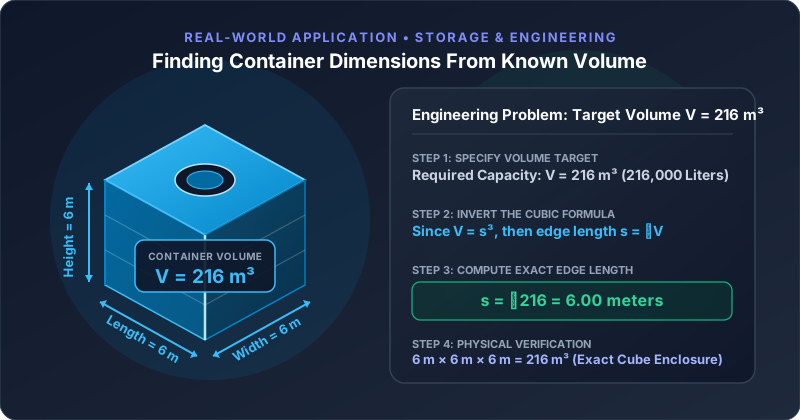
Architects and designers use cube roots to find the edge length of cubic spaces from a known volume. For example, ∛64 = 4 m per side for a 64 m³ room.
Logistics companies calculate box dimensions from a target volume using cube roots to optimize parcel packaging and dimensional weight.
Formulas in fluid dynamics, thermodynamics, and astronomy (such as planetary orbital periods and spherical radii) rely heavily on cube roots.
Calculating 3-year compound annual growth rates (CAGR) requires taking the cube root of the total growth multiplier: r = ∛(End/Start) - 1.
Finding side lengths from container capacities (e.g. aquarium volume, storage bins) without measuring tools.
All calculations execute directly in your browser with zero latency and 100% data privacy.
Instantly checks whether the radicand is a perfect cube and outputs exact integers without rounding drift.
Performs prime factorization in real time to extract triple factors, rendering exact forms like ∛24 = 2∛3.
Applies the mathematical odd symmetry rule ∛(-x) = -∛x, returning exact real solutions for negative inputs.
Provides clean decimal approximations and comprehensive step-by-step mathematical reasoning.
A cube root of a number is a value that, when multiplied by itself three times, produces the original number. In mathematical notation, the cube root of x is written as ∛x or x^(1/3). For example, the cube root of 27 is 3, because 3 × 3 × 3 = 27.
Yes! Unlike square roots, cube roots of negative numbers are real numbers because multiplying three negative numbers results in a negative product. The rule is ∛(-x) = -∛x. For example, ∛(-8) = -2, because (-2) × (-2) × (-2) = -8.
Cubing and taking the cube root are inverse operations. Cubing a number means raising it to the power of 3 (for example, 4³ = 64). Taking the cube root reverses this process to recover the original base value: ∛64 = 4.
A perfect cube is an integer that results from multiplying an integer by itself three times. Examples include 1, 8, 27, 64, 125, 216, 343, 512, 729, and 1000. The cube root of a perfect cube is always a whole number.
For perfect cubes, use prime factorization: break the number into prime factors, group identical factors into sets of three, and extract one from each group (e.g. 3375 = 3³ × 5³ = 15). For non-perfect cubes, use estimation between the two nearest known perfect cubes.
The cube root symbol is ∛ (Unicode character U+221B). It consists of a standard radical sign with a small index 3 in the upper-left notch. In software code it is written cbrt(x), and in LaTeX as \sqrt[3]{x}.
On Windows, type 221B then press Alt+X in supported apps, or use Character Map. On Mac, press Cmd+Ctrl+Space to open Character Viewer and search 'cube root'. In HTML, use the entity ∛ or copy and paste ∛ directly.
The cube root of 0 is exactly 0, because 0 × 0 × 0 = 0.
The cube root of 2 (∛2 ≈ 1.2599) is an irrational number. It cannot be expressed as an exact fraction of two integers, and its decimal expansion continues infinitely without repeating.
The real cube root of 1 is 1, since 1 × 1 × 1 = 1. (In complex mathematics, there are also two non-real complex cube roots of unity: e^(2πi/3) and e^(-2πi/3)).

A cube root answers one question: what number, multiplied by itself three times, gives you this value? That single idea carries you through everything else on this page: notation, formulas, manual methods, and the fact that (unlike square roots) cube roots handle negative numbers without needing anything imaginary. Use the calculator above for a fast, exact answer, and come back here anytime you want to work through the math yourself.