Perfect Cube Calculator & Checker
Check if any number is a perfect cube
Quick Test
Enter any integer (positive or negative) to check if it equals a whole number multiplied by itself 3 times (k³ = n).
Check whether any number (positive or negative) is a perfect cube instantly. Get base integer roots, prime factor powers, nearest bounding cubes, and algebraic proofs. 100% free.
Our interactive tool checks numbers of any magnitude in milliseconds. Follow these 3 easy steps:
Type any positive or negative whole number into the input box, or click one of the preset chips like -27, 216, or 1331.
Click the check button or hit Enter. The tool immediately computes the exact real cube root and tests integer divisibility.
Get an instant verdict banner, base root, prime factor powers, nearest bounding cubes, and the exact multiplier needed if it is not a cube.
A perfect cube (or cube number) is an integer obtained by multiplying another whole number by itself three times: n = k³ = k × k × k.
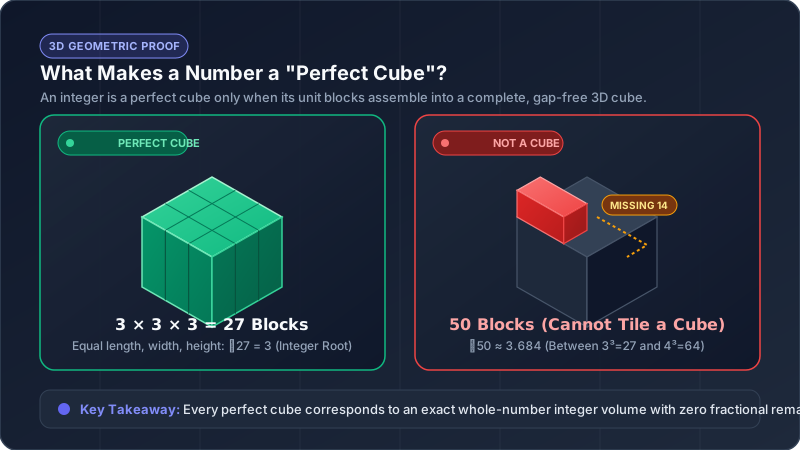
For example, 27 is a perfect cube because 3 × 3 × 3 = 27. Similarly, 125 is a perfect cube because 5 × 5 × 5 = 125. In contrast, 50 is not a perfect cube because its cube root is approximately 3.684, which is not an integer.
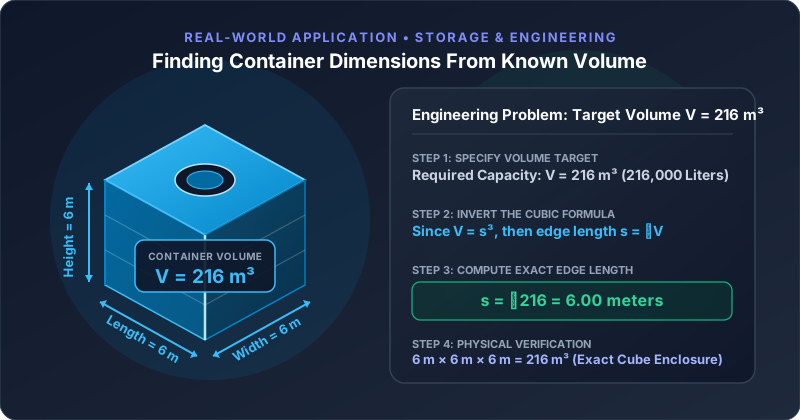
The term cube comes directly from 3D geometry: if you have 27 unit blocks, you can build a solid 3×3×3 geometric cube with equal length, width, and height. With 50 blocks, you can never assemble a solid cube without leftover pieces.
Unlike square roots, odd roots preserve signs! (-3)³ = (-3) × (-3) × (-3) = -27. Therefore, negative integers can be legitimate real perfect cubes.
0 and 1 are trivial perfect cubes: 0³ = 0 and 1³ = 1. Negative one is also a cube: (-1)³ = -1.
The cube of an even integer is always even (2³=8, 4³=64), and the cube of an odd integer is always odd (3³=27, 5³=125).
In prime factorization, an integer is a perfect cube if and only if the exponent of every prime factor is a multiple of 3.
Mathematicians use four rigorous tests to verify whether an unknown integer n is a perfect cube:
Take the cube root ∛n. If the result is an exact integer with zero fractional remainder, n is a perfect cube.
Break n down into its prime factors. If all prime exponents are divisible by 3 (3, 6, 9...), then n is a perfect cube.
Because (-k)³ = -k³, a negative number -n is a perfect cube if and only if |n| is a perfect cube.
Sum the digits of n repeatedly until you get a single digit. The digital root of any perfect cube is ALWAYS 0, 1, 8, or 9 (in mod 9 arithmetic: 0, ±1). If the digital root is 2, 3, 4, 5, 6, or 7, it is guaranteed NOT to be a cube!
∛512 = 8 : 8 × 8 × 8 = 512. Prime factorization is 2⁹ with exponent 9 divisible by 3. Digital root: 5 + 1 + 2 = 8 (valid).
∛100 ≈ 4.642 : 100 sits strictly between 4³ = 64 and 5³ = 125. Prime factors are 2² × 5², neither exponent is divisible by 3.
∛(-216) = -6 : (-6) × (-6) × (-6) = 36 × (-6) = -216. Odd roots preserve negative signs, producing a valid real integer root.
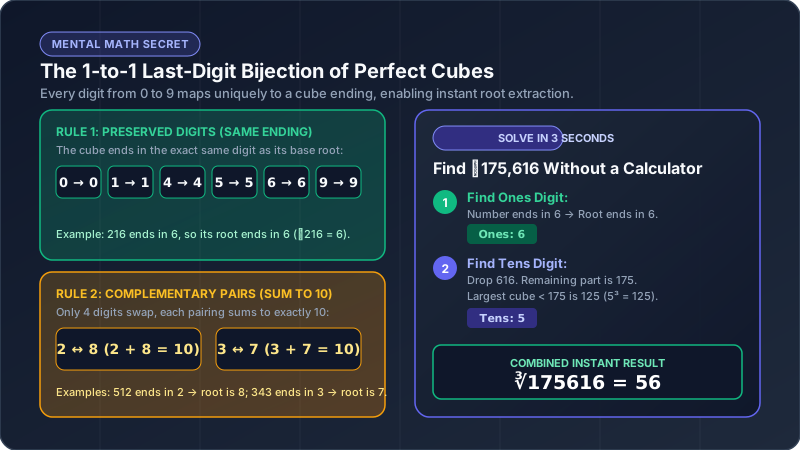
Unlike perfect squares (which can only end in 0, 1, 4, 5, 6, or 9), every digit from 0 to 9 can be the last digit of a perfect cube. In fact, there is a strict one-to-one bijection between the ones digit of a base integer and the ones digit of its cube:
| Base Last Digit (k) | Cube Calculation (k³ mod 10) | Cube Last Digit (k³) | Memory Rule |
|---|---|---|---|
| 0 | 0³ = 0 | 0 | Preserved (Same digit) |
| 1 | 1³ = 1 | 1 | Preserved (Same digit) |
| 2 | 2³ = 8 | 8 | Complements to 10 (2 + 8 = 10) |
| 3 | 3³ = 27 | 7 | Complements to 10 (3 + 7 = 10) |
| 4 | 4³ = 64 | 4 | Preserved (Same digit) |
| 5 | 5³ = 125 | 5 | Preserved (Same digit) |
| 6 | 6³ = 216 | 6 | Preserved (Same digit) |
| 7 | 7³ = 343 | 3 | Complements to 10 (7 + 3 = 10) |
| 8 | 8³ = 512 | 2 | Complements to 10 (8 + 2 = 10) |
| 9 | 9³ = 729 | 9 | Preserved (Same digit) |
To find the cube root of 175,616:
1. Ones Digit: The number ends in 6. Looking at our table, a cube ending in 6 must have a root ending in 6.
2. Tens Digit: Cross off the last three digits (616), leaving 175. The largest perfect cube below 175 is 125 (5³). So the tens digit is 5.
Result: ∛175616 = 56. Verified: 56 × 56 × 56 = 175,616!
Odd powers behave differently from even powers. Here is how special numeric sets are evaluated:
Yes. 0 is an integer, and 0 × 0 × 0 = 0 (0³ = 0). Its principal cube root is exactly 0.
Fully Real. Unlike square roots which require the imaginary unit i, odd roots preserve signs: (-k)³ = -k³. For example, ∛(-64) = -4.
A fraction is a cubic power if both its numerator and denominator are perfect cubes: 27/64 = (3/4)³.
Decimals are cubes if the significant digits form a cube and the number of decimal places is a multiple of 3: 0.027 = (0.3)³, 0.000125 = (0.05)³.
Comparing cubic numbers with square numbers? Test whether an integer is a perfect square →
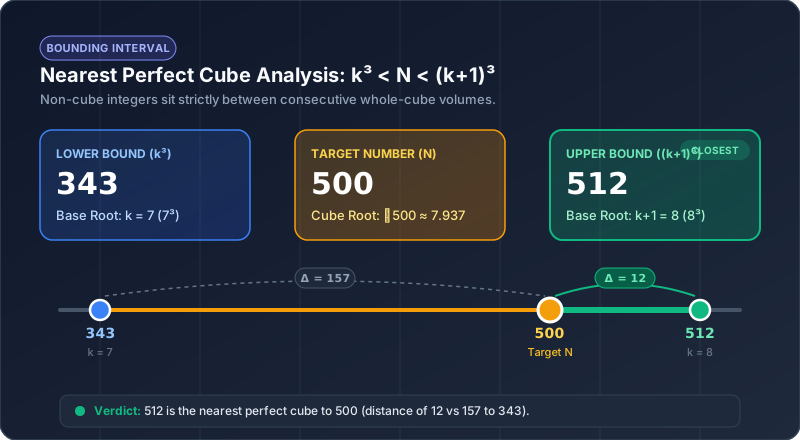
When a number is not a cube, it always sits between two consecutive integer cubes: k³ < n < (k + 1)³.
For example, 500 is not a cube. The nearest cubes are 7³ = 343 and 8³ = 512. The distance to 343 is 157, while the distance to 512 is only 12. Therefore, 512 is the closest cube to 500.
| Target (N) | Cube Root (∛N) | Lower Cube (k³) | Upper Cube ((k+1)³) | Nearest Cube | Distance |
|---|---|---|---|---|---|
| 50 | 3.684 | 27 (3³) | 64 (4³) | 64 | 64 - 50 = 14 |
| 200 | 5.848 | 125 (5³) | 216 (6³) | 216 | 216 - 200 = 16 |
| 500 | 7.937 | 343 (7³) | 512 (8³) | 512 | 512 - 500 = 12 |
| 800 | 9.283 | 729 (9³) | 1000 (10³) | 729 | 800 - 729 = 71 |
When an integer is not a perfect cube, its root is an irrational decimal. Compute exact decimal cube roots with radical steps →
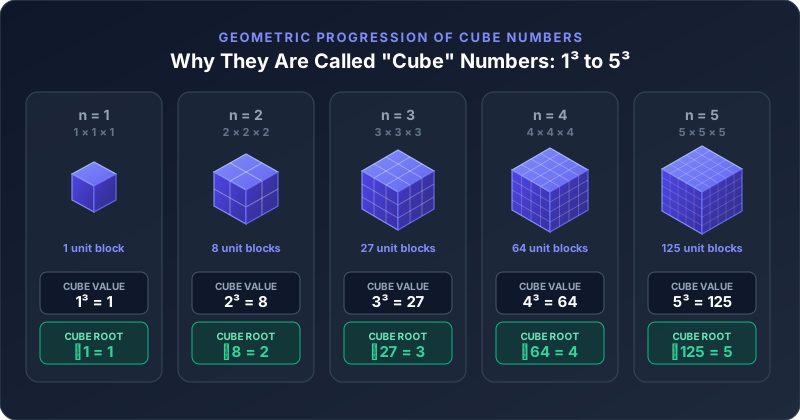
Between 1 and 1000 inclusive, there are exactly 10 perfect cubes:
| Base Root (k) | Formula (k × k × k) | Perfect Cube (k³) | Prime Factorization | ∛k³ |
|---|---|---|---|---|
| 1 | 1 × 1 × 1 | 1 | 1 | 1 |
| 2 | 2 × 2 × 2 | 8 | 2³ | 2 |
| 3 | 3 × 3 × 3 | 27 | 3³ | 3 |
| 4 | 4 × 4 × 4 | 64 | 2⁶ = (2²)³ | 4 |
| 5 | 5 × 5 × 5 | 125 | 5³ | 5 |
| 6 | 6 × 6 × 6 | 216 | 2³ × 3³ | 6 |
| 7 | 7 × 7 × 7 | 343 | 7³ | 7 |
| 8 | 8 × 8 × 8 | 512 | 2⁹ = (2³)³ | 8 |
| 9 | 9 × 9 × 9 | 729 | 3⁶ = (3²)³ | 9 |
| 10 | 10 × 10 × 10 | 1000 | 2³ × 5³ | 10 |
Between 1 and 10,000 inclusive, there are exactly 21 perfect cubes because 21³ = 9,261 and 22³ = 10,648.
| k | k³ | k | k³ | k | k³ |
|---|---|---|---|---|---|
| 1 | 1 | 8 | 512 | 15 | 3375 |
| 2 | 8 | 9 | 729 | 16 | 4096 |
| 3 | 27 | 10 | 1000 | 17 | 4913 |
| 4 | 64 | 11 | 1331 | 18 | 5832 |
| 5 | 125 | 12 | 1728 | 19 | 6859 |
| 6 | 216 | 13 | 2197 | 20 | 8000 |
| 7 | 343 | 14 | 2744 | 21 | 9261 |
Evaluating higher powers beyond the 3rd degree? Evaluate arbitrary nth degree radical roots →
Verify cube numbers automatically in Excel, Google Sheets, Python, and JavaScript:
=IF(ROUND(A2^(1/3), 0)^3 = A2, "Perfect Cube", "Not a Cube") def is_cube(n): return round(abs(n)**(1/3))**3 == abs(n) const isCube = n => Math.round(Math.cbrt(n))**3 === n; Terminology: Perfect Cube or Cube Number.
Terminology: Kubikzahlen (German) and Cubes parfaits (French).
Calculating box volumes, container dimensions, and material density in logistics and shipping.
Determining mass and buoyancy scaling according to the square-cube law in biomechanics and aviation.
3D voxel grid calculations, octree spatial indexing, and Minecraft-style block coordinate structures.
Elliptic curve cryptography and Diophantine equations involving sums of cubes (Fermat's Last Theorem).
Cubing a number means multiplying it by itself three times (4³ = 4 × 4 × 4 = 64), not multiplying it by three (4 × 3 = 12).
Unlike square roots, odd roots preserve negative signs. Multiplying three negative numbers gives a negative product: (-5) × (-5) × (-5) = -125.
Every digit from 0 to 9 can end a perfect cube. You cannot eliminate a candidate by its last digit alone; you must use prime factors or modulo 9 digital roots.
In computers, computing 125^(1/3) frequently yields 4.999999999999999. Naively checking if int(125^(1/3)) == 5 can fail without proper rounding logic.
A perfect cube is any whole number that you can get by multiplying another whole number by itself three times. For example, 27 is a perfect cube because 3 × 3 × 3 = 27.
Yes! Multiplying an odd number of negative factors results in a negative product: (-4) × (-4) × (-4) = -64. Thus, -64 is a valid real perfect cube with cube root -4.
Yes. Zero is an integer, and 0 × 0 × 0 = 0 (0³ = 0). Its principal cube root is 0.
Find the prime factorization of the number. If every prime factor has an exponent divisible by 3, the number is a perfect cube. In addition, compute its digital root: if the repeated digit sum is not 1, 8, or 9, it cannot be a cube.
A number that is both a square and a cube is a sixth power (k⁶). Because 2⁶ = 64, it can be written as 8² = 64 and 4³ = 64. Numbers of this form are known as perfect sixth powers.
The smallest positive perfect cube is 1, because 1 × 1 × 1 = 1. If non-positive integers are included, 0 is smaller, and negative cubes extend infinitely to negative infinity.
There are exactly 4 perfect cubes between 1 and 100 inclusive: 1 (1³), 8 (2³), 27 (3³), and 64 (4³). The next cube is 125 (5³), which exceeds 100.
No. The cube root of 100 is approximately 4.6416, which is not an integer. The prime factorization of 100 is 2² × 5², neither of which has an exponent divisible by 3.
A square root asks what number multiplied by itself gives the original value. A cube root asks what number multiplied by itself three times gives the original value.
Yes. Our calculator is 100% free with unlimited checks, instant answers, and detailed step-by-step mathematical proofs.

A perfect cube satisfies n = k³, meaning three identical integers multiply to give n.
Unlike square roots, cube roots of negative numbers are real and valid integers.
All prime exponents must divide cleanly by 3 in prime factorization.
Use our interactive checker above anytime for instant proofs, bounds, and steps.