Square Root
Calculate √x for any positive number
Enter any positive number to find its square root. Works with whole numbers, decimals, and large values.
√
Calculate the square root (racine carrée) of any number instantly with exact decimals, simplified radical form, and step-by-step solutions. 100% free with no limits.
Racine carrée is the French term for square root. It is one of the most searched mathematical phrases worldwide, and many students, professionals, and curious learners type "racine carree calculator" into search engines when they need a quick way to calculate the square root of a number.
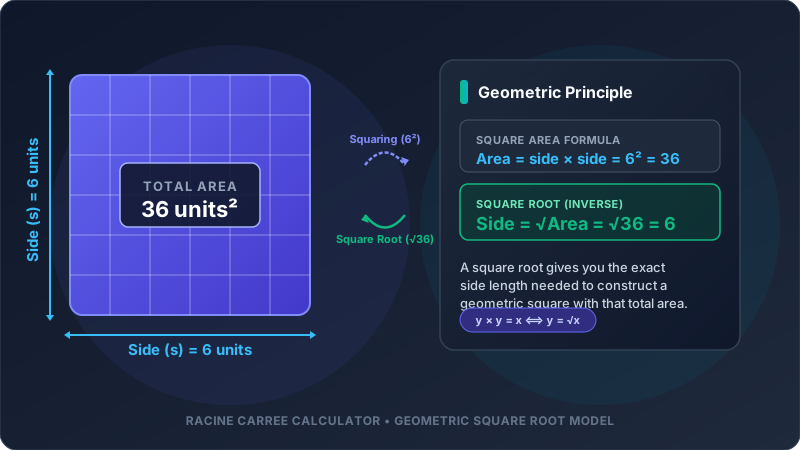
A square root is a value that, when multiplied by itself, produces the original number. If you multiply 7 by 7, you get 49. So the square root of 49 is 7. This works because the operation reverses squaring: squaring builds a number up, and the square root brings it back down.
In mathematical terms, the square root of a number x is a number y such that y × y = x. This is written as y² = x, which is the inverse relationship between squaring and finding a square root.
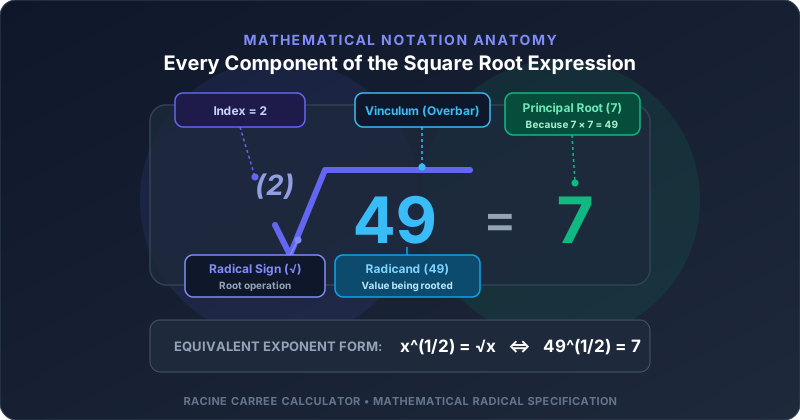
The sign indicating a root operation
The number underneath the radical sign (e.g. 49 in √49)
The resulting answer (e.g. 7)
Getting your answer takes three simple steps:
Enter any number into the input box above. The calculator accepts whole numbers, decimals, fractions, and negative numbers.
Press the Calculate button. The calculator processes your input instantly using precise mathematical algorithms.
The calculator displays the square root as an exact decimal, a simplified radical form when applicable (for example, √72 = 6√2), and a step-by-step breakdown.
That is the entire process. You do not need to know any formulas or methods to use the tool. The rest of this page explains how square roots actually work.
The radical sign √ is the standard symbol used in mathematics to represent a square root. When you write √36, you are asking: "What number multiplied by itself gives 36?" The answer is 6.
Every square root expression has three parts: the radical symbol (√), the radicand (the number under the symbol), and the root (the evaluated result).
You may also see square roots written using exponent notation:
Both forms mean exactly the same thing. Calculators and programming languages often use exponent notation x^(1/2) because it is straightforward to compute without special typography. For instance, 49^(1/2) = √49 = 7.
Unlike geometric formulas like circle area, there is no single formula that directly computes a square root. Instead, a square root is defined by a mathematical relationship:
In plain language: whatever number you get as the square root, multiplying it by itself must bring you back to the original number. This fundamental relationship is what every calculation method relies on.
The principal square root is the non-negative value that satisfies this relationship. For example, both 5 and -5 satisfy x² = 25, but by international convention, √25 = 5. The radical symbol always denotes the non-negative principal root.
√25 = +5 x² = 25 ⇒ x = ±5 These five rules make working with square roots faster and help you simplify complex expressions across algebra, geometry, and engineering:
Example: √(4 × 9) = √4 × √9 = 2 × 3 = 6. And directly: √36 = 6.
You can split a square root of a product into the product of two square roots. This is how our calculator simplifies √72 into 6√2 by factoring 72 as 36 × 2.
Example: √(16/4) = √16 / √4 = 4 / 2 = 2. And directly: √4 = 2.
You can find the square root of a fraction by taking the root of the numerator and denominator separately.
Example: √(7²) = √49 = 7. Squaring and square rooting cancel out.
Squaring a number and then taking its square root brings you back to the original magnitude. The absolute value ensures the result remains non-negative.
Example: √13 × √13 = 13. √5 × √5 = 5.
Multiplying a square root by itself always returns the radicand. This is essential for rationalizing denominators (e.g., 1/√5 = √5/5).
Example: √(√16) = √4 = 2. And 16^(1/4) = 2.
Taking the square root of a square root produces the fourth root of the original number.
There is more than one way to find the square root of a number. Each method suits different situations:
Enter your number above and click Calculate. The tool returns the exact decimal result, simplified radical form, and step-by-step breakdown instantly. This is the quickest and most accurate option for any number.
This method works exceptionally well for whole numbers and perfect squares.
The long division method is a systematic algorithm to find square roots to any number of decimal places without a calculator.
While this method requires pencil-and-paper practice, it gives 100% exact manual results for any positive number.
When you do not have a calculator and need a quick approximation, use the bounding technique:
This technique forms the basis of the Babylonian method (Newton-Raphson iteration), which refines guesses by averaging x and S/x.
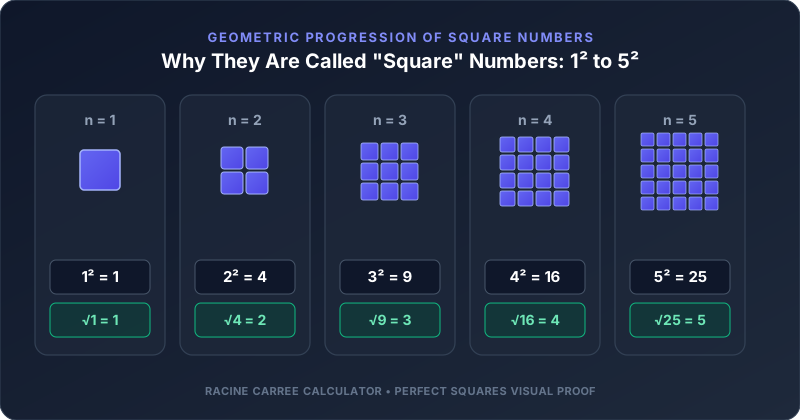
A perfect square is an integer that has an exact whole number as its square root. These numbers result from multiplying an integer by itself.
| Number (n) | Perfect Square (n²) | Square Root (√n²) | Number (n) | Perfect Square (n²) | Square Root (√n²) |
|---|---|---|---|---|---|
| 1 | 1 | √1 = 1 | 11 | 121 | √121 = 11 |
| 2 | 4 | √4 = 2 | 12 | 144 | √144 = 12 |
| 3 | 9 | √9 = 3 | 13 | 169 | √169 = 13 |
| 4 | 16 | √16 = 4 | 14 | 196 | √196 = 14 |
| 5 | 25 | √25 = 5 | 15 | 225 | √225 = 15 |
| 6 | 36 | √36 = 6 | 16 | 256 | √256 = 16 |
| 7 | 49 | √49 = 7 | 17 | 289 | √289 = 17 |
| 8 | 64 | √64 = 8 | 18 | 324 | √324 = 18 |
| 9 | 81 | √81 = 9 | 19 | 361 | √361 = 19 |
| 10 | 100 | √100 = 10 | 20 | 400 | √400 = 20 |
Memorizing the first 20 perfect squares makes mental math with square roots much faster. If you recognize that 144 = 12², you know √144 = 12 instantly. Want to test any specific number? Check if any number is a perfect square using our checker →
When a positive integer is not a perfect square, its square root is an irrational number. This means its decimal representation never terminates and never repeats.
These numbers are real numbers that cannot be written as a fraction of two integers. They exist alongside mathematical constants like pi (π).
Our Racine Carree Calculator computes these to full decimal precision and supplies the exact simplified radical form.
The square root operation applies to decimals and fractions following standard algebraic principles:
You can find square roots of terminating decimals directly:
Using the quotient rule, evaluate the numerator and denominator independently:
Enter any decimal or fraction into the calculator above to verify your solutions with instant precision.
In real arithmetic, negative numbers do not have real square roots because squaring any real number (positive or negative) always yields a positive number.
To overcome this limitation, mathematics defines the imaginary unit i, where i² = -1. Therefore: √(-a) = √a × i for any a > 0.
These expressions belong to the complex number system (a + bi), which is fundamental to electrical engineering, quantum mechanics, computer graphics, and signal processing.
Our calculator automatically identifies negative numbers and returns the exact imaginary result. Need real roots for negative numbers? Calculate cube roots of negative numbers with real solutions →
Squaring and taking a square root are inverse mathematical operations, similar to addition and subtraction or multiplication and division.
| Operation | What It Does | Example |
|---|---|---|
| Squaring (x²) | Multiplies a number by itself | 8² = 64 |
| Square Root (√x) | Finds what number multiplied by itself gives x | √64 = 8 |
One operation completely reverses the other: √(8²) = √64 = 8, and (√64)² = 8² = 64.
Because squaring eliminates negative signs ((-5)² = 25), taking the square root requires the principal root convention: √(a²) = |a|.
Quick lookup table for numbers from 1 to 50 with exact decimal roots, simplified radical representations, and perfect square indicators.
| Number (n) | Decimal (√n) | Simplified Radical | Classification |
|---|---|---|---|
| 1 * | 1.0000 | 1 | Perfect Square |
| 2 | 1.4142 | √2 | Irrational |
| 3 | 1.7321 | √3 | Irrational |
| 4 * | 2.0000 | 2 | Perfect Square |
| 5 | 2.2361 | √5 | Irrational |
| 6 | 2.4495 | √6 | Irrational |
| 7 | 2.6458 | √7 | Irrational |
| 8 | 2.8284 | 2√2 | Irrational |
| 9 * | 3.0000 | 3 | Perfect Square |
| 10 | 3.1623 | √10 | Irrational |
| 11 | 3.3166 | √11 | Irrational |
| 12 | 3.4641 | 2√3 | Irrational |
| 13 | 3.6056 | √13 | Irrational |
| 14 | 3.7417 | √14 | Irrational |
| 15 | 3.8730 | √15 | Irrational |
| 16 * | 4.0000 | 4 | Perfect Square |
| 17 | 4.1231 | √17 | Irrational |
| 18 | 4.2426 | 3√2 | Irrational |
| 19 | 4.3589 | √19 | Irrational |
| 20 | 4.4721 | 2√5 | Irrational |
| 21 | 4.5826 | √21 | Irrational |
| 22 | 4.6904 | √22 | Irrational |
| 23 | 4.7958 | √23 | Irrational |
| 24 | 4.8990 | 2√6 | Irrational |
| 25 * | 5.0000 | 5 | Perfect Square |
| 26 | 5.0990 | √26 | Irrational |
| 27 | 5.1962 | 3√3 | Irrational |
| 28 | 5.2915 | 2√7 | Irrational |
| 29 | 5.3852 | √29 | Irrational |
| 30 | 5.4772 | √30 | Irrational |
| 31 | 5.5678 | √31 | Irrational |
| 32 | 5.6569 | 4√2 | Irrational |
| 33 | 5.7446 | √33 | Irrational |
| 34 | 5.8310 | √34 | Irrational |
| 35 | 5.9161 | √35 | Irrational |
| 36 * | 6.0000 | 6 | Perfect Square |
| 37 | 6.0828 | √37 | Irrational |
| 38 | 6.1644 | √38 | Irrational |
| 39 | 6.2450 | √39 | Irrational |
| 40 | 6.3246 | 2√10 | Irrational |
| 41 | 6.4031 | √41 | Irrational |
| 42 | 6.4807 | √42 | Irrational |
| 43 | 6.5574 | √43 | Irrational |
| 44 | 6.6332 | 2√11 | Irrational |
| 45 | 6.7082 | 3√5 | Irrational |
| 46 | 6.7823 | √46 | Irrational |
| 47 | 6.8557 | √47 | Irrational |
| 48 | 6.9282 | 4√3 | Irrational |
| 49 * | 7.0000 | 7 | Perfect Square |
| 50 | 7.0711 | 5√2 | Irrational |
Simplifying a radical means factoring out all perfect square factors to write the expression in its most compact form:
| Original Radical | Simplified Form | Factorization & Method | Test |
|---|---|---|---|
| √8 | √(4 × 2) → 2√2 | 8 = 4 × 2, √4 = 2 | |
| √12 | √(4 × 3) → 2√3 | 12 = 4 × 3, √4 = 2 | |
| √18 | √(9 × 2) → 3√2 | 18 = 9 × 2, √9 = 3 | |
| √20 | √(4 × 5) → 2√5 | 20 = 4 × 5, √4 = 2 | |
| √32 | √(16 × 2) → 4√2 | 32 = 16 × 2, √16 = 4 | |
| √45 | √(9 × 5) → 3√5 | 45 = 9 × 5, √9 = 3 | |
| √50 | √(25 × 2) → 5√2 | 50 = 25 × 2, √25 = 5 | |
| √72 | √(36 × 2) → 6√2 | 72 = 36 × 2, √36 = 6 | |
| √75 | √(25 × 3) → 5√3 | 75 = 25 × 3, √25 = 5 | |
| √98 | √(49 × 2) → 7√2 | 98 = 49 × 2, √49 = 7 | |
| √200 | √(100 × 2) → 10√2 | 200 = 100 × 2, √100 = 10 |
The product rule √(a × b) = √a × √b allows extracting perfect square integers from under the radical.
Square roots are essential across science, design, finance, and daily problem-solving:
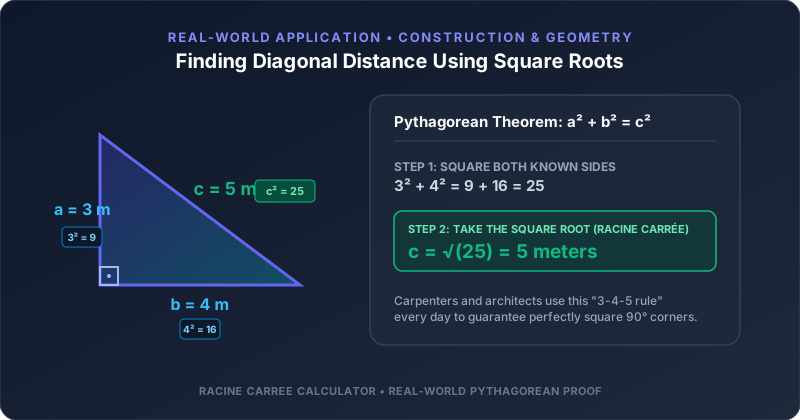
The Pythagorean theorem (a² + b² = c²) uses square roots to compute diagonal lengths, stair slopes, and corner framing (e.g., √(3² + 4²) = 5 meters).
Standard deviation, the primary metric of portfolio volatility and risk, requires calculating the square root of the variance.
Kinetic energy, free-fall velocity (v = √(2gh)), pendulums, and alternating current electrical impedance all rely on square roots.
Distance formulas in 2D/3D graphics, collision detection, machine learning loss functions, and algorithmic complexity √n rely on square root operations.
Finding room or garden perimeter dimensions from floor area: a 64 sq ft room has side length √64 = 8 ft.
Enter your number in the input field above and click Calculate. You will instantly receive the exact decimal result, the simplified radical form (e.g., √72 = 6√2), and a step-by-step breakdown.
"Racine carrée" is the French term for "square root." It translates directly as square root and represents the inverse of squaring a number.
Yes. When you enter a negative number, the calculator returns the result using the imaginary unit i (e.g., √(-16) = 4i) along with full mathematical steps.
A square root finds a number that multiplied by itself twice gives the value (index 2). A cube root finds a number multiplied by itself three times (index 3). Cube roots of negative numbers yield real solutions.
You can use prime factorization for perfect squares, the long division method for precise decimals, or the estimation method (averaging / Babylonian method) for quick approximations.
A perfect square is an integer whose square root is a whole number (e.g., 1, 4, 9, 16, 25, 36, 49, 64, 81, 100).
No. Square roots of perfect squares are rational numbers. Square roots of non-perfect squares are irrational numbers with non-repeating, infinite decimal expansions.
Yes. The Racine Carree Calculator is 100% free with unlimited calculations, no registration, and no download required.
Yes. Enter any decimal (like 2.25) or fraction, and the calculator computes the exact result using the quotient rule.
The principal square root is the non-negative square root of a number. By mathematical convention, the √ symbol denotes this positive root.

A square root answers one fundamental question: what number multiplied by itself gives this value? Use our free Racine Carree Calculator above whenever you need instant precision, and bookmark this guide for study and practical projects.