What Is an Nth Root?
You already know square roots (index 2) and cube roots (index 3). But what happens when you need the 4th root, the 5th root, or any higher degree? That is exactly what this nth root calculator is built for.
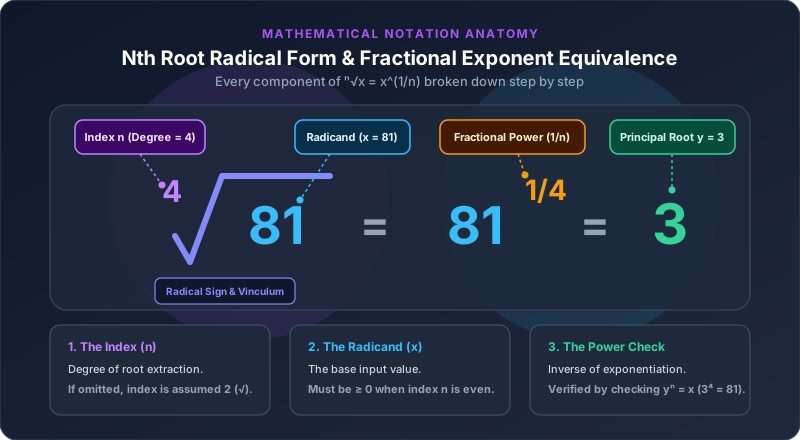
An nth root generalizes roots to any number of multiplications. The nth root of a number asks: what value, multiplied by itself n times, produces this number?
⁴ √ 81 = 3
1. Root Index (Degree n)
The small number in the upper left of the radical sign. Dictates how many identical factors multiply together. If omitted, it is universally assumed to be 2 (square root).
2. Radical Sign & Vinculum
The mathematical operator symbol (√). The horizontal upper bar, known as the vinculum, groups the radicand underneath to specify root extraction.
3. Radicand (x)
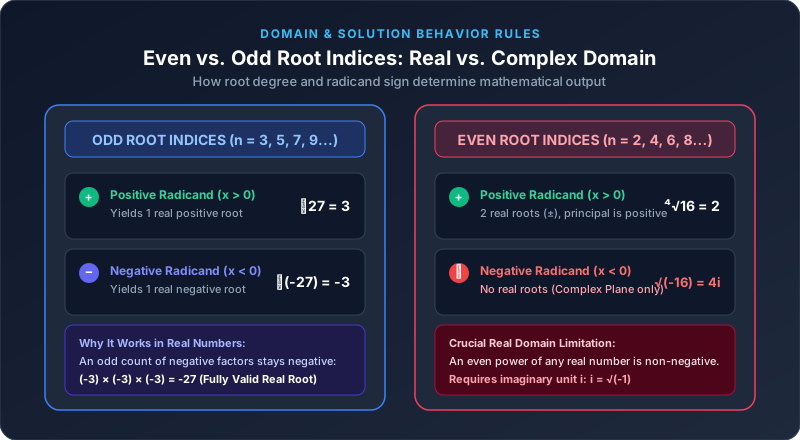
The number underneath the vinculum. When index n is even, the radicand must be non-negative (x ≥ 0) to yield a real-valued answer.
4. Principal Root (y)
The non-negative real answer. For ⁴√81, the principal root is 3 because 3⁴ = 81. While (-3)⁴ also equals 81, radical notation strictly designates the principal root.
Example: The 4th root of 16 is 2, because 2 × 2 × 2 × 2 = 16. Roots of any degree share the same mathematical foundation.