Perfect Square Calculator & Checker
Check if any whole number is a perfect square
Quick Test
Enter any integer to check if it can be formed by multiplying a whole number by itself.
Type in any number and this perfect square calculator tells you instantly whether it's a perfect square (and if it isn't, exactly which perfect squares it falls between). No manual multiplication, no guessing.
Check any integer in seconds. Follow these 3 easy steps:
Type any positive or negative whole integer into the input box, or click one of the quick preset chips.
Press Enter or click check to run the square root, integer remainder, and prime factor algorithms.
Inspect the verdict, principal root, parity, bounding square intervals, and prime factorization tree.
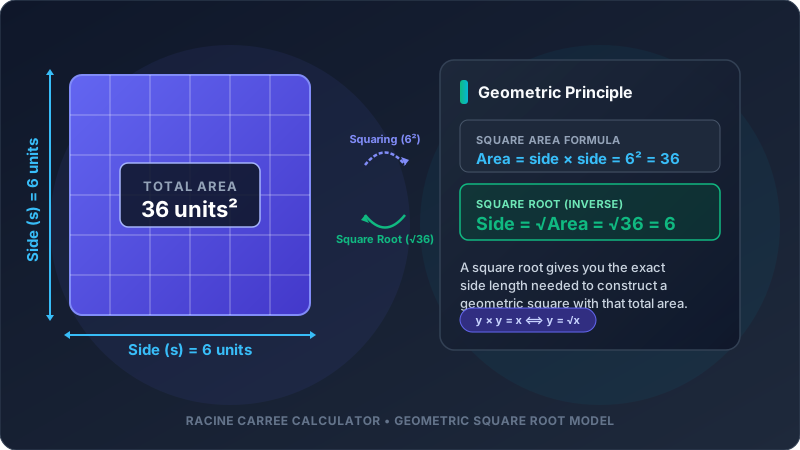
A perfect square (or square number) is an integer that equals a whole number multiplied by itself: N = k² = k × k where k is an integer.
For example, 25 is a perfect square because 5 × 5 = 25, and 144 is a perfect square because 12 × 12 = 144. In contrast, 50 is not a perfect square because √50 ≈ 7.071, which is not an integer.
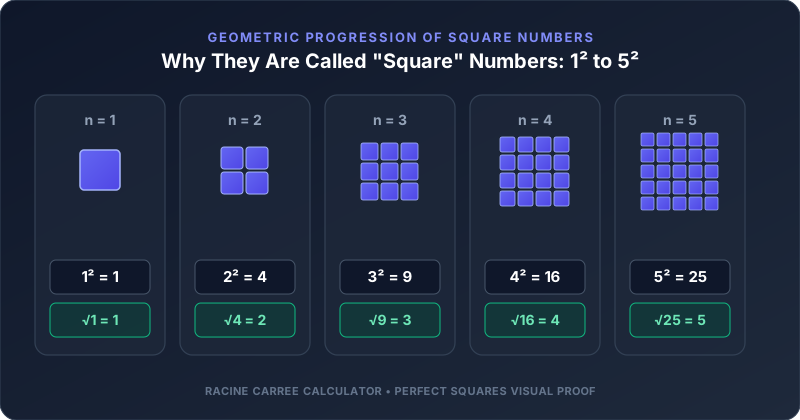
In 2D geometry, a perfect square represents the total area of a square whose side lengths are whole integers. If you have 25 unit square tiles, you can arrange them into a complete 5×5 square grid without leftover pieces.
Squaring any real number yields a non-negative result: (+k)² > 0 and (-k)² > 0.
0 and 1 are valid perfect squares: 0² = 0 and 1² = 1.
The square of an even number is always even (4²=16), and the square of an odd number is always odd (5²=25).
In prime factorization, every prime exponent must be an even integer (divisible by 2).
Our calculator evaluates integers using multi-stage mathematical verification:
Computes √N and checks whether the fractional decimal remainder equals zero.
Decomposes N into prime powers to verify that every prime exponent is an even number.
Verifies that the terminal digit is 0, 1, 4, 5, 6, or 9 (disqualifying 2, 3, 7, and 8).
Subtracts consecutive odd numbers (1, 3, 5, 7...) until reaching exactly 0 in k steps.
√144 = 12 : 12 × 12 = 144 (exact integer)
√50 ≈ 7.071 : Between 7²=49 and 8²=64 (not an integer)
√(-16) = ±4i : Real squares cannot be negative
Use these two fast mental math shortcuts to spot non-squares in seconds:
Every perfect square ends ONLY in 0, 1, 4, 5, 6, or 9. If an integer ends in 2, 3, 7, or 8, it can NEVER be a perfect square!
Sum digits recursively: the digital root of a perfect square is ALWAYS 1, 4, 7, or 9. If the digital root is 2, 3, 5, 6, or 8, it is not a square.
How edge cases and number sets are handled in number theory:
In real arithmetic, squaring any number always yields a result ≥ 0. Therefore, negative integers yield complex imaginary roots (±bi). 0 is a valid perfect square because 0 × 0 = 0. Rational decimals like 0.25 are rational squares, but not integer perfect squares.
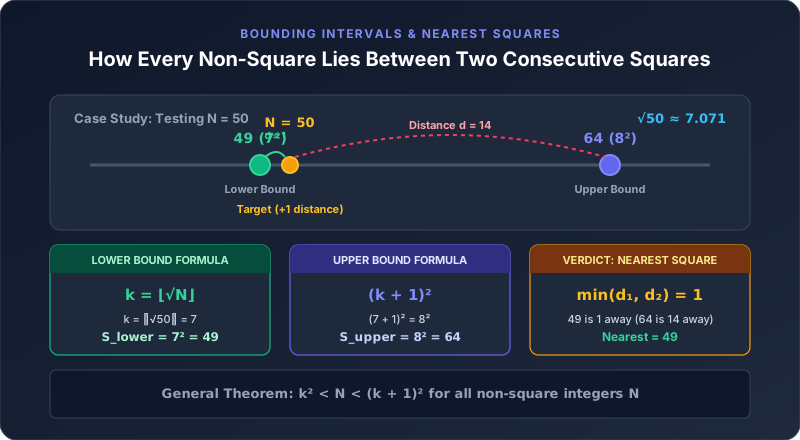
Every non-square integer N is bounded by two consecutive squares: k² < N < (k + 1)² where k = ⌊√N⌋.
For example, 50 lies between 49 (7²) and 64 (8²). Since 50 - 49 = 1 and 64 - 50 = 14, 49 is the nearest square (only 1 unit away).
| Target (N) | Square Root (√N) | Lower Square (k²) | Upper Square ((k+1)²) | Nearest Square | Distance |
|---|---|---|---|---|---|
| 50 | 7.071 | 49 (7²) | 64 (8²) | 49 | 50 - 49 = 1 |
| 75 | 8.660 | 64 (8²) | 81 (9²) | 81 | 81 - 75 = 6 |
| 120 | 10.954 | 100 (10²) | 121 (11²) | 121 | 121 - 120 = 1 |
| 500 | 22.361 | 484 (22²) | 529 (23²) | 484 | 500 - 484 = 16 |
When your number is not a perfect square, its root is an irrational decimal. Calculate simplified radicals and decimal square roots →
The essential reference table of square numbers up to 100:
| n | Formula | Square (n²) | √n² |
|---|---|---|---|
| 1 | 1 × 1 | 1 | 1.000 |
| 2 | 2 × 2 | 4 | 2.000 |
| 3 | 3 × 3 | 9 | 3.000 |
| 4 | 4 × 4 | 16 | 4.000 |
| 5 | 5 × 5 | 25 | 5.000 |
| 6 | 6 × 6 | 36 | 6.000 |
| 7 | 7 × 7 | 49 | 7.000 |
| 8 | 8 × 8 | 64 | 8.000 |
| 9 | 9 × 9 | 81 | 9.000 |
| 10 | 10 × 10 | 100 | 10.000 |
Between 1 and 1000 inclusive, there are exactly 31 perfect squares because 31² = 961 and 32² = 1024.
| n | n² | n | n² | n | n² |
|---|---|---|---|---|---|
| 1 | 1 | 12 | 144 | 23 | 529 |
| 2 | 4 | 13 | 169 | 24 | 576 |
| 3 | 9 | 14 | 196 | 25 | 625 |
| 4 | 16 | 15 | 225 | 26 | 676 |
| 5 | 25 | 16 | 256 | 27 | 729 |
| 6 | 36 | 17 | 289 | 28 | 784 |
| 7 | 49 | 18 | 324 | 29 | 841 |
| 8 | 64 | 19 | 361 | 30 | 900 |
| 9 | 81 | 20 | 400 | 31 | 961 |
| 10 | 100 | 21 | 441 | - | - |
| 11 | 121 | 22 | 484 | - | - |
Need an expanded lookup list with decimal square roots for all integers up to 1000? Browse the complete square root chart from 1 to 1000 →
Verify square numbers automatically in Excel, Google Sheets, Python, and JavaScript:
=IF(SQRT(A2)=INT(SQRT(A2)), "Perfect Square", "Not a Square") def is_square(n): return n >= 0 and math.isqrt(n)**2 == n const isSquare = n => n >= 0 && Number.isInteger(Math.sqrt(n)); Terminology: Perfect Square or Square Number.
Terminology: Quadratzahlen (German) and Carrés parfaits (French).
Finding the side length of square floor tiles, building plots, and layout grids.
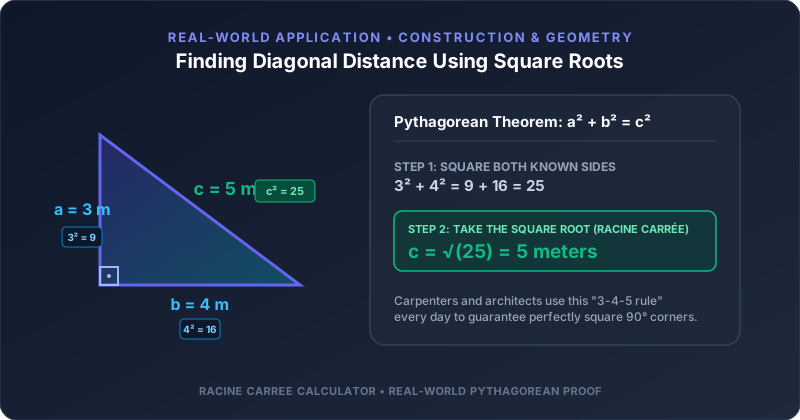
Calculating right triangles in carpentry and framing using square triples: a² + b² = c².
Kinetic energy (½mv²) and gravitational acceleration equations depend directly on squared terms.
2D textures (256×256, 1024×1024), quadtrees, and memory block alignment rely on square dimensions.
Expanding from two-dimensional squares to three-dimensional cubic geometry? Check if a number is a perfect cube with prime triplets →
Squaring is multiplying a number by itself (5² = 25), not multiplying by 2 (5 × 2 = 10).
Ending in 4 does not guarantee a square. 24 ends in 4, but 24 is not a square.
Parentheses change mathematical sign: (-4)² = 16, whereas -(4²) = -16.
A perfect square is an integer that you get when you multiply a whole number by itself. For example, 16 is a perfect square because 4 × 4 = 16.
Look at the last digit first. If it ends in 2, 3, 7, or 8, it cannot be a square. Next, check its digital root by summing digits recursively: if it is not 1, 4, 7, or 9, it is not a square. Finally, verify that all prime factor exponents are even.
No. The square root of 2 is approximately 1.414, which is an irrational number. Because there is no integer that multiplies by itself to equal 2, 2 is not a perfect square.
No. The square root of 50 is approximately 7.071. It falls between the two consecutive perfect squares 49 (7²) and 64 (8²). The nearest perfect square to 50 is 49.
Yes. 100 is a perfect square because 10 × 10 = 100 (10² = 100).
There are exactly 10 perfect squares from 1 to 100: 1, 4, 9, 16, 25, 36, 49, 64, 81, and 100.
There are exactly 31 perfect squares from 1 to 1000, starting at 1² = 1 and ending at 31² = 961.
In real-number mathematics, no negative number can be a perfect square because multiplying any real number by itself always produces a non-negative result.
Yes, 0 is a valid perfect square because 0 is an integer and 0 × 0 = 0 (0² = 0).
When an integer k is squared (k²), every prime factor in k is multiplied by itself, doubling its exponent. Since every prime exponent is multiplied by 2, all exponents in a perfect square must be even numbers.

N = k² where k is a whole integer.
Can only end in 0, 1, 4, 5, 6, 9.
Every prime factor exponent must be an even number.
Check any integer above instantly with complete step-by-step proofs.