حاسبة المكعب الكامل
تحقق مما إذا كان العدد يمثل مكعبًا كاملاً
فحص سريع
أدخل أي عدد صحيح (موجباً أو سالباً) للتحقق مما إذا كان يساوي مكعب عدد صحيح (k³ = n).
تحقق مما إذا كان العدد الموجب أو السالب مكعبًا كاملاً. اعرض الجذور الصحيحة وقوى العوامل الأولية والحدود.
تحقق من أي عدد صحيح في أجزاء من الثانية باتباع هذه الخطوات الثلاث:
اكتب عدداً صحيحاً موجباً أو سالباً، أو اختر زراً سريعاً (-27, 216, 1331...).
اضغط على زر التحقق أو مفتاح Enter لحساب الجذر التكعيبي والعوامل الأولية فوراً.
اكتشف النتيجة، والتحليل الأولي خطوة بخطوة، والمكعبات المحيطة، والمضاعف الجبري.
المكعب الكامل هو عدد صحيح ينتج عن ضرب عدد صحيح في نفسه مرتين: n = k × k × k = k³. يُسمى العدد k بالجذر التكعيبي للعدد n (ويُكتب ∛n).
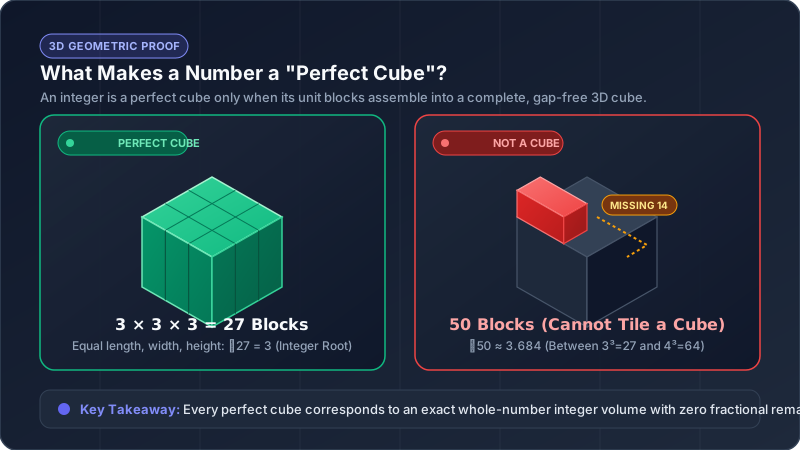
على سبيل المثال، 27 هو مكعب كامل لأن 3 × 3 × 3 = 27 (وبالتالي ∛27 = 3). وبالمثل، 125 = 5³ و -64 = (-4)³. لكن العدد 50 ليس مكعباً كاملاً لأن ∛50 ≈ 3.684.
المصطلح مشتق من الهندسة ثلاثية الأبعاد: إذا كان لديك 27 مكعباً صغيراً، يمكنك بناء مكعب مصمت متكامل بأبعاد 3×3×3 دون أي فراغ أو فائض.
الأسس الفردية تحافظ على الإشارة: (-3)³ = -27. الأعداد الصحيحة السالبة يمكن أن تكون مكعبات كاملة حقيقية.
0 و 1 هما مكعبان أساسيان: 0³ = 0 و 1³ = 1. والعدد -1 أيضاً مكعب: (-1)³ = -1.
مكعب العدد الزوجي زوجي دائماً (2³=8, 4³=64)، ومكعب الفردي فردي دائماً (3³=27, 5³=125).
في التحليل إلى العوامل الأولية، يجب أن يكون أس كل عامل أولي مضاعفاً للرقم 3.
يعتمد علماء الرياضيات على أربعة اختبارات أساسية للتأكد من المكعب الكامل:
احسب ∛n. إذا كان الناتج عدداً صحيحاً دون كسور، فإن n مكعب كامل.
حلل إلى العوامل الأولية. إذا كانت جميع الأسس تقبل القسمة على 3، فهو مكعب.
بما أن (-k)³ = -k³، فإن العدد السالب -n مكعب كامل إذا كان |n| مكعباً.
مجموع أرقام المكعب الكامل متكرراً يساوي دائماً 0 أو 1 أو 8 أو 9.
∛512 = 8 : 8 × 8 × 8 = 512. Prime factorization is 2⁹ with exponent 9 divisible by 3. Digital root: 5 + 1 + 2 = 8 (valid).
∛100 ≈ 4.642 : 100 sits strictly between 4³ = 64 and 5³ = 125. Prime factors are 2² × 5², neither exponent is divisible by 3.
∛(-216) = -6 : (-6) × (-6) × (-6) = 36 × (-6) = -216. Odd roots preserve negative signs, producing a valid real integer root.
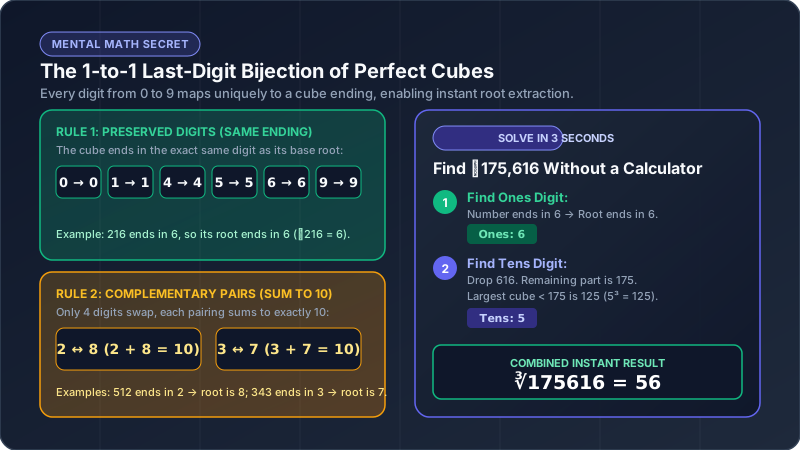
Unlike perfect squares (which can only end in 0, 1, 4, 5, 6, or 9), every digit from 0 to 9 can be the last digit of a perfect cube. In fact, there is a strict one-to-one bijection between the ones digit of a base integer and the ones digit of its cube:
| Base Last Digit (k) | Cube Calculation (k³ mod 10) | Cube Last Digit (k³) | Memory Rule |
|---|---|---|---|
| 0 | 0³ = 0 | 0 | Preserved (Same digit) |
| 1 | 1³ = 1 | 1 | Preserved (Same digit) |
| 2 | 2³ = 8 | 8 | Complements to 10 (2 + 8 = 10) |
| 3 | 3³ = 27 | 7 | Complements to 10 (3 + 7 = 10) |
| 4 | 4³ = 64 | 4 | Preserved (Same digit) |
| 5 | 5³ = 125 | 5 | Preserved (Same digit) |
| 6 | 6³ = 216 | 6 | Preserved (Same digit) |
| 7 | 7³ = 343 | 3 | Complements to 10 (7 + 3 = 10) |
| 8 | 8³ = 512 | 2 | Complements to 10 (8 + 2 = 10) |
| 9 | 9³ = 729 | 9 | Preserved (Same digit) |
To find the cube root of 175,616:
1. Ones Digit: The number ends in 6. Looking at our table, a cube ending in 6 must have a root ending in 6.
2. Tens Digit: Cross off the last three digits (616), leaving 175. The largest perfect cube below 175 is 125 (5³). So the tens digit is 5.
Result: ∛175616 = 56. Verified: 56 × 56 × 56 = 175,616!
Odd powers behave differently from even powers. Here is how special numeric sets are evaluated:
Yes. 0 is an integer, and 0 × 0 × 0 = 0 (0³ = 0). Its principal cube root is exactly 0.
Fully Real. Unlike square roots which require the imaginary unit i, odd roots preserve signs: (-k)³ = -k³. For example, ∛(-64) = -4.
A fraction is a cubic power if both its numerator and denominator are perfect cubes: 27/64 = (3/4)³.
Decimals are cubes if the significant digits form a cube and the number of decimal places is a multiple of 3: 0.027 = (0.3)³, 0.000125 = (0.05)³.
Comparing cubic numbers with square numbers? Test whether an integer is a perfect square →
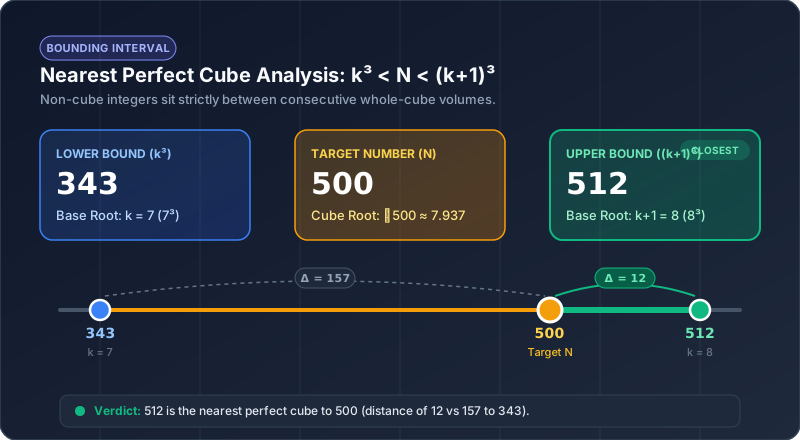
أي عدد ليس مكعباً يقع دائماً بين مكعبين متتاليين: k³ < n < (k + 1)³.
بالنسبة للعدد 500، المكعبان المحيطان هما 343 (7³) و 512 (8³). بما أن المسافة إلى 512 هي 12 فقط، فإن 512 هو المكعب الأقرب.
| Target (N) | Cube Root (∛N) | Lower Cube (k³) | Upper Cube ((k+1)³) | Nearest Cube | Distance |
|---|---|---|---|---|---|
| 50 | 3.684 | 27 (3³) | 64 (4³) | 64 | 64 - 50 = 14 |
| 200 | 5.848 | 125 (5³) | 216 (6³) | 216 | 216 - 200 = 16 |
| 500 | 7.937 | 343 (7³) | 512 (8³) | 512 | 512 - 500 = 12 |
| 800 | 9.283 | 729 (9³) | 1000 (10³) | 729 | 800 - 729 = 71 |
When an integer is not a perfect cube, its root is an irrational decimal. Compute exact decimal cube roots with radical steps →
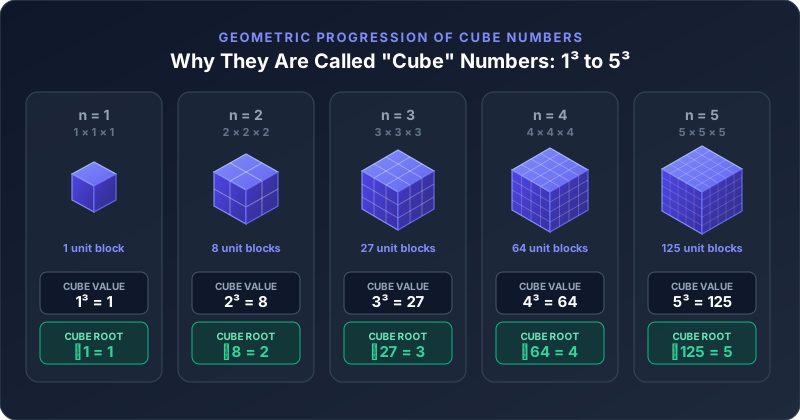
Between 1 and 1000 inclusive, there are exactly 10 perfect cubes:
| Base Root (k) | Formula (k × k × k) | Perfect Cube (k³) | Prime Factorization | ∛k³ |
|---|---|---|---|---|
| 1 | 1 × 1 × 1 | 1 | 1 | 1 |
| 2 | 2 × 2 × 2 | 8 | 2³ | 2 |
| 3 | 3 × 3 × 3 | 27 | 3³ | 3 |
| 4 | 4 × 4 × 4 | 64 | 2⁶ = (2²)³ | 4 |
| 5 | 5 × 5 × 5 | 125 | 5³ | 5 |
| 6 | 6 × 6 × 6 | 216 | 2³ × 3³ | 6 |
| 7 | 7 × 7 × 7 | 343 | 7³ | 7 |
| 8 | 8 × 8 × 8 | 512 | 2⁹ = (2³)³ | 8 |
| 9 | 9 × 9 × 9 | 729 | 3⁶ = (3²)³ | 9 |
| 10 | 10 × 10 × 10 | 1000 | 2³ × 5³ | 10 |
Between 1 and 10,000 inclusive, there are exactly 21 perfect cubes because 21³ = 9,261 and 22³ = 10,648.
| k | k³ | k | k³ | k | k³ |
|---|---|---|---|---|---|
| 1 | 1 | 8 | 512 | 15 | 3375 |
| 2 | 8 | 9 | 729 | 16 | 4096 |
| 3 | 27 | 10 | 1000 | 17 | 4913 |
| 4 | 64 | 11 | 1331 | 18 | 5832 |
| 5 | 125 | 12 | 1728 | 19 | 6859 |
| 6 | 216 | 13 | 2197 | 20 | 8000 |
| 7 | 343 | 14 | 2744 | 21 | 9261 |
Evaluating higher powers beyond the 3rd degree? Evaluate arbitrary nth degree radical roots →
Verify cube numbers automatically in Excel, Google Sheets, Python, and JavaScript:
=IF(ROUND(A2^(1/3), 0)^3 = A2, "Perfect Cube", "Not a Cube") def is_cube(n): return round(abs(n)**(1/3))**3 == abs(n) const isCube = n => Math.round(Math.cbrt(n))**3 === n; Terminology: Perfect Cube or Cube Number.
Terminology: Kubikzahlen (German) and Cubes parfaits (French).
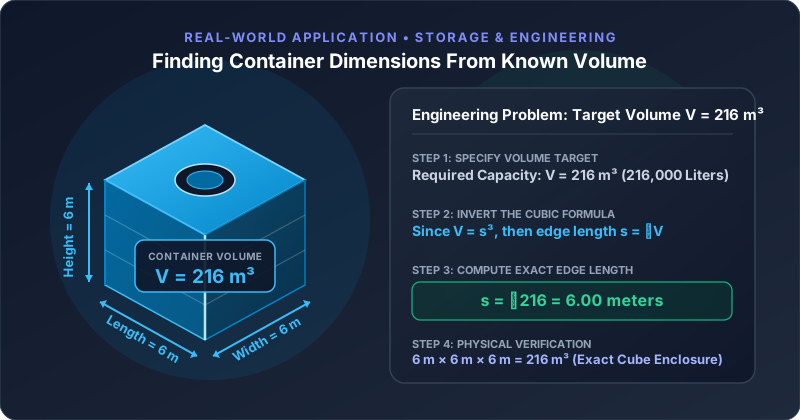
أبعاد صناديق الشحن، الحاويات وخزانات التخزين في النقل ثلاثي الأبعاد.
قانون التربيع والتكعيب الذي يربط بين مساحة السطح وكتلة الكائنات.
النمذجة الحجمية القائمة على الفوكسل في ألعاب مثل ماينكرافت.
المنحنيات الإهليلجية ونظرية الأعداد التحليلية في الأمن السيبراني.
Cubing a number means multiplying it by itself three times (4³ = 4 × 4 × 4 = 64), not multiplying it by three (4 × 3 = 12).
Unlike square roots, odd roots preserve negative signs. Multiplying three negative numbers gives a negative product: (-5) × (-5) × (-5) = -125.
Every digit from 0 to 9 can end a perfect cube. You cannot eliminate a candidate by its last digit alone; you must use prime factors or modulo 9 digital roots.
In computers, computing 125^(1/3) frequently yields 4.999999999999999. Naively checking if int(125^(1/3)) == 5 can fail without proper rounding logic.
هو عدد صحيح ينتج عن ضرب عدد صحيح في نفسه ثلاث مرات. مثلاً 27 مكعب كامل لأن 3 × 3 × 3 = 27.
نعم! حاصل ضرب ثلاثة أعداد سالبة هو سالب: (-4) × (-4) × (-4) = -64. وبالتالي -64 مكعب كامل جذره -4.
نعم، الصفر مكعب كامل لأن 0 × 0 × 0 = 0 (0³ = 0).
نعم، الأعداد التي أسس عواملها الأولية من مضاعفات 6: 1، 64 (8² و 4³)، 729 (27² و 9³) و 4096 (64² و 16³).
نعم، حاسبة المكعبات الكاملة لدينا مجانية تماماً وبدون أي حدود للاستخدام.

يحقق العلاقة n = k × k × k حيث k عدد صحيح.
على عكس الجذور التربيعية، الجذور التكعيبية للأعداد السالبة حقيقية.
يجب أن يكون أس كل عامل أولي قابلاً للقسمة على 3.
تحقق من عدد غير محدود من الأرقام مع شرح كامل وخطوات مفصلة.