立方根電卓
正負を問わず任意の数の3乗根 ∛x を算出
立方根を求めたい数値を入力してください。負の数にも実数解が存在します。
∛
任意の数の3乗根(立方根)を瞬時に計算。正負の数に対応し、正確な小数値、簡略化した根号、途中式を100%無料で表示します。
立方根(フランス語で Racine Cubique、英語で Cube Root)は、3次元空間の体積や立方体の寸法を計算するための基本的な数学演算です。当サイトのオンライン計算機を使用すれば、任意の数値の立方根を瞬時に高精度で計算できます。
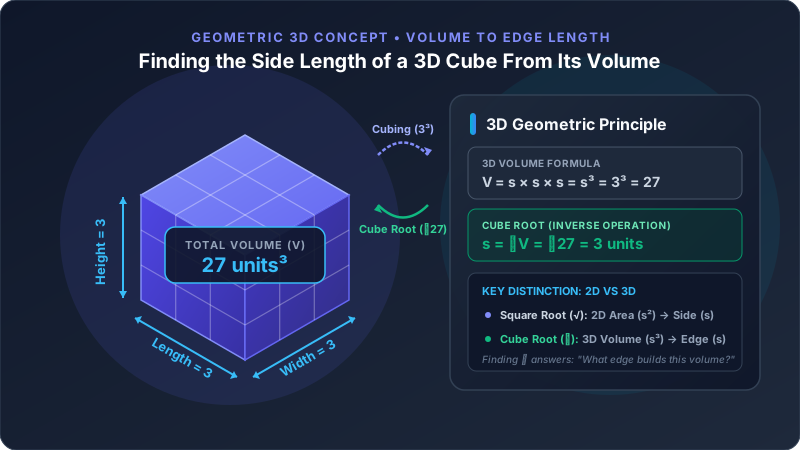
ある数値の立方根とは、3回同じ数同士を掛け合わせたときに元の数値になる値のことです(例:3 × 3 × 3 = 27 であるため、∛27 = 3)。
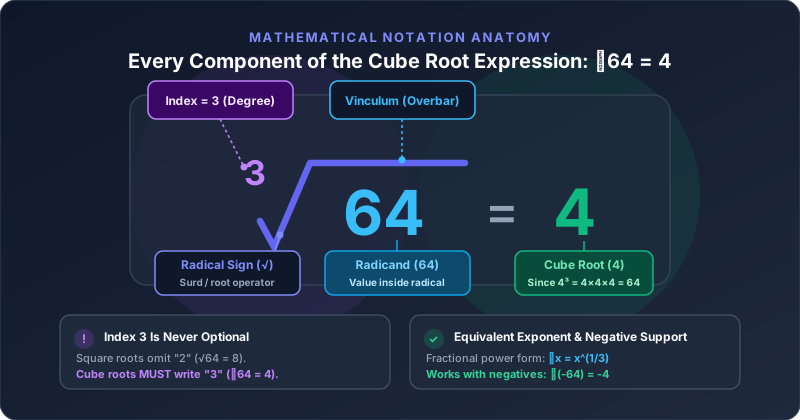
The small number 3 in the upper-left of the radical sign. It indicates you are finding the 3rd root (cube root) rather than a square root (index 2).
The mathematical sign ∛ denoting the extraction of the cube root. In Unicode, it is character U+221B.
The number underneath the radical sign whose cube root is being calculated. It can be positive, negative, or zero.
The real value that, when multiplied by itself three times (y × y × y), equals the radicand.
幾何学的には、体積がわかっている立方体の一辺の長さを求める操作に相当します。
わずか3つの簡単なステップで答えが分かります:
上の入力フィールドに調べたい数値を入力します。
「計算」ボタンを押して処理を開始します。
正確な小数値と簡約根の表示が即座に得られます。
手計算や複雑な公式は不要で、計算機が全ステップを自動処理します。
立方根は、根号の左肩に指数「3」をつけた ∛ という記号で表されます:
Standard mathematical radical notation using index 3 and radical sign.
Fractional power representation: raising any number to 1/3 equals its cube root.
Standard in JavaScript, Python (64 ** (1/3)), C, Java, and modern runtimes.
Excel and Google Sheets formula. Alternatively use =A1^(1/3).
LaTeX mathematical typesetting command for academic papers and documents.
On Windows: type 221B then press Alt+X. On Mac: Cmd+Ctrl+Space. HTML: ∛.
立方根は分数指数を用いて表すこともできます:
これら2つの表記は数学的に同一です。プログラミング言語では通常 x^(1/3) と記述します。
∛x も x^(1/3) も、同一の数学的演算を表しています。
立方根は、3乗(立方)の逆演算として定義されます:
任意の実数 x に対して、y³ = x を満たす実数 y がただ1つ存在します。平方根とは異なり、立方根は負の数値に対しても実数の範囲で完全に定義されます。
以下の基本法則により、立方根を含む式の簡約や計算がスムーズに行えます:
例: ∛(8 × 27) = ∛8 × ∛27 = 2 × 3 = 6。
例: ∛(64 / 8) = ∛64 / ∛8 = 4 / 2 = 2。
例: ∛(2⁶) = 2^(6/3) = 2² = 4。
例: ∛(-8) = -∛8 = -2。
Working with higher degree root indices beyond 3? Compute 4th, 5th, and general nth roots online →
電卓なしで立方根を求める主な4つのアプローチ:
前後の完全立方数を見つけて挟み込み、小数を推測して二乗・三乗しながら絞り込みます。
完全立方数に最適な方法:素因数分解を行い、3つずつのグループを作ります。
1〜100万までの完全立方数の一の位と十の位を瞬時に見抜くテクニック:
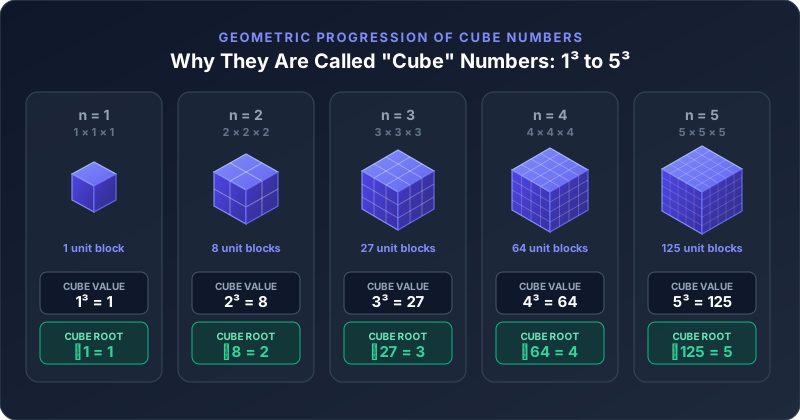
学校の授業や日常計算で頻出する立方根のビジュアル一覧。
スクロールして表を表示 ↓
| Number (n) | Cube (n³) | Cube Root (∛n³) | Quick Test |
|---|---|---|---|
| 1 | 1 | 1 | |
| 2 | 8 | 2 | |
| 3 | 27 | 3 | |
| 4 | 64 | 4 | |
| 5 | 125 | 5 | |
| 6 | 216 | 6 | |
| 7 | 343 | 7 | |
| 8 | 512 | 8 | |
| 9 | 729 | 9 | |
| 10 | 1,000 | 10 | |
| 11 | 1,331 | 11 | |
| 12 | 1,728 | 12 | |
| 15 | 3,375 | 15 | |
| 20 | 8,000 | 20 | |
| 25 | 15,625 | 25 | |
| 50 | 125,000 | 50 | |
| 100 | 1,000,000 | 100 |
平方根とは異なり、負の数の立方根は実数の範囲内で完全に存在し、答えも負の実数になります。
負の数を奇数回(3回)掛けると結果は負になるため、数学的に完全に成り立ちます。
Requires the imaginary unit i (±4i) because squaring any real number produces a non-negative result.
100% Real solution! Multiplying three negative numbers gives a negative product: (-4) × (-4) × (-4) = -64.
(-3) × (-3) × (-3) = 9 × (-3) = -27 であるため、∛(-27) = -3 となります。
一般公式:任意の実数 x に対して ∛(-x) = -∛x が成立します。
負の数の実数立方根を求めるのに虚数単位(i)は必要ありません。
To find the cube root of a decimal, convert it into a fraction or power of ten, simplify, and evaluate the root.
Apply the quotient property by taking the cube root of the numerator and denominator separately: ∛(a/b) = ∛a / ∛b.
完全立方数ではない場合、立方数の因数を根号の外に出して整理します:
| 元の式 | 簡約形 | 変形の手順 | Actions |
|---|---|---|---|
| ∛16 | 2∛2 | 16 = 2³ × 2 = 8 × 2 | |
| ∛24 | 2∛3 | 24 = 2³ × 3 = 8 × 3 | |
| ∛32 | 2∛4 | 32 = 2³ × 4 = 8 × 4 | |
| ∛40 | 2∛5 | 40 = 2³ × 5 = 8 × 5 | |
| ∛48 | 2∛6 | 48 = 2³ × 6 = 8 × 6 | |
| ∛54 | 3∛2 | 54 = 3³ × 2 = 27 × 2 | |
| ∛56 | 2∛7 | 56 = 2³ × 7 = 8 × 7 | |
| ∛72 | 2∛9 | 72 = 2³ × 9 = 8 × 9 | |
| ∛108 | 3∛4 | 108 = 3³ × 4 = 27 × 4 | |
| ∛128 | 4∛2 | 128 = 4³ × 2 = 64 × 2 | |
最大の完全立方因数を見つけることが、簡約を素早く行う鍵です。
立方根と平方根の決定的な違いをまとめた比較表です:
| Property / Feature | 立方根 (∛) | 平方根 (√) |
|---|---|---|
| 記号と次数 | ∛ (Index 3) | √ (Index 2) |
| Exponent Form | x^(1/3) | x^(1/2) |
| 負の数の扱い | 実数として常に定義される | 実数範囲では未定義(複素数が必要) |
| 掛ける回数 | 3回掛け合わせる | 2回掛け合わせる |
| Number of Real Roots | Exactly 1 for all real numbers | 1 for positive / 0 for negative |
| Graph Symmetry | Odd function (symmetric about origin) | Defined only for x ≥ 0 |
| Output Sign | Always matches input sign (∛(-8) = -2) | Always non-negative (principal root) |
| 主な例 | ∛64 = 4 | √64 = 8 |
Need to evaluate square roots instead? Calculate square roots with exact decimals and simplified radicals →
1から100までの自然数の立方根(小数第4位まで四捨五入):
必要に応じて表を横スクロールしてください
| 数値 (n) | 立方根 (∛n) | Simplified Radical | 種類 | Quick Test |
|---|---|---|---|---|
| 1 | 1 | 1 | 完全立方数 | |
| 2 | 1.2599 | ∛2 | 無理数 | |
| 3 | 1.4422 | ∛3 | 無理数 | |
| 4 | 1.5874 | ∛4 | 無理数 | |
| 5 | 1.7100 | ∛5 | 無理数 | |
| 6 | 1.8171 | ∛6 | 無理数 | |
| 7 | 1.9129 | ∛7 | 無理数 | |
| 8 | 2 | 2 | 完全立方数 | |
| 9 | 2.0801 | ∛9 | 無理数 | |
| 10 | 2.1544 | ∛10 | 無理数 | |
| 11 | 2.2240 | ∛11 | 無理数 | |
| 12 | 2.2894 | ∛12 | 無理数 | |
| 13 | 2.3513 | ∛13 | 無理数 | |
| 14 | 2.4101 | ∛14 | 無理数 | |
| 15 | 2.4662 | ∛15 | 無理数 | |
| 16 | 2.5198 | 2∛2 | 無理数 | |
| 17 | 2.5713 | ∛17 | 無理数 | |
| 18 | 2.6207 | ∛18 | 無理数 | |
| 19 | 2.6684 | ∛19 | 無理数 | |
| 20 | 2.7144 | ∛20 | 無理数 | |
| 21 | 2.7589 | ∛21 | 無理数 | |
| 22 | 2.8020 | ∛22 | 無理数 | |
| 23 | 2.8439 | ∛23 | 無理数 | |
| 24 | 2.8845 | 2∛3 | 無理数 | |
| 25 | 2.9240 | ∛25 | 無理数 | |
| 26 | 2.9625 | ∛26 | 無理数 | |
| 27 | 3 | 3 | 完全立方数 | |
| 28 | 3.0366 | ∛28 | 無理数 | |
| 29 | 3.0723 | ∛29 | 無理数 | |
| 30 | 3.1072 | ∛30 | 無理数 | |
| 31 | 3.1414 | ∛31 | 無理数 | |
| 32 | 3.1748 | 2∛4 | 無理数 | |
| 33 | 3.2075 | ∛33 | 無理数 | |
| 34 | 3.2396 | ∛34 | 無理数 | |
| 35 | 3.2711 | ∛35 | 無理数 | |
| 36 | 3.3019 | ∛36 | 無理数 | |
| 37 | 3.3322 | ∛37 | 無理数 | |
| 38 | 3.3620 | ∛38 | 無理数 | |
| 39 | 3.3912 | ∛39 | 無理数 | |
| 40 | 3.4200 | 2∛5 | 無理数 | |
| 41 | 3.4482 | ∛41 | 無理数 | |
| 42 | 3.4760 | ∛42 | 無理数 | |
| 43 | 3.5034 | ∛43 | 無理数 | |
| 44 | 3.5303 | ∛44 | 無理数 | |
| 45 | 3.5569 | ∛45 | 無理数 | |
| 46 | 3.5830 | ∛46 | 無理数 | |
| 47 | 3.6088 | ∛47 | 無理数 | |
| 48 | 3.6342 | 2∛6 | 無理数 | |
| 49 | 3.6593 | ∛49 | 無理数 | |
| 50 | 3.6840 | ∛50 | 無理数 | |
| 51 | 3.7084 | ∛51 | 無理数 | |
| 52 | 3.7325 | ∛52 | 無理数 | |
| 53 | 3.7563 | ∛53 | 無理数 | |
| 54 | 3.7798 | 3∛2 | 無理数 | |
| 55 | 3.8030 | ∛55 | 無理数 | |
| 56 | 3.8259 | 2∛7 | 無理数 | |
| 57 | 3.8485 | ∛57 | 無理数 | |
| 58 | 3.8709 | ∛58 | 無理数 | |
| 59 | 3.8930 | ∛59 | 無理数 | |
| 60 | 3.9149 | ∛60 | 無理数 | |
| 61 | 3.9365 | ∛61 | 無理数 | |
| 62 | 3.9579 | ∛62 | 無理数 | |
| 63 | 3.9791 | ∛63 | 無理数 | |
| 64 | 4 | 4 | 完全立方数 | |
| 65 | 4.0207 | ∛65 | 無理数 | |
| 66 | 4.0412 | ∛66 | 無理数 | |
| 67 | 4.0615 | ∛67 | 無理数 | |
| 68 | 4.0817 | ∛68 | 無理数 | |
| 69 | 4.1016 | ∛69 | 無理数 | |
| 70 | 4.1213 | ∛70 | 無理数 | |
| 71 | 4.1408 | ∛71 | 無理数 | |
| 72 | 4.1602 | 2∛9 | 無理数 | |
| 73 | 4.1793 | ∛73 | 無理数 | |
| 74 | 4.1983 | ∛74 | 無理数 | |
| 75 | 4.2172 | ∛75 | 無理数 | |
| 76 | 4.2358 | ∛76 | 無理数 | |
| 77 | 4.2543 | ∛77 | 無理数 | |
| 78 | 4.2727 | ∛78 | 無理数 | |
| 79 | 4.2908 | ∛79 | 無理数 | |
| 80 | 4.3089 | 2∛10 | 無理数 | |
| 81 | 4.3267 | 3∛3 | 無理数 | |
| 82 | 4.3445 | ∛82 | 無理数 | |
| 83 | 4.3621 | ∛83 | 無理数 | |
| 84 | 4.3795 | ∛84 | 無理数 | |
| 85 | 4.3968 | ∛85 | 無理数 | |
| 86 | 4.4140 | ∛86 | 無理数 | |
| 87 | 4.4310 | ∛87 | 無理数 | |
| 88 | 4.4480 | 2∛11 | 無理数 | |
| 89 | 4.4647 | ∛89 | 無理数 | |
| 90 | 4.4814 | ∛90 | 無理数 | |
| 91 | 4.4979 | ∛91 | 無理数 | |
| 92 | 4.5144 | ∛92 | 無理数 | |
| 93 | 4.5307 | ∛93 | 無理数 | |
| 94 | 4.5468 | ∛94 | 無理数 | |
| 95 | 4.5629 | ∛95 | 無理数 | |
| 96 | 4.5789 | 2∛12 | 無理数 | |
| 97 | 4.5947 | ∛97 | 無理数 | |
| 98 | 4.6104 | ∛98 | 無理数 | |
| 99 | 4.6261 | ∛99 | 無理数 | |
| 100 | 4.6416 | ∛100 | 無理数 |
Want to verify whether any specific integer is an exact cube? Test integers with our instant perfect cube checker →
立方根は工学、物理学、天文学など多岐にわたる分野で使われています:
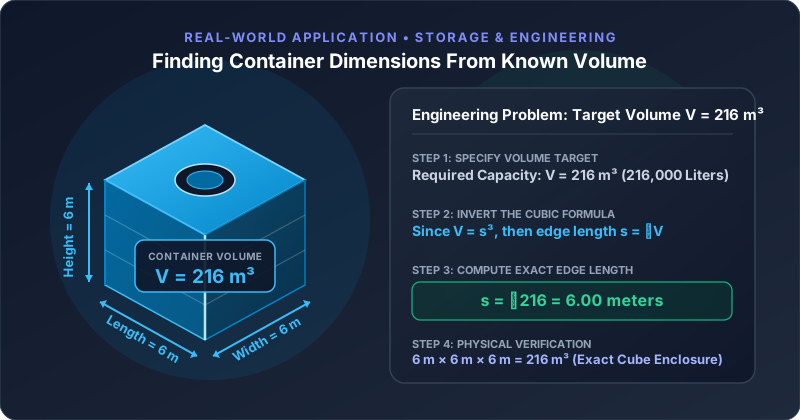
指定された体積を持つ立方体タンクの一辺の寸法を決定する。
惑星の公転周期と太陽からの軌道半径の関係を計算する。
結晶格子における原子間距離や密度を体積から導く。
生物の体重と体表面積・代謝率の相関関係を解明する。
All calculations execute directly in your browser with zero latency and 100% data privacy.
Instantly checks whether the radicand is a perfect cube and outputs exact integers without rounding drift.
Performs prime factorization in real time to extract triple factors, rendering exact forms like ∛24 = 2∛3.
Applies the mathematical odd symmetry rule ∛(-x) = -∛x, returning exact real solutions for negative inputs.
Provides clean decimal approximations and comprehensive step-by-step mathematical reasoning.
A cube root of a number is a value that, when multiplied by itself three times, produces the original number. In mathematical notation, the cube root of x is written as ∛x or x^(1/3). For example, the cube root of 27 is 3, because 3 × 3 × 3 = 27.
Yes! Unlike square roots, cube roots of negative numbers are real numbers because multiplying three negative numbers results in a negative product. The rule is ∛(-x) = -∛x. For example, ∛(-8) = -2, because (-2) × (-2) × (-2) = -8.
Cubing and taking the cube root are inverse operations. Cubing a number means raising it to the power of 3 (for example, 4³ = 64). Taking the cube root reverses this process to recover the original base value: ∛64 = 4.
A perfect cube is an integer that results from multiplying an integer by itself three times. Examples include 1, 8, 27, 64, 125, 216, 343, 512, 729, and 1000. The cube root of a perfect cube is always a whole number.
For perfect cubes, use prime factorization: break the number into prime factors, group identical factors into sets of three, and extract one from each group (e.g. 3375 = 3³ × 5³ = 15). For non-perfect cubes, use estimation between the two nearest known perfect cubes.
The cube root symbol is ∛ (Unicode character U+221B). It consists of a standard radical sign with a small index 3 in the upper-left notch. In software code it is written cbrt(x), and in LaTeX as \sqrt[3]{x}.
On Windows, type 221B then press Alt+X in supported apps, or use Character Map. On Mac, press Cmd+Ctrl+Space to open Character Viewer and search 'cube root'. In HTML, use the entity ∛ or copy and paste ∛ directly.
The cube root of 0 is exactly 0, because 0 × 0 × 0 = 0.
The cube root of 2 (∛2 ≈ 1.2599) is an irrational number. It cannot be expressed as an exact fraction of two integers, and its decimal expansion continues infinitely without repeating.
The real cube root of 1 is 1, since 1 × 1 × 1 = 1. (In complex mathematics, there are also two non-real complex cube roots of unity: e^(2πi/3) and e^(-2πi/3)).

立方根は3乗の逆演算であり、正の数だけでなく負の数に対しても実数の範囲で常に答えが存在します。