Kubikwurzel Rechner
Finden Sie ∛x für jede Zahl, einschließlich negativer Zahlen
Geben Sie eine positive oder negative Zahl ein, um die Kubikwurzel zu berechnen.
∛
Berechnen Sie die Kubikwurzel jeder Zahl — positiv oder negativ — sofort mit exakter Dezimalanzeige, vereinfachter Wurzel und Schritten. 100% kostenlos.
Die Kubikwurzel (dritte Wurzel) ist eine fundamentale Operation für dreidimensionale Probleme. Unser Online-Rechner liefert Ihnen das exakte Ergebnis mit einem Klick.
Eine Kubikwurzel ist jene Zahl, die dreimal mit sich selbst multipliziert die Ausgangszahl ergibt (3 × 3 × 3 = 27, also ∛27 = 3).
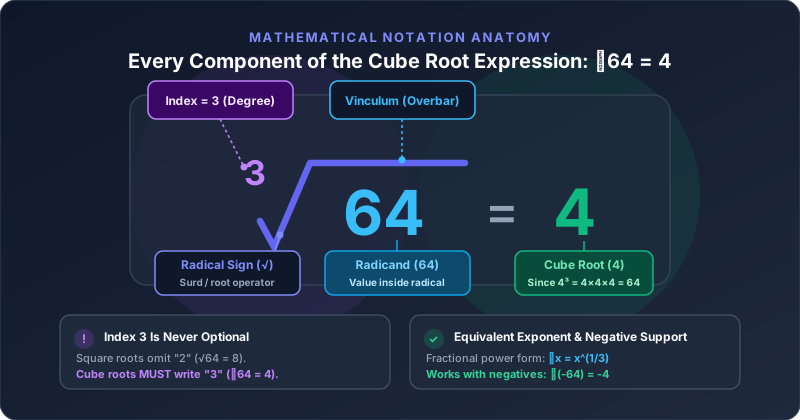
The small number 3 in the upper-left of the radical sign. It indicates you are finding the 3rd root (cube root) rather than a square root (index 2).
The mathematical sign ∛ denoting the extraction of the cube root. In Unicode, it is character U+221B.
The number underneath the radical sign whose cube root is being calculated. It can be positive, negative, or zero.
The real value that, when multiplied by itself three times (y × y × y), equals the radicand.
Sie bildet die geometrische Grundlage zur Berechnung der Kantenlänge eines Würfels aus dessen Volumen.
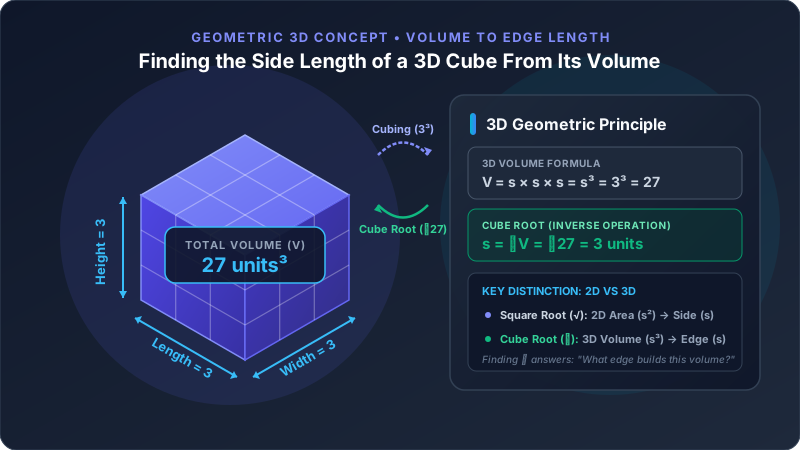
In drei einfachen Schritten zum Ergebnis:
Tragen Sie Ihre Zahl in das Eingabefeld oben ein.
Starten Sie die Berechnung per Klick.
Erhalten Sie sofort den exakten Dezimalwert und die vereinfachte Wurzel.
Keine Formeln nötig: Der Rechner erledigt alle Rechenschritte automatisch.
Das Symbol ∛ kennzeichnet die Kubikwurzel mit dem Wurzelexponenten (Index) 3.
Standard mathematical radical notation using index 3 and radical sign.
Fractional power representation: raising any number to 1/3 equals its cube root.
Standard in JavaScript, Python (64 ** (1/3)), C, Java, and modern runtimes.
Excel and Google Sheets formula. Alternatively use =A1^(1/3).
LaTeX mathematical typesetting command for academic papers and documents.
On Windows: type 221B then press Alt+X. On Mac: Cmd+Ctrl+Space. HTML: ∛.
Die Kubikwurzel kann auch als gebrochener Exponent geschrieben werden:
Beide Schreibweisen sind identisch. In Programmiersprachen wird x^(1/3) verwendet.
Sowohl ∛x als auch x^(1/3) beschreiben dieselbe mathematische Operation.
Die Kubikwurzel wird über die Umkehrung des Kubierens definiert:
Dreimal mit sich selbst multipliziert muss die Wurzel wieder die Ausgangszahl ergeben.
Wichtige Gesetze für das Rechnen mit Wurzeln 3. Grades:
Ermöglicht das Zerlegen großer Kubikzahlen.
Erlaubt das getrennte Wurzelziehen bei Brüchen.
Gilt für alle reellen Zahlen, ob positiv oder negativ!
Grundlegend zum Lösen von Wurzelgleichungen.
Feste mathematische Referenzwerte.
Working with higher degree root indices beyond 3? Compute 4th, 5th, and general nth roots online →
Vier bewährte Vorgehensweisen:
Zahl eingeben und sofort die Lösung erhalten.
Faktoren in 3er-Gruppen zusammenfassen.
Zahl zwischen zwei bekannte Kubikzahlen einordnen.
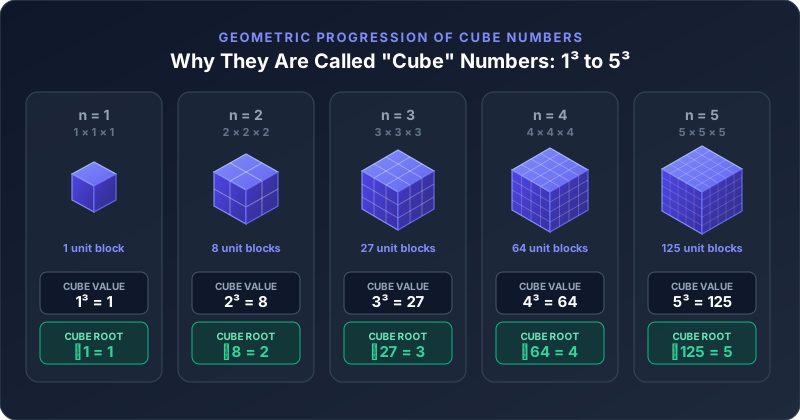
Kubikzahlen wachsen extrem schnell. Hier die ersten 10:
Scrollen, um die Tabelle zu durchsuchen ↓
| Number (n) | Cube (n³) | Cube Root (∛n³) | Quick Test |
|---|---|---|---|
| 1 | 1 | 1 | |
| 2 | 8 | 2 | |
| 3 | 27 | 3 | |
| 4 | 64 | 4 | |
| 5 | 125 | 5 | |
| 6 | 216 | 6 | |
| 7 | 343 | 7 | |
| 8 | 512 | 8 | |
| 9 | 729 | 9 | |
| 10 | 1,000 | 10 | |
| 11 | 1,331 | 11 | |
| 12 | 1,728 | 12 | |
| 15 | 3,375 | 15 | |
| 20 | 8,000 | 20 | |
| 25 | 15,625 | 25 | |
| 50 | 125,000 | 50 | |
| 100 | 1,000,000 | 100 |
Der entscheidende Unterschied zur Quadratwurzel: Die Kubikwurzel aus einer negativen Zahl ist eine ganz normale, reelle Zahl.
Drei negative Zahlen miteinander multipliziert ergeben wieder ein negatives Produkt: Minus mal Minus ist Plus, Plus mal Minus ist Minus.
Requires the imaginary unit i (±4i) because squaring any real number produces a non-negative result.
100% Real solution! Multiplying three negative numbers gives a negative product: (-4) × (-4) × (-4) = -64.
∛(−64) = −4, da (−4) × (−4) × (−4) = −64
Keine imaginäre Einheit i nötig: Die Lösung ist vollständig reell.
Quadratwurzeln aus negativen Zahlen erfordern die imaginäre Einheit i, während Kubikwurzeln direkt reelle Zahlen liefern.
To find the cube root of a decimal, convert it into a fraction or power of ten, simplify, and evaluate the root.
Apply the quotient property by taking the cube root of the numerator and denominator separately: ∛(a/b) = ∛a / ∛b.
Ziehen Sie perfekte Kubikzahlen vor die Wurzel:
| Ausdruck | Vereinfacht | Grund | Actions |
|---|---|---|---|
| ∛16 | 2∛2 | 16 = 2³ × 2 = 8 × 2 | |
| ∛24 | 2∛3 | 24 = 2³ × 3 = 8 × 3 | |
| ∛32 | 2∛4 | 32 = 2³ × 4 = 8 × 4 | |
| ∛40 | 2∛5 | 40 = 2³ × 5 = 8 × 5 | |
| ∛48 | 2∛6 | 48 = 2³ × 6 = 8 × 6 | |
| ∛54 | 3∛2 | 54 = 3³ × 2 = 27 × 2 | |
| ∛56 | 2∛7 | 56 = 2³ × 7 = 8 × 7 | |
| ∛72 | 2∛9 | 72 = 2³ × 9 = 8 × 9 | |
| ∛108 | 3∛4 | 108 = 3³ × 4 = 27 × 4 | |
| ∛128 | 4∛2 | 128 = 4³ × 2 = 64 × 2 | |
Suchen Sie den größten kubischen Teiler des Radikanden.
2D- vs. 3D-Radikale im Überblick:
| Property / Feature | Kubikwurzel | Quadratwurzel |
|---|---|---|
| Symbol | ∛ (Index 3) | √ (Index 2) |
| Exponent Form | x^(1/3) | x^(1/2) |
| Negative Zahlen | Reelle Lösung existiert (∛-64 = -4) | Keine reelle Lösung (erfordert i) |
| Multiplikationen | 3 (x × x × x) | 2 (x × x) |
| Number of Real Roots | Exactly 1 for all real numbers | 1 for positive / 0 for negative |
| Graph Symmetry | Odd function (symmetric about origin) | Defined only for x ≥ 0 |
| Output Sign | Always matches input sign (∛(-8) = -2) | Always non-negative (principal root) |
| Beispiel | ∛64 = 4 (4³=64) | √64 = 8 (8²=64) |
Need to evaluate square roots instead? Calculate square roots with exact decimals and simplified radicals →
Werte auf 3 Dezimalstellen gerundet mit Markierung der perfekten Kubikzahlen.
Scrollen für alle 100 Werte ↓
| Zahl (n) | Wurzel (∛n) | Simplified Radical | Typ | Quick Test |
|---|---|---|---|---|
| 1 | 1 | 1 | Kubikzahl | |
| 2 | 1.2599 | ∛2 | Irrational | |
| 3 | 1.4422 | ∛3 | Irrational | |
| 4 | 1.5874 | ∛4 | Irrational | |
| 5 | 1.7100 | ∛5 | Irrational | |
| 6 | 1.8171 | ∛6 | Irrational | |
| 7 | 1.9129 | ∛7 | Irrational | |
| 8 | 2 | 2 | Kubikzahl | |
| 9 | 2.0801 | ∛9 | Irrational | |
| 10 | 2.1544 | ∛10 | Irrational | |
| 11 | 2.2240 | ∛11 | Irrational | |
| 12 | 2.2894 | ∛12 | Irrational | |
| 13 | 2.3513 | ∛13 | Irrational | |
| 14 | 2.4101 | ∛14 | Irrational | |
| 15 | 2.4662 | ∛15 | Irrational | |
| 16 | 2.5198 | 2∛2 | Irrational | |
| 17 | 2.5713 | ∛17 | Irrational | |
| 18 | 2.6207 | ∛18 | Irrational | |
| 19 | 2.6684 | ∛19 | Irrational | |
| 20 | 2.7144 | ∛20 | Irrational | |
| 21 | 2.7589 | ∛21 | Irrational | |
| 22 | 2.8020 | ∛22 | Irrational | |
| 23 | 2.8439 | ∛23 | Irrational | |
| 24 | 2.8845 | 2∛3 | Irrational | |
| 25 | 2.9240 | ∛25 | Irrational | |
| 26 | 2.9625 | ∛26 | Irrational | |
| 27 | 3 | 3 | Kubikzahl | |
| 28 | 3.0366 | ∛28 | Irrational | |
| 29 | 3.0723 | ∛29 | Irrational | |
| 30 | 3.1072 | ∛30 | Irrational | |
| 31 | 3.1414 | ∛31 | Irrational | |
| 32 | 3.1748 | 2∛4 | Irrational | |
| 33 | 3.2075 | ∛33 | Irrational | |
| 34 | 3.2396 | ∛34 | Irrational | |
| 35 | 3.2711 | ∛35 | Irrational | |
| 36 | 3.3019 | ∛36 | Irrational | |
| 37 | 3.3322 | ∛37 | Irrational | |
| 38 | 3.3620 | ∛38 | Irrational | |
| 39 | 3.3912 | ∛39 | Irrational | |
| 40 | 3.4200 | 2∛5 | Irrational | |
| 41 | 3.4482 | ∛41 | Irrational | |
| 42 | 3.4760 | ∛42 | Irrational | |
| 43 | 3.5034 | ∛43 | Irrational | |
| 44 | 3.5303 | ∛44 | Irrational | |
| 45 | 3.5569 | ∛45 | Irrational | |
| 46 | 3.5830 | ∛46 | Irrational | |
| 47 | 3.6088 | ∛47 | Irrational | |
| 48 | 3.6342 | 2∛6 | Irrational | |
| 49 | 3.6593 | ∛49 | Irrational | |
| 50 | 3.6840 | ∛50 | Irrational | |
| 51 | 3.7084 | ∛51 | Irrational | |
| 52 | 3.7325 | ∛52 | Irrational | |
| 53 | 3.7563 | ∛53 | Irrational | |
| 54 | 3.7798 | 3∛2 | Irrational | |
| 55 | 3.8030 | ∛55 | Irrational | |
| 56 | 3.8259 | 2∛7 | Irrational | |
| 57 | 3.8485 | ∛57 | Irrational | |
| 58 | 3.8709 | ∛58 | Irrational | |
| 59 | 3.8930 | ∛59 | Irrational | |
| 60 | 3.9149 | ∛60 | Irrational | |
| 61 | 3.9365 | ∛61 | Irrational | |
| 62 | 3.9579 | ∛62 | Irrational | |
| 63 | 3.9791 | ∛63 | Irrational | |
| 64 | 4 | 4 | Kubikzahl | |
| 65 | 4.0207 | ∛65 | Irrational | |
| 66 | 4.0412 | ∛66 | Irrational | |
| 67 | 4.0615 | ∛67 | Irrational | |
| 68 | 4.0817 | ∛68 | Irrational | |
| 69 | 4.1016 | ∛69 | Irrational | |
| 70 | 4.1213 | ∛70 | Irrational | |
| 71 | 4.1408 | ∛71 | Irrational | |
| 72 | 4.1602 | 2∛9 | Irrational | |
| 73 | 4.1793 | ∛73 | Irrational | |
| 74 | 4.1983 | ∛74 | Irrational | |
| 75 | 4.2172 | ∛75 | Irrational | |
| 76 | 4.2358 | ∛76 | Irrational | |
| 77 | 4.2543 | ∛77 | Irrational | |
| 78 | 4.2727 | ∛78 | Irrational | |
| 79 | 4.2908 | ∛79 | Irrational | |
| 80 | 4.3089 | 2∛10 | Irrational | |
| 81 | 4.3267 | 3∛3 | Irrational | |
| 82 | 4.3445 | ∛82 | Irrational | |
| 83 | 4.3621 | ∛83 | Irrational | |
| 84 | 4.3795 | ∛84 | Irrational | |
| 85 | 4.3968 | ∛85 | Irrational | |
| 86 | 4.4140 | ∛86 | Irrational | |
| 87 | 4.4310 | ∛87 | Irrational | |
| 88 | 4.4480 | 2∛11 | Irrational | |
| 89 | 4.4647 | ∛89 | Irrational | |
| 90 | 4.4814 | ∛90 | Irrational | |
| 91 | 4.4979 | ∛91 | Irrational | |
| 92 | 4.5144 | ∛92 | Irrational | |
| 93 | 4.5307 | ∛93 | Irrational | |
| 94 | 4.5468 | ∛94 | Irrational | |
| 95 | 4.5629 | ∛95 | Irrational | |
| 96 | 4.5789 | 2∛12 | Irrational | |
| 97 | 4.5947 | ∛97 | Irrational | |
| 98 | 4.6104 | ∛98 | Irrational | |
| 99 | 4.6261 | ∛99 | Irrational | |
| 100 | 4.6416 | ∛100 | Irrational |
Want to verify whether any specific integer is an exact cube? Test integers with our instant perfect cube checker →
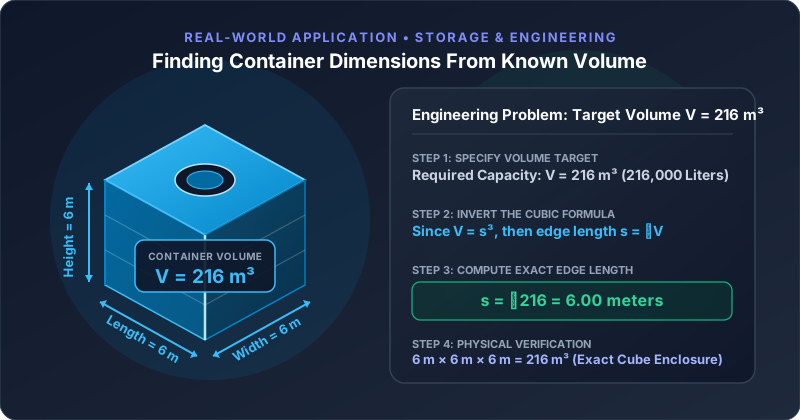
Kubikwurzeln sind im dreidimensionalen Raum unersetzlich:
Berechnung von Kantenlängen aus Raumvolumina (z. B. 64 m³ Raum hat ∛64 = 4 m Seitenlänge).
Volumenberechnung für Verpackungsmaße und Volumengewicht.
Kugelradien aus Volumen und Strömungsmechanik.
Jährliche Wachstumsrate über 3 Jahre: r = ∛(Endwert / Startwert) - 1.
Abmessungen von Wassertanks und Pflanzkübeln ermitteln.
All calculations execute directly in your browser with zero latency and 100% data privacy.
Instantly checks whether the radicand is a perfect cube and outputs exact integers without rounding drift.
Performs prime factorization in real time to extract triple factors, rendering exact forms like ∛24 = 2∛3.
Applies the mathematical odd symmetry rule ∛(-x) = -∛x, returning exact real solutions for negative inputs.
Provides clean decimal approximations and comprehensive step-by-step mathematical reasoning.
A cube root of a number is a value that, when multiplied by itself three times, produces the original number. In mathematical notation, the cube root of x is written as ∛x or x^(1/3). For example, the cube root of 27 is 3, because 3 × 3 × 3 = 27.
Yes! Unlike square roots, cube roots of negative numbers are real numbers because multiplying three negative numbers results in a negative product. The rule is ∛(-x) = -∛x. For example, ∛(-8) = -2, because (-2) × (-2) × (-2) = -8.
Cubing and taking the cube root are inverse operations. Cubing a number means raising it to the power of 3 (for example, 4³ = 64). Taking the cube root reverses this process to recover the original base value: ∛64 = 4.
A perfect cube is an integer that results from multiplying an integer by itself three times. Examples include 1, 8, 27, 64, 125, 216, 343, 512, 729, and 1000. The cube root of a perfect cube is always a whole number.
For perfect cubes, use prime factorization: break the number into prime factors, group identical factors into sets of three, and extract one from each group (e.g. 3375 = 3³ × 5³ = 15). For non-perfect cubes, use estimation between the two nearest known perfect cubes.
The cube root symbol is ∛ (Unicode character U+221B). It consists of a standard radical sign with a small index 3 in the upper-left notch. In software code it is written cbrt(x), and in LaTeX as \sqrt[3]{x}.
On Windows, type 221B then press Alt+X in supported apps, or use Character Map. On Mac, press Cmd+Ctrl+Space to open Character Viewer and search 'cube root'. In HTML, use the entity ∛ or copy and paste ∛ directly.
The cube root of 0 is exactly 0, because 0 × 0 × 0 = 0.
The cube root of 2 (∛2 ≈ 1.2599) is an irrational number. It cannot be expressed as an exact fraction of two integers, and its decimal expansion continues infinitely without repeating.
The real cube root of 1 is 1, since 1 × 1 × 1 = 1. (In complex mathematics, there are also two non-real complex cube roots of unity: e^(2πi/3) and e^(-2πi/3)).

Die Kubikwurzel beantwortet die Frage: Welche Zahl dreimal mit sich selbst multipliziert ergibt diesen Wert? Nutzen Sie unseren Rechner oben für schnelle Ergebnisse.