Kubikzahl Rechner
Prüfen Sie, ob eine Zahl eine perfekte Kubikzahl ist
Schnelltest
Geben Sie eine ganze Zahl (positiv oder negativ) ein, um zu prüfen, ob sie das Dreifachprodukt einer ganzen Zahl ist (k³ = n).
Prüfen Sie, ob eine Zahl — positiv oder negativ — eine perfekte Kubikzahl ist. Wurzeln, Primfaktoren und Schranken.
Überprüfen Sie jede beliebige Zahl in Millisekunden anhand dieser 3 Schritte:
Geben Sie eine positive oder negative ganze Zahl ein oder wählen Sie eine Vorlage (-27, 216, 1331...).
Klicken Sie auf Prüfen oder drücken Sie Enter, um Wurzel und Faktoren sofort zu berechnen.
Erkunden Sie das Ergebnis, die Primfaktorzerlegung, Nachbar-Kuben und den Multiplikator.
Eine Kubikzahl (perfekter Kubus) ist eine ganze Zahl, die entsteht, wenn eine ganze Zahl zweimal mit sich selbst multipliziert wird: n = k × k × k = k³. Die Zahl k heißt Kubikwurzel von n (geschrieben ∛n).
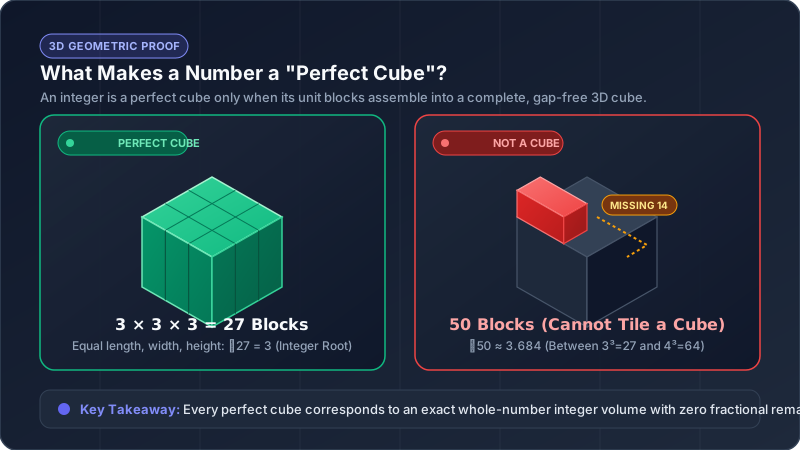
Beispielsweise ist 27 eine Kubikzahl, da 3 × 3 × 3 = 27 (also ∛27 = 3). Ebenso gilt 125 = 5³ und -64 = (-4)³. Dagegen ist 50 keine Kubikzahl, da ∛50 ≈ 3,684 ergibt.
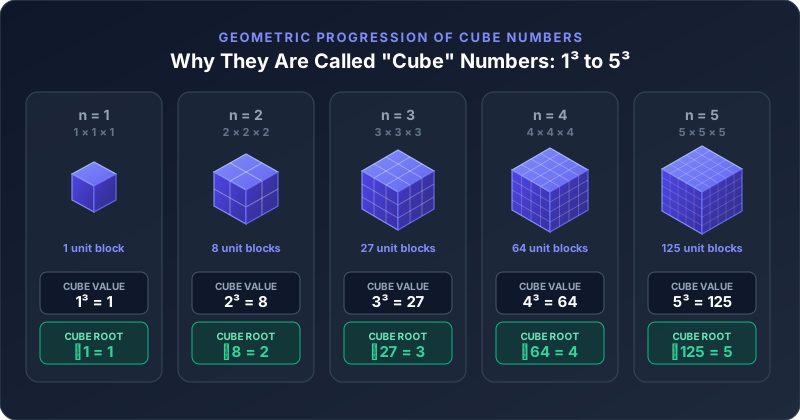
Der Begriff stammt aus der 3D-Geometrie: Aus 27 Einheitswürfeln lässt sich ein solider 3×3×3-Würfel lückenlos zusammensetzen.
Ungerade Potenzen behalten das Vorzeichen: (-3)³ = -27. Negative ganze Zahlen können echte reelle Kubikzahlen sein.
0 und 1 sind grundlegende Kubikzahlen: 0³ = 0 und 1³ = 1. Auch -1 ist eine Kubikzahl: (-1)³ = -1.
Der Kubus einer geraden Zahl ist immer gerade (2³=8, 4³=64), und einer ungeraden immer ungerade (3³=27, 5³=125).
In der Primfaktorzerlegung muss jeder Exponent ein ganzzahliges Vielfaches von 3 sein.
Mathematiker nutzen vier grundlegende Tests zur Überprüfung von Kubikzahlen:
Berechnen Sie ∛n. Ist das Ergebnis ohne Nachkommastellen, ist n eine Kubikzahl.
Zerlegen Sie in Primfaktoren. Wenn jeder Exponent durch 3 teilbar ist, liegt ein Kubus vor.
Da (-k)³ = -k³ gilt, ist eine negative Zahl -n ein Kubus, wenn |n| einer ist.
Die wiederholte Quersumme einer Kubikzahl ist stets 0, 1, 8 oder 9.
∛512 = 8 : 8 × 8 × 8 = 512. Prime factorization is 2⁹ with exponent 9 divisible by 3. Digital root: 5 + 1 + 2 = 8 (valid).
∛100 ≈ 4.642 : 100 sits strictly between 4³ = 64 and 5³ = 125. Prime factors are 2² × 5², neither exponent is divisible by 3.
∛(-216) = -6 : (-6) × (-6) × (-6) = 36 × (-6) = -216. Odd roots preserve negative signs, producing a valid real integer root.
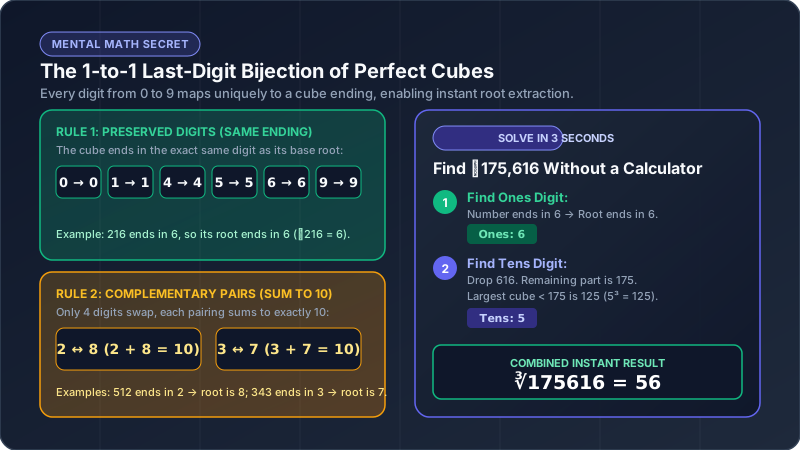
Unlike perfect squares (which can only end in 0, 1, 4, 5, 6, or 9), every digit from 0 to 9 can be the last digit of a perfect cube. In fact, there is a strict one-to-one bijection between the ones digit of a base integer and the ones digit of its cube:
| Base Last Digit (k) | Cube Calculation (k³ mod 10) | Cube Last Digit (k³) | Memory Rule |
|---|---|---|---|
| 0 | 0³ = 0 | 0 | Preserved (Same digit) |
| 1 | 1³ = 1 | 1 | Preserved (Same digit) |
| 2 | 2³ = 8 | 8 | Complements to 10 (2 + 8 = 10) |
| 3 | 3³ = 27 | 7 | Complements to 10 (3 + 7 = 10) |
| 4 | 4³ = 64 | 4 | Preserved (Same digit) |
| 5 | 5³ = 125 | 5 | Preserved (Same digit) |
| 6 | 6³ = 216 | 6 | Preserved (Same digit) |
| 7 | 7³ = 343 | 3 | Complements to 10 (7 + 3 = 10) |
| 8 | 8³ = 512 | 2 | Complements to 10 (8 + 2 = 10) |
| 9 | 9³ = 729 | 9 | Preserved (Same digit) |
To find the cube root of 175,616:
1. Ones Digit: The number ends in 6. Looking at our table, a cube ending in 6 must have a root ending in 6.
2. Tens Digit: Cross off the last three digits (616), leaving 175. The largest perfect cube below 175 is 125 (5³). So the tens digit is 5.
Result: ∛175616 = 56. Verified: 56 × 56 × 56 = 175,616!
Odd powers behave differently from even powers. Here is how special numeric sets are evaluated:
Yes. 0 is an integer, and 0 × 0 × 0 = 0 (0³ = 0). Its principal cube root is exactly 0.
Fully Real. Unlike square roots which require the imaginary unit i, odd roots preserve signs: (-k)³ = -k³. For example, ∛(-64) = -4.
A fraction is a cubic power if both its numerator and denominator are perfect cubes: 27/64 = (3/4)³.
Decimals are cubes if the significant digits form a cube and the number of decimal places is a multiple of 3: 0.027 = (0.3)³, 0.000125 = (0.05)³.
Comparing cubic numbers with square numbers? Test whether an integer is a perfect square →
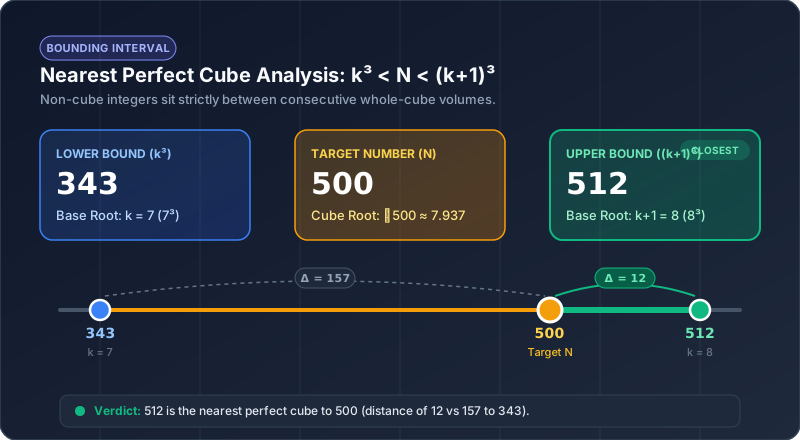
Jede Zahl, die keine Kubikzahl ist, liegt zwischen zwei aufeinanderfolgenden Kuben: k³ < n < (k + 1)³.
Für 500 liegen die begrenzenden Kuben bei 343 (7³) und 512 (8³). Der Abstand zu 512 beträgt nur 12, daher ist 512 der nächste Kubus.
| Target (N) | Cube Root (∛N) | Lower Cube (k³) | Upper Cube ((k+1)³) | Nearest Cube | Distance |
|---|---|---|---|---|---|
| 50 | 3,684 | 27 (3³) | 64 (4³) | 64 | 64 - 50 = 14 |
| 200 | 5,848 | 125 (5³) | 216 (6³) | 216 | 216 - 200 = 16 |
| 500 | 7,937 | 343 (7³) | 512 (8³) | 512 | 512 - 500 = 12 |
| 800 | 9,283 | 729 (9³) | 1000 (10³) | 729 | 800 - 729 = 71 |
When an integer is not a perfect cube, its root is an irrational decimal. Compute exact decimal cube roots with radical steps →
Between 1 and 1000 inclusive, there are exactly 10 perfect cubes:
| Base Root (k) | Formula (k × k × k) | Perfect Cube (k³) | Prime Factorization | ∛k³ |
|---|---|---|---|---|
| 1 | 1 × 1 × 1 | 1 | 1 | 1 |
| 2 | 2 × 2 × 2 | 8 | 2³ | 2 |
| 3 | 3 × 3 × 3 | 27 | 3³ | 3 |
| 4 | 4 × 4 × 4 | 64 | 2⁶ = (2²)³ | 4 |
| 5 | 5 × 5 × 5 | 125 | 5³ | 5 |
| 6 | 6 × 6 × 6 | 216 | 2³ × 3³ | 6 |
| 7 | 7 × 7 × 7 | 343 | 7³ | 7 |
| 8 | 8 × 8 × 8 | 512 | 2⁹ = (2³)³ | 8 |
| 9 | 9 × 9 × 9 | 729 | 3⁶ = (3²)³ | 9 |
| 10 | 10 × 10 × 10 | 1000 | 2³ × 5³ | 10 |
Between 1 and 10,000 inclusive, there are exactly 21 perfect cubes because 21³ = 9,261 and 22³ = 10,648.
| k | k³ | k | k³ | k | k³ |
|---|---|---|---|---|---|
| 1 | 1 | 8 | 512 | 15 | 3375 |
| 2 | 8 | 9 | 729 | 16 | 4096 |
| 3 | 27 | 10 | 1000 | 17 | 4913 |
| 4 | 64 | 11 | 1331 | 18 | 5832 |
| 5 | 125 | 12 | 1728 | 19 | 6859 |
| 6 | 216 | 13 | 2197 | 20 | 8000 |
| 7 | 343 | 14 | 2744 | 21 | 9261 |
Evaluating higher powers beyond the 3rd degree? Evaluate arbitrary nth degree radical roots →
Verify cube numbers automatically in Excel, Google Sheets, Python, and JavaScript:
=IF(ROUND(A2^(1/3), 0)^3 = A2, "Perfect Cube", "Not a Cube") def is_cube(n): return round(abs(n)**(1/3))**3 == abs(n) const isCube = n => Math.round(Math.cbrt(n))**3 === n; Terminology: Perfect Cube or Cube Number.
Terminology: Kubikzahlen (German) and Cubes parfaits (French).
Optimierung von Lagerbehältern, Frachtkisten und Transportcontainern.
Das Quadrat-Kubus-Gesetz für Oberflächen-Masse-Verhältnisse in Natur und Technik.
Volumetrische Voxel-Gitter in 3D-Engines und Spielen wie Minecraft.
Elliptische Kurven und analytische Zahlentheorie in der Informationssicherheit.
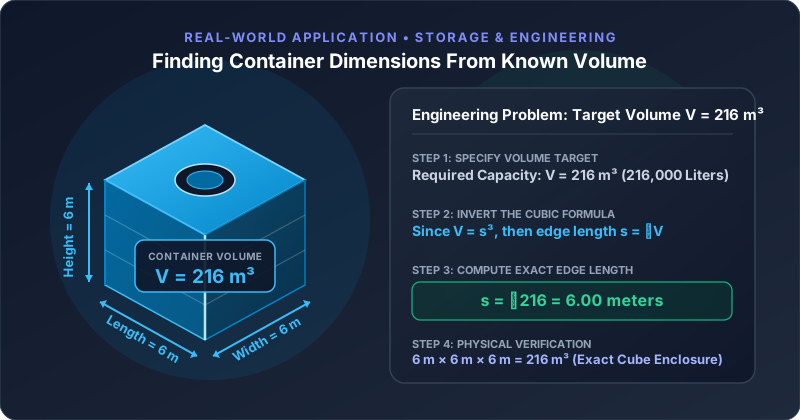
Cubing a number means multiplying it by itself three times (4³ = 4 × 4 × 4 = 64), not multiplying it by three (4 × 3 = 12).
Unlike square roots, odd roots preserve negative signs. Multiplying three negative numbers gives a negative product: (-5) × (-5) × (-5) = -125.
Every digit from 0 to 9 can end a perfect cube. You cannot eliminate a candidate by its last digit alone; you must use prime factors or modulo 9 digital roots.
In computers, computing 125^(1/3) frequently yields 4.999999999999999. Naively checking if int(125^(1/3)) == 5 can fail without proper rounding logic.
Eine ganze Zahl, die entsteht, wenn man eine Zahl dreimal mit sich selbst multipliziert. Beispiel: 27 ist eine Kubikzahl, da 3 × 3 × 3 = 27.
Ja! Das Produkt dreier negativer Zahlen ist negativ: (-4) × (-4) × (-4) = -64. Daher ist -64 eine Kubikzahl mit Wurzel -4.
Ja, 0 ist eine Kubikzahl, da 0 × 0 × 0 = 0 (0³ = 0).
Ja, wenn die Primexponenten Vielfache von 6 sind: 1, 64 (8² und 4³), 729 (27² und 9³) und 4096 (64² und 16³).
Ja, unser Kubikzahl-Rechner ist 100% kostenlos und ohne Einschränkungen nutzbar.

Erfüllt die Formel n = k × k × k mit ganzzahligem k.
Anders als Quadratwurzeln sind ungerade Wurzeln aus negativen Zahlen reell.
Jeder Primfaktor besitzt einen durch 3 teilbaren Exponenten.
Beliebig viele Zahlen mit sofortiger Rechenanalyse prüfen.