পূর্ণঘন ক্যালকুলেটর
একটি সংখ্যা পূর্ণঘন কিনা তা যাচাই করুন
দ্রুত পরীক্ষা
কোনো পূর্ণসংখ্যাকে ৩ বার নিজের সাথে গুণ করলে এটি সমান হয় কিনা তা পরীক্ষা করতে যেকোনো পূর্ণসংখ্যা লিখুন (k³ = n)।
একটি ধনাত্মক বা ঋণাত্মক সংখ্যা পূর্ণঘন কিনা তা যাচাই করুন। পূর্ণসংখ্যার মূল, মৌলিক ঘাত এবং সীমা দেখুন।
এই ৩টি সহজ ধাপ অনুসরণ করে যেকোনো সংখ্যার ঘনমূল পরীক্ষা করুন:
যেকোনো ধনাত্মক বা ঋণাত্মক পূর্ণসংখ্যা লিখুন, অথবা প্রিসেট বোতাম নির্বাচন করুন (-২৭, ২১৬, ১৩৩১...)।
ঘনমূল এবং মৌলিক উৎপাদক তাৎক্ষণিকভাবে গণনা করতে বোতাম চাপুন।
ফলাফল, ধাপে ধাপে উৎপাদক বিশ্লেষণ, নিকটতম ঘনসংখ্যা ও গুণক পর্যালোচনা করুন।
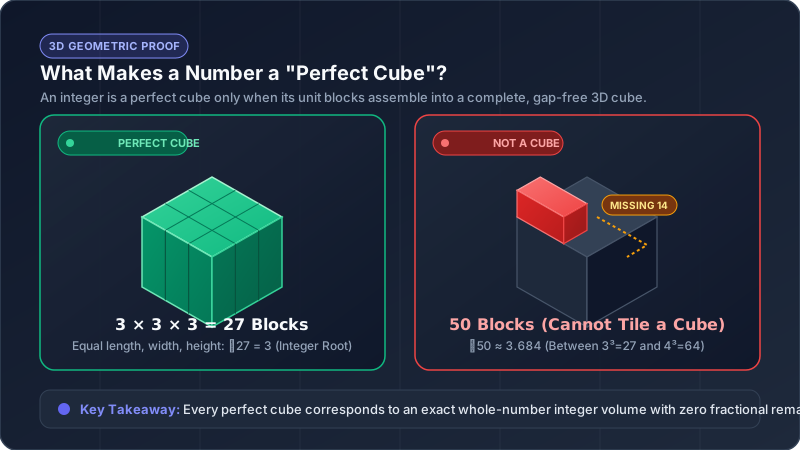
পূর্ণ ঘনসংখ্যা (Perfect Cube) হলো একটি পূর্ণসংখ্যা যা কোনো পূর্ণসংখ্যাকে নিজের সাথে দুইবার গুণ করে পাওয়া যায়: n = k × k × k = k³। সংখ্যা k-কে n-এর ঘনমূল বলা হয় (লেখা হয় ∛n)।
উদাহরণস্বরূপ, ২৭ একটি পূর্ণ ঘনসংখ্যা কারণ ৩ × ৩ × ৩ = ২৭ (সুতরাং ∛২৭ = ৩)। একইভাবে, ১২৫ = ৫³ এবং -৬৪ = (-৪)³। তবে ৫০ পূর্ণ ঘনসংখ্যা নয় কারণ ∛৫০ ≈ ৩.৬৮৪।
এই শব্দটি 3D জ্যামিতি থেকে এসেছে: ২৭টি একক ব্লক দিয়ে আপনি কোনো ফাঁকা জায়গা ছাড়া ৩×৩×৩ পরিমাপের একটি নিরেট ঘনক তৈরি করতে পারেন।
বিজোড় ঘাত চিহ্ন বজায় রাখে: (-৩)³ = -২৭। ঋণাত্মক পূর্ণসংখ্যাও বাস্তব পূর্ণ ঘনসংখ্যা হতে পারে।
০ এবং ১ প্রাথমিক ঘনসংখ্যা: ০³ = ০ এবং ১³ = ১। -১-ও একটি ঘনসংখ্যা: (-১)³ = -১।
জোড় সংখ্যার ঘন সর্বদা জোড় (২³=৮, ৪³=৬৪), এবং বিজোড় সংখ্যার ঘন সর্বদা বিজোড় (৩³=২৭, ৫³=১২৫)।
মৌলিক উৎপাদকে বিশ্লেষণে প্রতিটি মৌলিক সংখ্যার ঘাত অবশ্যই ৩-এর গুণিতক হতে হবে।
গণিতবিদরা পূর্ণ ঘনসংখ্যা নিশ্চিত করতে চারটি প্রধান পরীক্ষা ব্যবহার করেন:
∛n নির্ণয় করুন। মূলে কোনো দশমিক না থাকলে n একটি পূর্ণ ঘনসংখ্যা।
মৌলিক উৎপাদকে বিশ্লেষণ করুন। সব ঘাত ৩ দিয়ে ভাগ হলে এটি পূর্ণ ঘনসংখ্যা।
যেহেতু (-k)³ = -k³, ঋণাত্মক সংখ্যা -n ঘনসংখ্যা যদি |n| ঘনসংখ্যা হয়।
অঙ্কগুলোর পুনরাবৃত্ত যোগফল ঘনসংখ্যার ক্ষেত্রে সর্বদা ০, ১, ৮ বা ৯ হয়।
∛512 = 8 : 8 × 8 × 8 = 512. Prime factorization is 2⁹ with exponent 9 divisible by 3. Digital root: 5 + 1 + 2 = 8 (valid).
∛100 ≈ 4.642 : 100 sits strictly between 4³ = 64 and 5³ = 125. Prime factors are 2² × 5², neither exponent is divisible by 3.
∛(-216) = -6 : (-6) × (-6) × (-6) = 36 × (-6) = -216. Odd roots preserve negative signs, producing a valid real integer root.
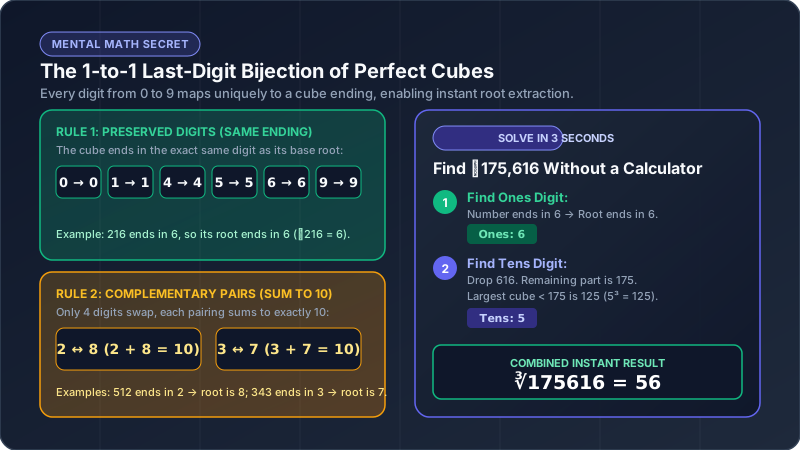
Unlike perfect squares (which can only end in 0, 1, 4, 5, 6, or 9), every digit from 0 to 9 can be the last digit of a perfect cube. In fact, there is a strict one-to-one bijection between the ones digit of a base integer and the ones digit of its cube:
| Base Last Digit (k) | Cube Calculation (k³ mod 10) | Cube Last Digit (k³) | Memory Rule |
|---|---|---|---|
| 0 | 0³ = 0 | 0 | Preserved (Same digit) |
| 1 | 1³ = 1 | 1 | Preserved (Same digit) |
| 2 | 2³ = 8 | 8 | Complements to 10 (2 + 8 = 10) |
| 3 | 3³ = 27 | 7 | Complements to 10 (3 + 7 = 10) |
| 4 | 4³ = 64 | 4 | Preserved (Same digit) |
| 5 | 5³ = 125 | 5 | Preserved (Same digit) |
| 6 | 6³ = 216 | 6 | Preserved (Same digit) |
| 7 | 7³ = 343 | 3 | Complements to 10 (7 + 3 = 10) |
| 8 | 8³ = 512 | 2 | Complements to 10 (8 + 2 = 10) |
| 9 | 9³ = 729 | 9 | Preserved (Same digit) |
To find the cube root of 175,616:
1. Ones Digit: The number ends in 6. Looking at our table, a cube ending in 6 must have a root ending in 6.
2. Tens Digit: Cross off the last three digits (616), leaving 175. The largest perfect cube below 175 is 125 (5³). So the tens digit is 5.
Result: ∛175616 = 56. Verified: 56 × 56 × 56 = 175,616!
Odd powers behave differently from even powers. Here is how special numeric sets are evaluated:
Yes. 0 is an integer, and 0 × 0 × 0 = 0 (0³ = 0). Its principal cube root is exactly 0.
Fully Real. Unlike square roots which require the imaginary unit i, odd roots preserve signs: (-k)³ = -k³. For example, ∛(-64) = -4.
A fraction is a cubic power if both its numerator and denominator are perfect cubes: 27/64 = (3/4)³.
Decimals are cubes if the significant digits form a cube and the number of decimal places is a multiple of 3: 0.027 = (0.3)³, 0.000125 = (0.05)³.
Comparing cubic numbers with square numbers? Test whether an integer is a perfect square →
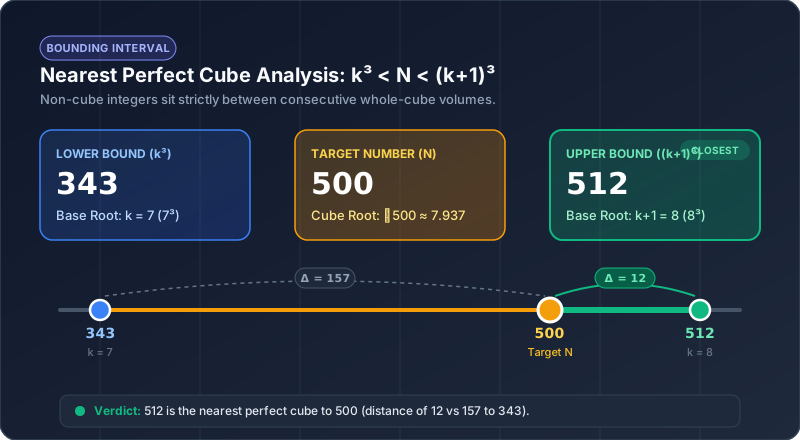
প্রতিটি অ-ঘনসংখ্যা দুটি ক্রমিক ঘনসংখ্যার মাঝে অবস্থান করে: k³ < n < (k + 1)³।
৫০০-এর জন্য নিকটতম ঘনসংখ্যা হলো ৩৪৩ (৭³) এবং ৫১২ (৮³)। ৫১২-এর সাথে ব্যবধান মাত্র ১২, তাই ৫১২ নিকটতম ঘনসংখ্যা।
| Target (N) | Cube Root (∛N) | Lower Cube (k³) | Upper Cube ((k+1)³) | Nearest Cube | Distance |
|---|---|---|---|---|---|
| 50 | 3.684 | 27 (3³) | 64 (4³) | 64 | 64 - 50 = 14 |
| 200 | 5.848 | 125 (5³) | 216 (6³) | 216 | 216 - 200 = 16 |
| 500 | 7.937 | 343 (7³) | 512 (8³) | 512 | 512 - 500 = 12 |
| 800 | 9.283 | 729 (9³) | 1000 (10³) | 729 | 800 - 729 = 71 |
When an integer is not a perfect cube, its root is an irrational decimal. Compute exact decimal cube roots with radical steps →
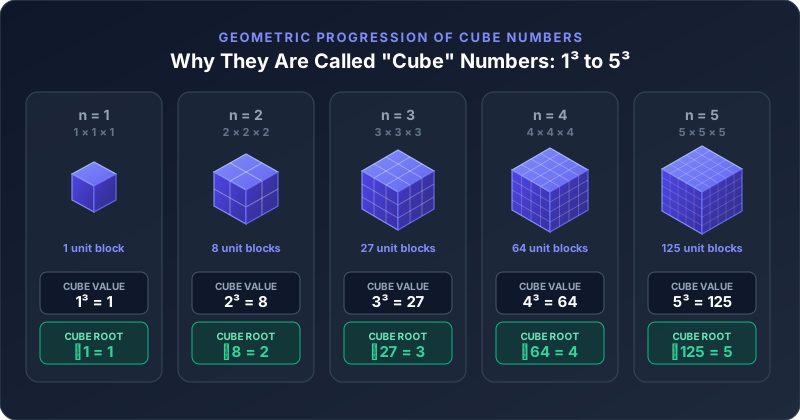
Between 1 and 1000 inclusive, there are exactly 10 perfect cubes:
| Base Root (k) | Formula (k × k × k) | Perfect Cube (k³) | Prime Factorization | ∛k³ |
|---|---|---|---|---|
| 1 | 1 × 1 × 1 | 1 | 1 | 1 |
| 2 | 2 × 2 × 2 | 8 | 2³ | 2 |
| 3 | 3 × 3 × 3 | 27 | 3³ | 3 |
| 4 | 4 × 4 × 4 | 64 | 2⁶ = (2²)³ | 4 |
| 5 | 5 × 5 × 5 | 125 | 5³ | 5 |
| 6 | 6 × 6 × 6 | 216 | 2³ × 3³ | 6 |
| 7 | 7 × 7 × 7 | 343 | 7³ | 7 |
| 8 | 8 × 8 × 8 | 512 | 2⁹ = (2³)³ | 8 |
| 9 | 9 × 9 × 9 | 729 | 3⁶ = (3²)³ | 9 |
| 10 | 10 × 10 × 10 | 1000 | 2³ × 5³ | 10 |
Between 1 and 10,000 inclusive, there are exactly 21 perfect cubes because 21³ = 9,261 and 22³ = 10,648.
| k | k³ | k | k³ | k | k³ |
|---|---|---|---|---|---|
| 1 | 1 | 8 | 512 | 15 | 3375 |
| 2 | 8 | 9 | 729 | 16 | 4096 |
| 3 | 27 | 10 | 1000 | 17 | 4913 |
| 4 | 64 | 11 | 1331 | 18 | 5832 |
| 5 | 125 | 12 | 1728 | 19 | 6859 |
| 6 | 216 | 13 | 2197 | 20 | 8000 |
| 7 | 343 | 14 | 2744 | 21 | 9261 |
Evaluating higher powers beyond the 3rd degree? Evaluate arbitrary nth degree radical roots →
Verify cube numbers automatically in Excel, Google Sheets, Python, and JavaScript:
=IF(ROUND(A2^(1/3), 0)^3 = A2, "Perfect Cube", "Not a Cube") def is_cube(n): return round(abs(n)**(1/3))**3 == abs(n) const isCube = n => Math.round(Math.cbrt(n))**3 === n; Terminology: Perfect Cube or Cube Number.
Terminology: Kubikzahlen (German) and Cubes parfaits (French).
কার্গো কন্টেইনার, স্টোরেজ ট্যাংক এবং বাক্সের ত্রিমাত্রিক প্যাকিং।
পৃষ্ঠতলের ক্ষেত্রফল এবং ভরের অনুপাত নিয়ন্ত্রণকারী বর্গ-ঘন সূত্র।
মাইনক্রাফটের মতো গেম ইঞ্জিনে ভক্সেল ভিত্তিক ত্রিমাত্রিক মডেলিং।
সাইবার সুরক্ষায় উপবৃত্তাকার বক্ররেখা এবং সংখ্যাতত্ত্বের ব্যবহার।
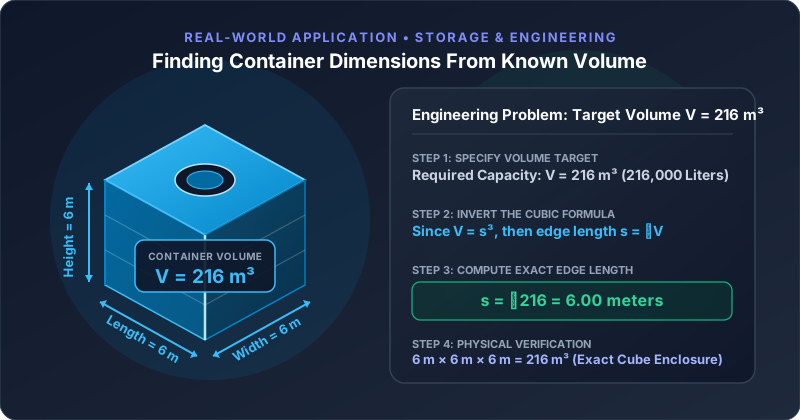
Cubing a number means multiplying it by itself three times (4³ = 4 × 4 × 4 = 64), not multiplying it by three (4 × 3 = 12).
Unlike square roots, odd roots preserve negative signs. Multiplying three negative numbers gives a negative product: (-5) × (-5) × (-5) = -125.
Every digit from 0 to 9 can end a perfect cube. You cannot eliminate a candidate by its last digit alone; you must use prime factors or modulo 9 digital roots.
In computers, computing 125^(1/3) frequently yields 4.999999999999999. Naively checking if int(125^(1/3)) == 5 can fail without proper rounding logic.
কোনো পূর্ণসংখ্যাকে তিনবার নিজের সাথে গুণ করলে যে সংখ্যা পাওয়া যায়। যেমন ২৭, কারণ ৩ × ৩ × ৩ = ২৭।
হ্যাঁ! তিনটি ঋণাত্মক সংখ্যার গুণফল ঋণাত্মক: (-৪) × (-৪) × (-৪) = -৬৪। সুতরাং -৬৪ একটি পূর্ণ ঘনসংখ্যা যার মূল -৪।
হ্যাঁ, ০ একটি পূর্ণ ঘনসংখ্যা কারণ ০ × ০ × ০ = ০ (০³ = ০)।
হ্যাঁ, যাদের মৌলিক ঘাত ৬-এর গুণিতক: ১, ৬৪ (৮² এবং ৪³), ৭২৯ (২৭² এবং ৯³) এবং ৪০৯৬ (৬৪² এবং ১৬³)।
হ্যাঁ, আমাদের পূর্ণ ঘন ক্যালকুলেটর সম্পূর্ণ বিনামূল্যে সীমাহীন ব্যবহারের সুবিধা দেয়।

n = k × k × k সম্পর্ক পূরণ করে যেখানে k একটি পূর্ণসংখ্যা।
বর্গমূলের বিপরীতভাবে, ঋণাত্মক সংখ্যার ঘনমূল বাস্তব সংখ্যা।
প্রতিটি মৌলিক উৎপাদকের ঘাত অবশ্যই ৩ দ্বারা বিভাজ্য হতে হবে।
ধাপে ধাপে সমাধানসহ সীমাহীন সংখ্যা তাৎক্ষণিকভাবে যাচাই করুন।