Tam Küp Hesaplayıcı
Bir sayının tam küp olup olmadığını kontrol edin
Hızlı test
Bir tam sayının 3 kez kendisiyle çarpımına eşit olup olmadığını kontrol etmek için pozitif veya negatif bir tam sayı girin (k³ = n).
Pozitif veya negatif bir sayının tam küp olup olmadığını kontrol edin. Kökler, asal kuvvetler ve sınırlar.
Şu 3 basit adımı izleyerek herhangi bir sayıyı saniyeler içinde test edin:
Pozitif veya negatif bir tam sayı yazın ya da hazır bir butona tıklayın (-27, 216, 1331...).
Küpkökü ve asal çarpanları hesaplamak için butona veya Enter'a basın.
Sonucu, adım adım çarpanları, çevreleyen küpleri ve cebirsel çarpanı keşfedin.
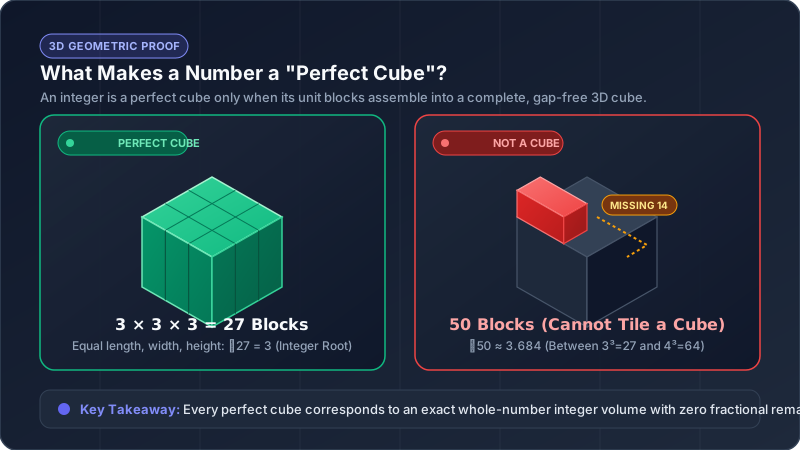
Tam küp, bir tam sayının kendisiyle iki kez çarpılmasıyla elde edilen tam sayıdır: n = k × k × k = k³. k sayısına n'nin küpkökü denir (∛n olarak yazılır).
Örneğin, 27 tam küptür çünkü 3 × 3 × 3 = 27'dir (yani ∛27 = 3). Benzer şekilde 125 = 5³ ve -64 = (-4)³'tür. Ancak 50 tam küp değildir çünkü ∛50 ≈ 3,684'tür.
Bu terim 3B geometriden gelir: 27 birim küp ile boşluksuz ve tam bir 3×3×3 katı küp inşa edebilirsiniz.
Tek kuvvetler işareti korur: (-3)³ = -27. Negatif sayılar gerçek tam küpler olabilir.
0 ve 1 temel tam küplerdir: 0³ = 0 ve 1³ = 1. -1 de bir tam küptür: (-1)³ = -1.
Çift sayının küpü daima çift (2³=8, 4³=64), tek sayının küpü daima tektir (3³=27, 5³=125).
Asal çarpanlara ayırmada her asal çarpanın üssü mutlaka 3'ün katı olmalıdır.
Matematikçiler tam küpleri doğrulamak için dört temel testten yararlanır:
∛n değerini hesaplayın. Kökün ondalık kısmı yoksa n bir tam küptür.
Asal çarpanlara ayırın. Her üs 3'e bölünüyorsa sayı bir tam küptür.
(-k)³ = -k³ olduğundan, negatif -n sayısı |n| küpse küptür.
Basamakların toplamı bir küp için daima 0, 1, 8 veya 9 olur.
∛512 = 8 : 8 × 8 × 8 = 512. Prime factorization is 2⁹ with exponent 9 divisible by 3. Digital root: 5 + 1 + 2 = 8 (valid).
∛100 ≈ 4.642 : 100 sits strictly between 4³ = 64 and 5³ = 125. Prime factors are 2² × 5², neither exponent is divisible by 3.
∛(-216) = -6 : (-6) × (-6) × (-6) = 36 × (-6) = -216. Odd roots preserve negative signs, producing a valid real integer root.
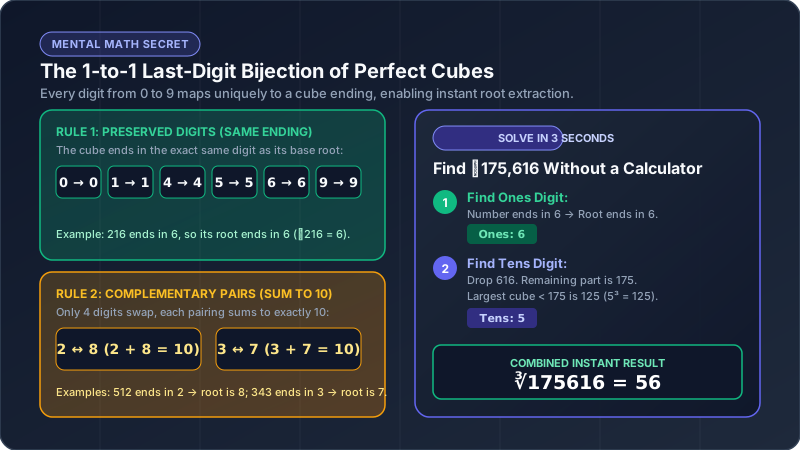
Unlike perfect squares (which can only end in 0, 1, 4, 5, 6, or 9), every digit from 0 to 9 can be the last digit of a perfect cube. In fact, there is a strict one-to-one bijection between the ones digit of a base integer and the ones digit of its cube:
| Base Last Digit (k) | Cube Calculation (k³ mod 10) | Cube Last Digit (k³) | Memory Rule |
|---|---|---|---|
| 0 | 0³ = 0 | 0 | Preserved (Same digit) |
| 1 | 1³ = 1 | 1 | Preserved (Same digit) |
| 2 | 2³ = 8 | 8 | Complements to 10 (2 + 8 = 10) |
| 3 | 3³ = 27 | 7 | Complements to 10 (3 + 7 = 10) |
| 4 | 4³ = 64 | 4 | Preserved (Same digit) |
| 5 | 5³ = 125 | 5 | Preserved (Same digit) |
| 6 | 6³ = 216 | 6 | Preserved (Same digit) |
| 7 | 7³ = 343 | 3 | Complements to 10 (7 + 3 = 10) |
| 8 | 8³ = 512 | 2 | Complements to 10 (8 + 2 = 10) |
| 9 | 9³ = 729 | 9 | Preserved (Same digit) |
To find the cube root of 175,616:
1. Ones Digit: The number ends in 6. Looking at our table, a cube ending in 6 must have a root ending in 6.
2. Tens Digit: Cross off the last three digits (616), leaving 175. The largest perfect cube below 175 is 125 (5³). So the tens digit is 5.
Result: ∛175616 = 56. Verified: 56 × 56 × 56 = 175,616!
Odd powers behave differently from even powers. Here is how special numeric sets are evaluated:
Yes. 0 is an integer, and 0 × 0 × 0 = 0 (0³ = 0). Its principal cube root is exactly 0.
Fully Real. Unlike square roots which require the imaginary unit i, odd roots preserve signs: (-k)³ = -k³. For example, ∛(-64) = -4.
A fraction is a cubic power if both its numerator and denominator are perfect cubes: 27/64 = (3/4)³.
Decimals are cubes if the significant digits form a cube and the number of decimal places is a multiple of 3: 0.027 = (0.3)³, 0.000125 = (0.05)³.
Comparing cubic numbers with square numbers? Test whether an integer is a perfect square →
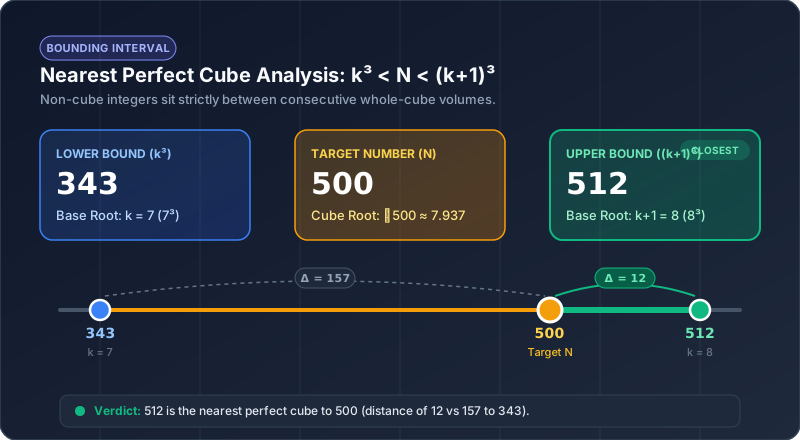
Tam küp olmayan her sayı ardışık iki küp arasındadır: k³ < n < (k + 1)³.
500 için sınır küpler 343 (7³) ve 512 (8³)'dir. 512'ye olan fark yalnızca 12 olduğundan en yakın küp 512'dir.
| Target (N) | Cube Root (∛N) | Lower Cube (k³) | Upper Cube ((k+1)³) | Nearest Cube | Distance |
|---|---|---|---|---|---|
| 50 | 3.684 | 27 (3³) | 64 (4³) | 64 | 64 - 50 = 14 |
| 200 | 5.848 | 125 (5³) | 216 (6³) | 216 | 216 - 200 = 16 |
| 500 | 7.937 | 343 (7³) | 512 (8³) | 512 | 512 - 500 = 12 |
| 800 | 9.283 | 729 (9³) | 1000 (10³) | 729 | 800 - 729 = 71 |
When an integer is not a perfect cube, its root is an irrational decimal. Compute exact decimal cube roots with radical steps →
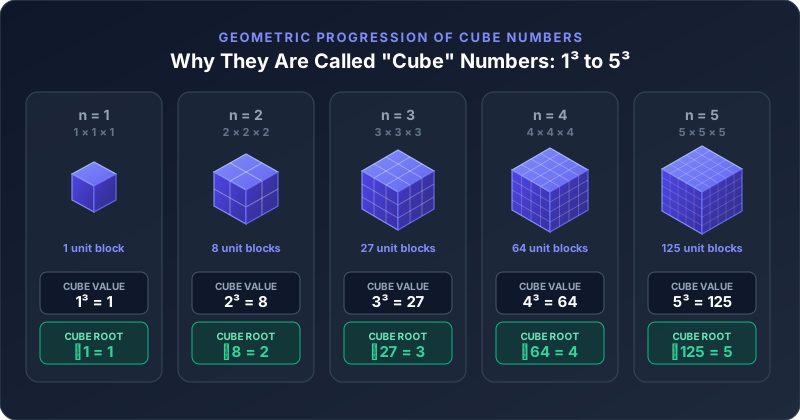
Between 1 and 1000 inclusive, there are exactly 10 perfect cubes:
| Base Root (k) | Formula (k × k × k) | Perfect Cube (k³) | Prime Factorization | ∛k³ |
|---|---|---|---|---|
| 1 | 1 × 1 × 1 | 1 | 1 | 1 |
| 2 | 2 × 2 × 2 | 8 | 2³ | 2 |
| 3 | 3 × 3 × 3 | 27 | 3³ | 3 |
| 4 | 4 × 4 × 4 | 64 | 2⁶ = (2²)³ | 4 |
| 5 | 5 × 5 × 5 | 125 | 5³ | 5 |
| 6 | 6 × 6 × 6 | 216 | 2³ × 3³ | 6 |
| 7 | 7 × 7 × 7 | 343 | 7³ | 7 |
| 8 | 8 × 8 × 8 | 512 | 2⁹ = (2³)³ | 8 |
| 9 | 9 × 9 × 9 | 729 | 3⁶ = (3²)³ | 9 |
| 10 | 10 × 10 × 10 | 1000 | 2³ × 5³ | 10 |
Between 1 and 10,000 inclusive, there are exactly 21 perfect cubes because 21³ = 9,261 and 22³ = 10,648.
| k | k³ | k | k³ | k | k³ |
|---|---|---|---|---|---|
| 1 | 1 | 8 | 512 | 15 | 3375 |
| 2 | 8 | 9 | 729 | 16 | 4096 |
| 3 | 27 | 10 | 1000 | 17 | 4913 |
| 4 | 64 | 11 | 1331 | 18 | 5832 |
| 5 | 125 | 12 | 1728 | 19 | 6859 |
| 6 | 216 | 13 | 2197 | 20 | 8000 |
| 7 | 343 | 14 | 2744 | 21 | 9261 |
Evaluating higher powers beyond the 3rd degree? Evaluate arbitrary nth degree radical roots →
Verify cube numbers automatically in Excel, Google Sheets, Python, and JavaScript:
=IF(ROUND(A2^(1/3), 0)^3 = A2, "Perfect Cube", "Not a Cube") def is_cube(n): return round(abs(n)**(1/3))**3 == abs(n) const isCube = n => Math.round(Math.cbrt(n))**3 === n; Terminology: Perfect Cube or Cube Number.
Terminology: Kubikzahlen (German) and Cubes parfaits (French).
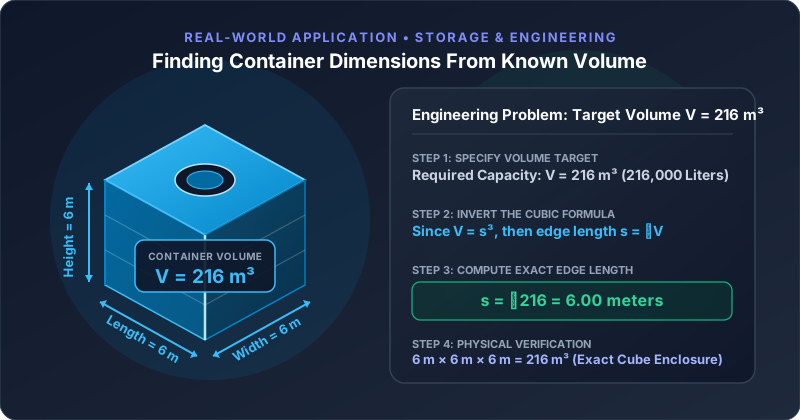
3B kargo taşımacılığında konteyner yerleşimi ve depo kutu ölçüleri.
Canlılarda yüzey alanı-kütle oranını yöneten kare-küp yasası.
Minecraft benzeri oyun motorlarında voksel tabanlı hacim modelleme.
Siber güvenlikte eliptik eğri şifreleme ve analitik sayılar teorisi.
Cubing a number means multiplying it by itself three times (4³ = 4 × 4 × 4 = 64), not multiplying it by three (4 × 3 = 12).
Unlike square roots, odd roots preserve negative signs. Multiplying three negative numbers gives a negative product: (-5) × (-5) × (-5) = -125.
Every digit from 0 to 9 can end a perfect cube. You cannot eliminate a candidate by its last digit alone; you must use prime factors or modulo 9 digital roots.
In computers, computing 125^(1/3) frequently yields 4.999999999999999. Naively checking if int(125^(1/3)) == 5 can fail without proper rounding logic.
Bir tam sayının kendisiyle üç kez çarpılmasıyla oluşan sayıdır. Örneğin 27 bir tam küptür çünkü 3 × 3 × 3 = 27'dir.
Evet! Üç negatif sayının çarpımı negatiftir: (-4) × (-4) × (-4) = -64. Bu nedenle -64, kökü -4 olan bir tam küptür.
Evet, 0 bir tam küptür çünkü 0 × 0 × 0 = 0'dır (0³ = 0).
Evet, asal üsleri 6'nın katı olan sayılar: 1, 64 (8² ve 4³), 729 (27² ve 9³) ve 4096 (64² ve 16³).
Evet, tam küp hesaplayıcımız tamamen ücretsizdir ve sınırsız sorgulama imkanı sunar.

k tam sayı olmak üzere n = k × k × k kuralını sağlar.
Kareköklerin aksine, negatif sayıların tek dereceli kökleri gerçektir.
Her asal çarpanın üssü 3'e bölünebilmelidir.
Adım adım ispatlarla sınırsız sayıda sayıyı hemen kontrol edin.