Racine Cubique Calculator

Calculate the cube root of any number — positive or negative — instantly. Get the exact decimal result, simplified radical form, and step-by-step workings. 100% free.

Instant Step-by-step 100% Free

Cube Root Calculator

Find ∛x for any number, including negatives

Enter any number — positive or negative — to find its cube root. Unlike square roots, cube roots work with negative numbers too.

Your result will appear here

Enter a number above and press Calculate

Recent calculations

Complete Guide

What Is Racine Cubique (Cube Root)?

Racine cubique is the French word for cube root, and just like its cousin "racine carrée," it's a term people search in English all the time. If you landed here looking for a fast answer, the racine cubique calculator above will give you one instantly. Everything below explains what a cube root actually is, how to find one by hand, and where it shows up outside the classroom.

A cube root is a number that, when multiplied by itself three times, gives you another number. Multiply 3 by itself three times — 3 × 3 × 3 — and you get 27. So we say the cube root of 27 is 3.

∛8 = 2because 2 × 2 × 2 = 8
∛64 = 4because 4 × 4 × 4 = 64
∛1000 = 10because 10 × 10 × 10 = 1,000

That's the entire idea. Everything else on this page just builds on it.
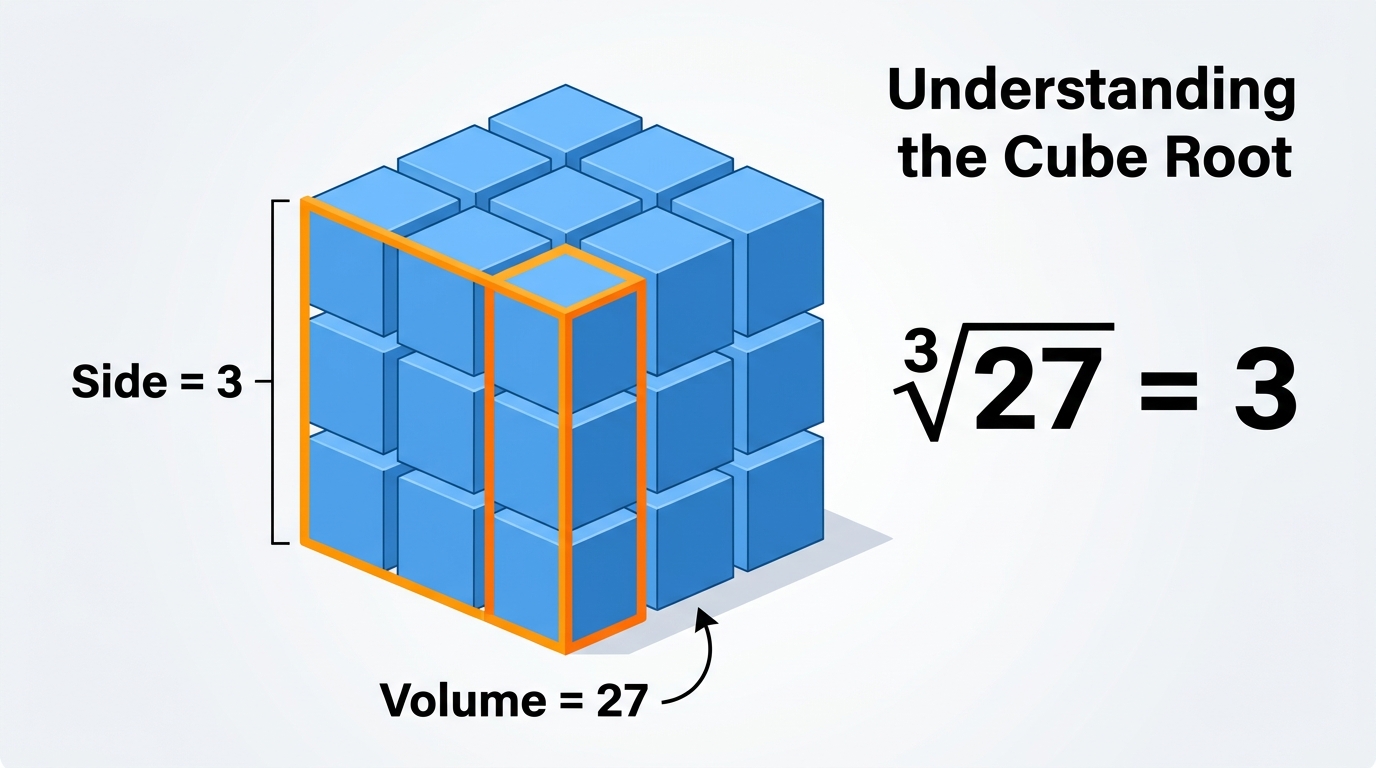
Cube root 3D geometry diagram: 27 block cube demonstrating that the cube root of 27 is 3 (∛27 = 3)
Visualizing a cube root: Finding the side length of a 3D cube from its volume
How To Use

How to Use the Racine Cubique Calculator

1

Type Your Number

Type your number into the box above.

2

Click Calculate

Hit the Calculate button to process your number.

3

Read Your Result

The calculator shows the cube root instantly, including a simplified form when one's available and correct handling of negative numbers.

No formulas needed to use the tool itself. The rest of this guide is for anyone who wants to understand what's happening behind that one click.

Notation

Cube Root Notation: What Does the ∛ Symbol Mean?

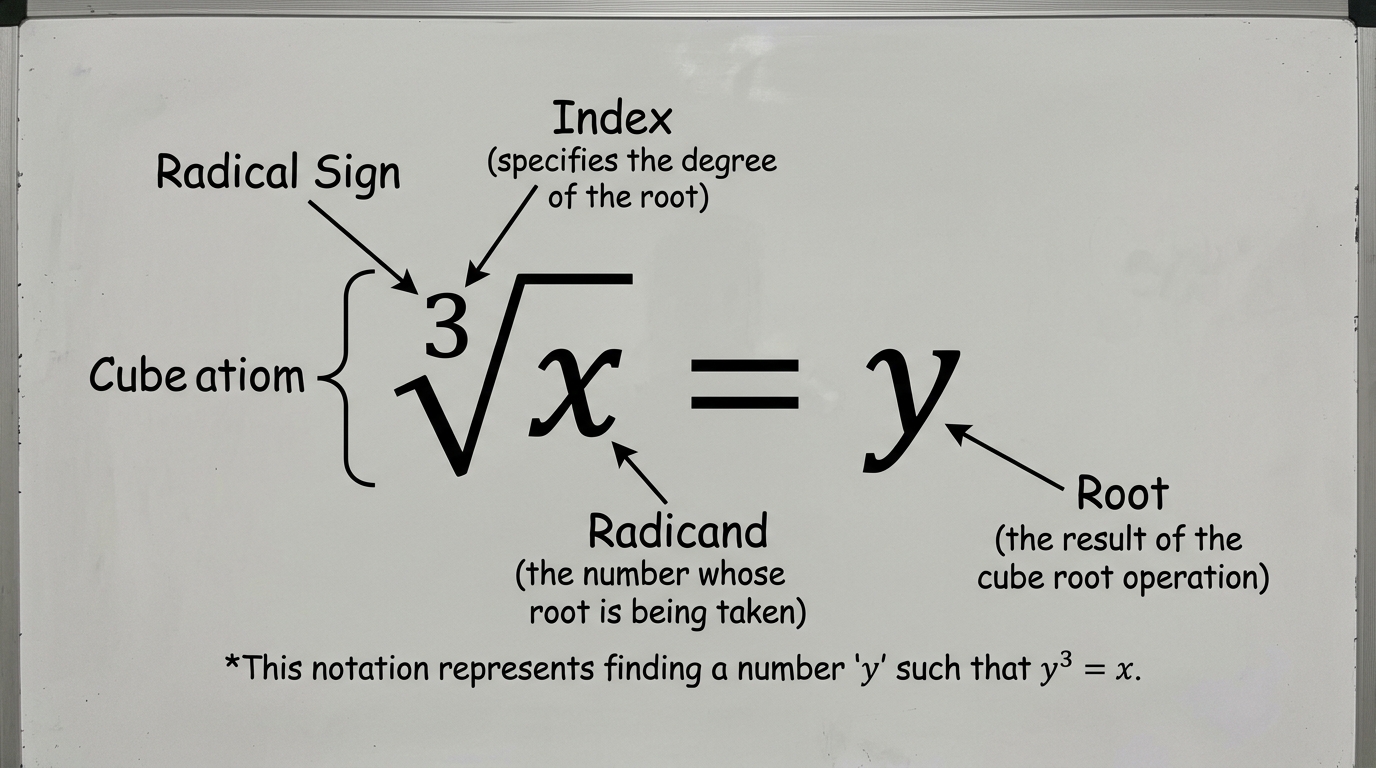
The symbol is the cube root sign. It's built from the same radical symbol used for square roots, but with a small "3" (called the index) tucked into the notch.

∛27"the cube root of 27"
27 = radicandThe number inside the symbol
3 = indexHow many times to multiply

You'll also see cube roots written as a fractional exponent:

x^(1/3) = ∛x

Both forms mean the same thing — the exponent version is often used in calculators, spreadsheets, and programming because the ∛ symbol isn't always easy to type.

Racine cubique radical notation diagram labeling index 3, radical symbol, radicand x, and root y in ∛x = y
The anatomy of a cube root expression and its mathematical terms
Formula

What Is the Formula for Cube Roots?

Like square roots, there's no single plug-and-play formula — a cube root is defined by a relationship:

If x = ∛y, then x × x × x = y (or x³ = y)

In plain words: whatever answer you get, multiplying it by itself three times has to bring you back to your starting number.

Core Laws

The Five Core Laws of Cube Roots

These five rules mirror the square root laws you may already know — but adapted for the third degree. Once you master them, the nth root calculator generalizes the same patterns even further.

1
Product Rule
Split products inside radicals
∛(a × b) = ∛a × ∛b

Example: ∛8 × ∛27 = 2 × 3 = 6, and ∛(8×27) = ∛216 = 6. Same answer.

Just like with square roots (racine carrée), you can break a complicated cube root into simpler pieces. Instead of computing ∛216 directly, factor it as 8 × 27, compute each cube root separately, and multiply. This is the go-to technique for simplifying expressions like ∛(24) = ∛(8×3) = 2∛3.

2
Quotient Rule
Split quotients inside radicals
∛(a ÷ b) = ∛a ÷ ∛b

Example: ∛64 ÷ ∛8 = 4 ÷ 2 = 2, and ∛(64÷8) = ∛8 = 2.

The mirror of the product rule — take the cube root of a fraction by rooting the numerator and denominator separately. Particularly useful when simplifying algebraic expressions like ∛(125/8) = ∛125 ÷ ∛8 = 5/2.

3
Power Rule
Cubing and cube root cancel each other
∛(a³) = a

Example: ∛(5³) = ∛125 = 5. Cubing and cube-rooting undo each other.

Unlike square roots, which only return non-negative values, the power rule for cube roots works for all real numbers — positive, negative, and zero. ∛((-3)³) = ∛(-27) = -3. This is a key difference from the racine carrée (which needs absolute value for negatives).

4
Self-Cube Rule
Cubing a cube root returns the radicand
(∛a)³ = a

Example: (∛5)³ = 5. (∛12)³ = 12. It always works.

This is the definition of cube root stated in reverse. If ∛a is "the number that, when cubed, gives a," then cubing ∛a must give you a back. This identity is used to rationalize cube-root denominators and appears in solving cubic equations.

5
Identity Values
The cube roots of 0 and 1 never change
∛1 = 1  and  ∛0 = 0

Example: No matter the context, ∛1 is always 1 and ∛0 is always 0.

These are the fixed points of the cube root function. ∛1 = 1 because 1³ = 1, and ∛0 = 0 because 0³ = 0. They serve as boundary conditions in proofs and as sanity checks for formulas — plug in 0 or 1, and you should always get a sensible answer.

Methods

How to Calculate Racine Cubique — Different Methods

1. Using This Racine Cubique Calculator (Fastest)

Type in your number, click Calculate, done. This is the method most people reach for once they know it exists — especially for decimals or large numbers where hand methods get slow. You can also use our square root calculator for second-degree roots or the nth root calculator for any custom degree.

2. Prime Factorization Method (Best for Perfect Cubes)

This method breaks a number into its prime factors and groups them in sets of three.

Example: Find ∛216
  • Step 1 — Break 216 into prime factors: 216 = 2 × 2 × 2 × 3 × 3 × 3
  • Step 2 — Group into sets of three: (2 × 2 × 2) × (3 × 3 × 3)
  • Step 3 — Take one number from each group: 2 × 3 = 6
  • So ∛216 = 6.

3. Newton-Raphson Method (Best for Precision)

This is an approximation method used by computers and scientific calculators to home in on a very precise decimal answer through repeated refinement.

4. Estimation Method (Fastest by Hand)

Example: Estimate ∛50
  • 3³ = 27
  • 4³ = 64
  • Since 50 is between 27 and 64, ∛50 is between 3 and 4 — closer to 4.
  • The real answer is about 3.68, so this trick gets you close fast.
Positive Numbers

Cube Roots of Positive Numbers

Every positive number has exactly one real cube root, and it's always positive.

NumberCube RootWhy
822 × 2 × 2 = 8
12555 × 5 × 5 = 125
51288 × 8 × 8 = 512
10≈2.154Not a whole number, but still a real, exact value

Unlike square roots, cube roots don't have a "second" answer to worry about — there's only one real cube root for any given number.

Negative Numbers

Cube Roots of Negative Numbers (Why They're Real — Unlike Square Roots)

Here's the single most important thing that separates cube roots from square roots: you can take the cube root of a negative number, and the answer is a normal, real number.

Why does this work when it doesn't for square roots? Because multiplying three negative numbers together gives you a negative result: negative × negative = positive, then positive × negative = negative.

Example: ∛(−64)
  • ∛(−64) = −4, because (−4) × (−4) × (−4) = −64

That's the full answer. No "i," no imaginary unit, nothing extra needed.

Key Difference from Square Roots

Square roots of negative numbers require the imaginary unit i, but cube roots handle negatives just fine on their own. This is genuinely useful to know if you've also looked at our Racine Carrée Calculator.

Comparison

Difference Between Racine Cubique and Racine Carrée

Cube RootSquare Root
Symbol
Multiplications3 (x × x × x)2 (x × x)
Example∛64 = 4 (4×4×4=64)√64 = 8 (8×8=64)
Negative numbersReal answer exists (∛-64 = -4)No real answer (needs "i")

If you need a square root specifically, our Racine Carrée Calculator covers that in full, including the imaginary number rules.

Applications

Real-Life Applications of Racine Cubique

While square roots (racine carrée) deal with two-dimensional problems, cube roots shine whenever the problem involves three dimensions:

Architecture & 3D Design

Architects and designers use cube roots to find the edge length of cubic spaces from a known volume. If a client wants a 64 m³ storage room in a cube shape, ∛64 = 4 m per side. This applies to water tanks, HVAC ducts, and any three-dimensional space planning.

Shipping & Packaging

Logistics companies calculate box dimensions from a target volume using cube roots. If a parcel must fit exactly 1,000 cm³, the cube root tells them each side needs to be ∛1000 = 10 cm. This feeds directly into shipping cost formulas that use "dimensional weight."

Physics & Engineering

Volume-related formulas in fluid dynamics, thermodynamics, and materials science frequently involve cube roots. For instance, the radius of a sphere from its volume (r = ∛(3V/4π)) is a cube root operation. Scaling laws also use cube roots — doubling the volume of a structure doesn't double its dimensions.

Finance & Growth Rates

When you know a total return over three years and want the annual compound growth rate, you need a cube root. If an investment grows from $1,000 to $1,331 in three years, the annual rate is ∛(1.331) - 1 ≈ 10%. This concept extends to nth roots for longer periods.

Everyday Measuring & DIY

If you know how much a cube-shaped container holds — say, a 27-liter fish tank — the cube root tells you the dimensions: ∛27 = 3, so each edge is roughly 30 cm. No ruler needed, just the racine cubique.

Simplification

Cube Root Simplification Table

Not every cube root is a perfect cube, but many can still be simplified by pulling out any perfect-cube factors.

ExpressionSimplified FormWhy
∛162∛216 = 8 × 2, and ∛8 = 2
∛242∛324 = 8 × 3
∛402∛540 = 8 × 5
∛543∛254 = 27 × 2
∛813∛381 = 27 × 3
∛1284∛2128 = 64 × 2
∛2505∛2250 = 125 × 2

The trick: find the largest perfect cube that divides evenly into your number, pull it out, and the rest stays under the radical.

Reference Tables

Complete Reference Table — Cube Roots 1 to 100

Bookmark this section for quick lookups. Perfect cubes are highlighted in bold with a badge. Values are rounded to three decimal places. For square root reference tables, see our main homepage.

Scroll to see all 100 values ↓
Number (n)Cube Root (∛n)Type
11.000Perfect Cube
21.260Irrational
31.442Irrational
41.587Irrational
51.710Irrational
61.817Irrational
71.913Irrational
82.000Perfect Cube
92.080Irrational
102.154Irrational
112.224Irrational
122.289Irrational
132.351Irrational
142.410Irrational
152.466Irrational
162.520Irrational
172.571Irrational
182.621Irrational
192.668Irrational
202.714Irrational
212.759Irrational
222.802Irrational
232.844Irrational
242.884Irrational
252.924Irrational
262.962Irrational
273.000Perfect Cube
283.037Irrational
293.072Irrational
303.107Irrational
313.141Irrational
323.175Irrational
333.208Irrational
343.240Irrational
353.271Irrational
363.302Irrational
373.332Irrational
383.362Irrational
393.391Irrational
403.420Irrational
413.448Irrational
423.476Irrational
433.503Irrational
443.530Irrational
453.557Irrational
463.583Irrational
473.609Irrational
483.634Irrational
493.659Irrational
503.684Irrational
513.708Irrational
523.733Irrational
533.756Irrational
543.780Irrational
553.803Irrational
563.826Irrational
573.849Irrational
583.871Irrational
593.893Irrational
603.915Irrational
613.936Irrational
623.958Irrational
633.979Irrational
644.000Perfect Cube
654.021Irrational
664.041Irrational
674.062Irrational
684.082Irrational
694.102Irrational
704.121Irrational
714.141Irrational
724.160Irrational
734.179Irrational
744.198Irrational
754.217Irrational
764.236Irrational
774.254Irrational
784.273Irrational
794.291Irrational
804.309Irrational
814.327Irrational
824.344Irrational
834.362Irrational
844.380Irrational
854.397Irrational
864.414Irrational
874.431Irrational
884.448Irrational
894.465Irrational
904.481Irrational
914.498Irrational
924.514Irrational
934.531Irrational
944.547Irrational
954.563Irrational
964.579Irrational
974.595Irrational
984.610Irrational
994.626Irrational
1004.642Irrational
Perfect Cubes

Perfect Cubes — The Essential Memorization List

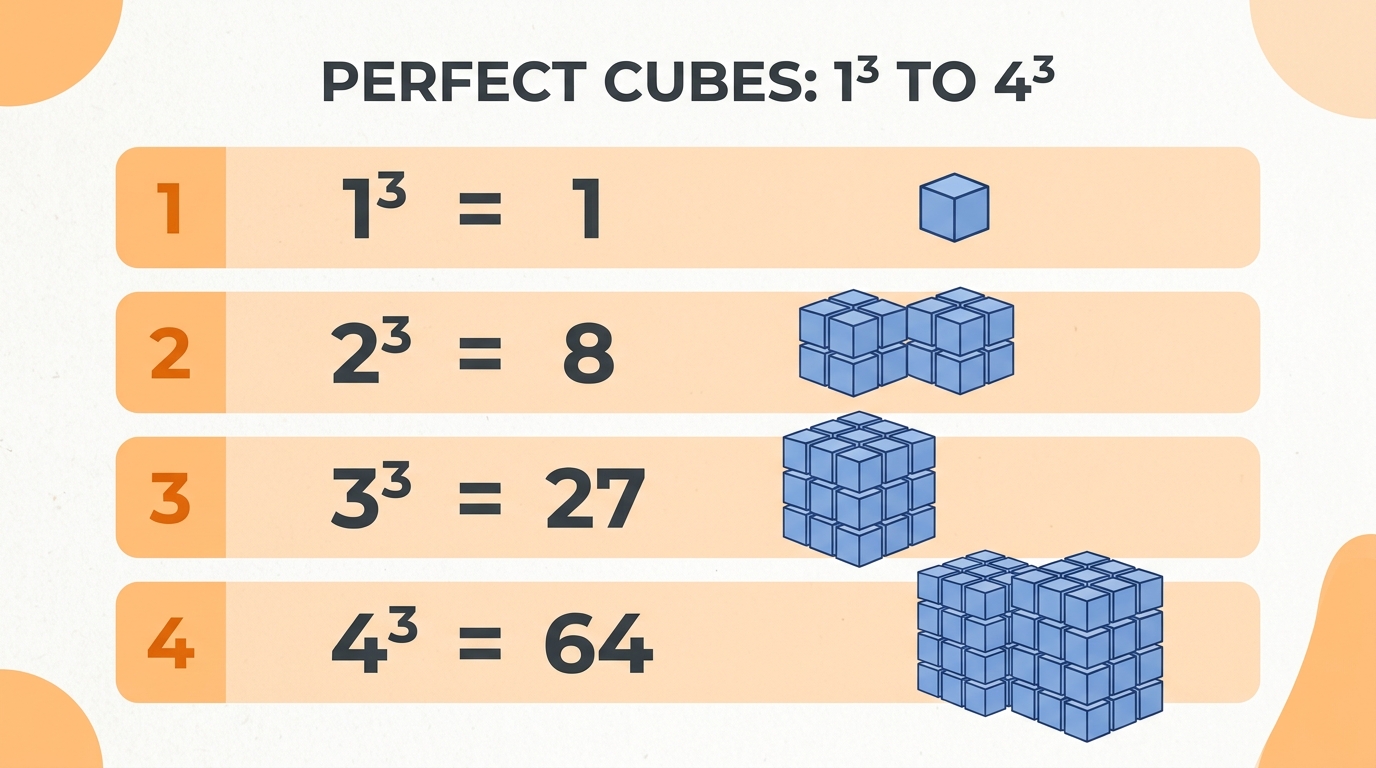
A perfect cube is a number you get by multiplying a whole number by itself three times. Cubes grow much faster than squares, which is why this list stops at 10.

NumberCubeNumberCube
116216
287343
3278512
4649729
5125101,000
Perfect cubes reference chart from 1 to 4 with 3D block volume representations
Perfect cubes: Whole numbers multiplied by themselves three times
FAQs

Frequently Asked Questions

How do I use the Racine Cubique Calculator?

Type any number into the box above and click Calculate. The tool instantly returns the cube root, including a simplified form where one exists, and it correctly handles negative numbers as real values.

Can I calculate cube roots manually?

Yes. For perfect cubes, prime factorization works cleanly. For everything else, estimation (finding which two perfect cubes your number falls between) gets you close fast.

What does "racine cubique" mean?

It's French for "cube root." A racine cubique calculator and a cube root calculator do exactly the same job.

Can cube roots of negative numbers be calculated?

Yes, and this is one of the biggest differences between cube roots and square roots. The cube root of a negative number is simply a negative real number — for example, ∛-8 = -2. No imaginary numbers involved.

Can I calculate cube roots of decimals or large numbers?

Yes. The calculator handles decimals, whole numbers, and large values with full precision.

What's the difference between a cube root and a square root?

A square root asks what number times itself equals your value. A cube root asks what number times itself three times equals your value. See the comparison table above for a full breakdown.

Is this calculator free to use?

Yes — no sign-up, no downloads, no usage limits.

Summary

A Quick Recap

The Bottom Line

A cube root answers one question: what number, multiplied by itself three times, gives you this value? That single idea carries you through everything else on this page — notation, formulas, manual methods, and the fact that (unlike square roots) cube roots handle negative numbers without needing anything imaginary. Use the calculator above for a fast, exact answer, and come back here anytime you want to work through the math yourself.