Nth Root Calculator

Calculate any root — 4th, 5th, or any custom index — instantly. Works for square roots, cube roots, and beyond. Get exact results with simplified forms. 100% free.

Any Root Precise 100% Free

Nth Root Calculator

Calculate any root — 4th, 5th, or custom degree

The root index. Enter 2 for square root, 3 for cube root, 4 for fourth root, etc.
n
The number you want to find the root of. For example, if n=4 and x=625, the result is 5 because 5⁴ = 625.
x

Your result will appear here

Enter degree and number, then press Calculate

Recent calculations

Complete Guide

What Is an Nth Root?

By now you might already know square roots (racine carrée) and cube roots (racine cubique) — but what happens when you need the 4th root, the 5th root, or any root beyond those two? That's exactly what the nth root calculator above is built for.

An nth root generalizes the idea of square roots and cube roots to work for any number of multiplications, not just two or three. The nth root of a number asks, "what value, multiplied by itself n times, gives me this number?"

n = 2 → Square Root√x (the familiar one)
n = 3 → Cube Root∛x (three multiplications)
n = 4 → Fourth Root⁴√x (four multiplications)

Example: The 4th root of 16 is 2, because 2 × 2 × 2 × 2 = 16. Once you see that square roots and cube roots are just two specific cases of this same idea, the nth root stops feeling abstract.
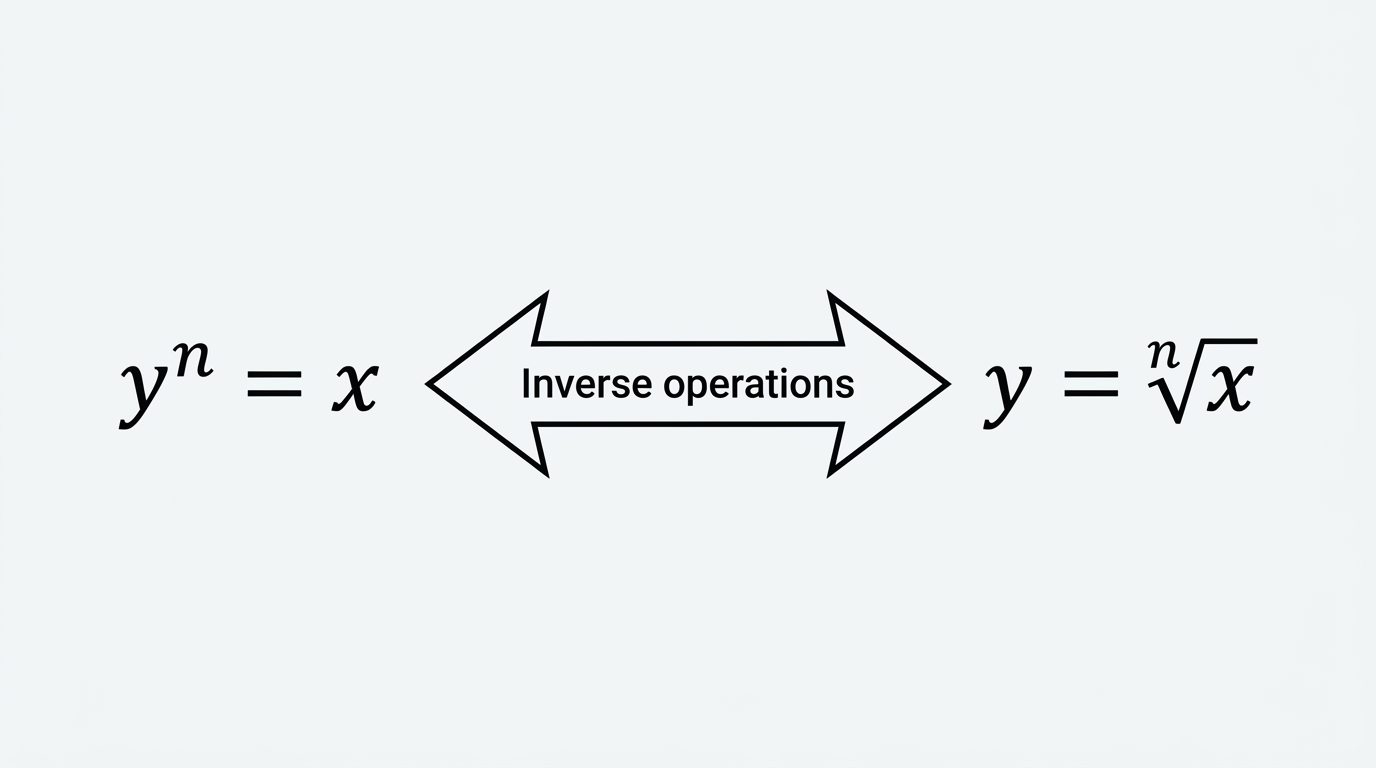
Nth root inverse operation math diagram showing relationship between exponentiation y^n = x and nth root y = ⁿ√x
The inverse relationship: Nth roots undo exponentiation powers
How To Use

How to Use the Nth Root Calculator

1

Enter Your Number

Enter your number (the radicand) into the first box.

2

Enter the Index

Enter the index — the "n" in nth root — into the second box (for example, enter 4 for a 4th root, or 5 for a 5th root).

3

Click Calculate

Click Calculate to get your answer instantly, including a simplified form when one's available.

Notation

Nth Root Symbol: What Does ⁿ√ Mean?

The nth root uses the same radical symbol (√) as square roots, but with a small number tucked into the notch to show the index:

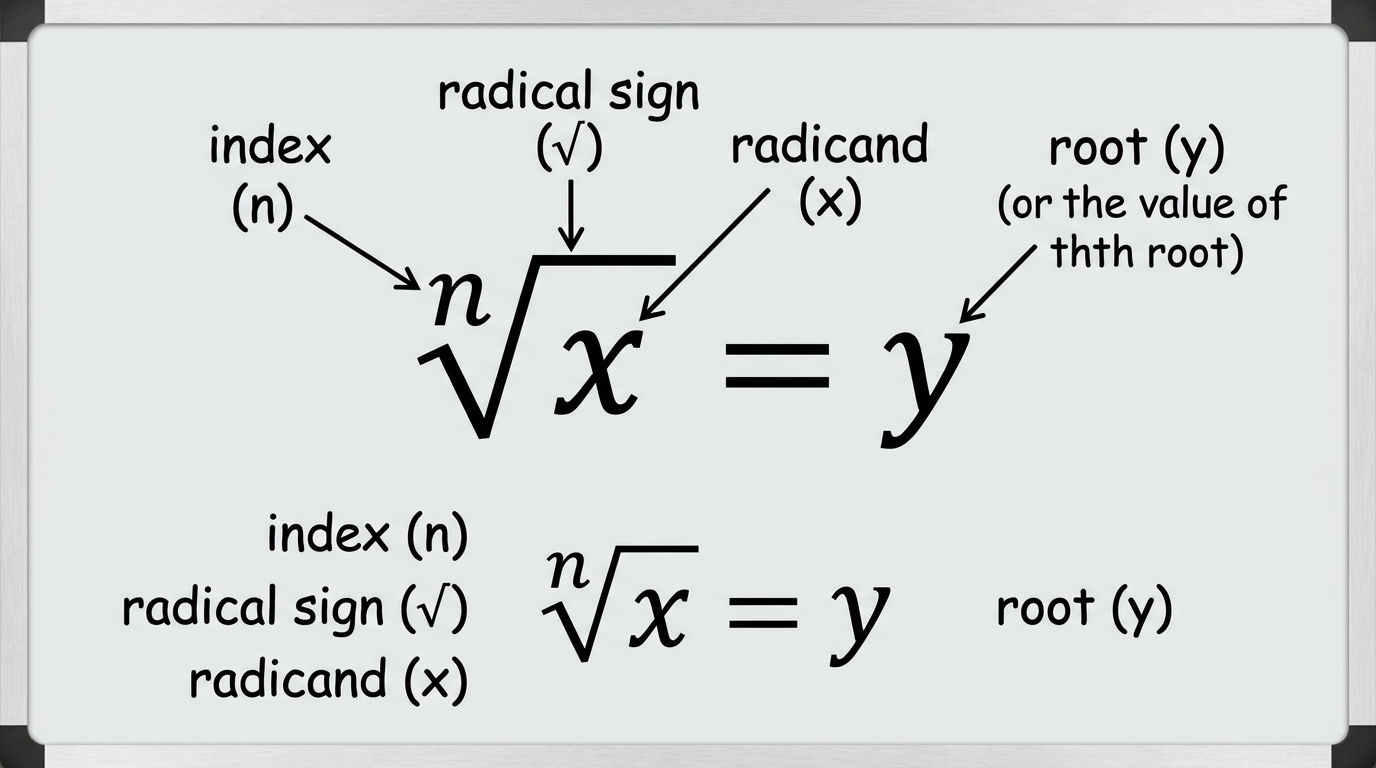
ⁿ√x"the nth root of x"
n = indexHow many times to multiply
x = radicandThe number you're finding the root of

When no index is shown (just √x), it's assumed to mean n = 2, which is why square roots don't need a visible "2."

You'll also see nth roots written using fractional exponents:

ⁿ√x = x^(1/n)

Both notations mean exactly the same thing.

Nth root radical notation diagram labeling index n, radical symbol, radicand x, and root y in ⁿ√x = y
The anatomy of an nth root expression and its mathematical terms
Formula

What Is the Formula for Nth Root?

Just like square and cube roots, the nth root is defined by a relationship rather than a plug-in formula:

If y = ⁿ√x, then yⁿ = x

In plain words: whatever answer you get, raising it to the power of n has to bring you back to your original number.

Index and Radicand: The Two Parts of Every Root

It's worth pausing on these two terms, because they show up constantly:

n
Index
How many times a value is multiplied by itself

2 for square root, 3 for cube root, 4 for 4th root, and so on.

x
Radicand
The number under the radical symbol

For example, in ⁵√32: 5 is the index, 32 is the radicand, and the answer is 2 (because 2⁵ = 32).

Examples

Worked Examples Across Different Indices

Seeing several indices side by side makes the pattern click faster than any single example can.

Scroll →
RootExpressionAnswerWhy
Square root (n=2)√6488 × 8 = 64
Cube root (n=3)∛6444 × 4 × 4 = 64
4th root (n=4)⁴√8133 × 3 × 3 × 3 = 81
5th root (n=5)⁵√24333 × 3 × 3 × 3 × 3 = 243
6th root (n=6)⁶√72933⁶ = 729
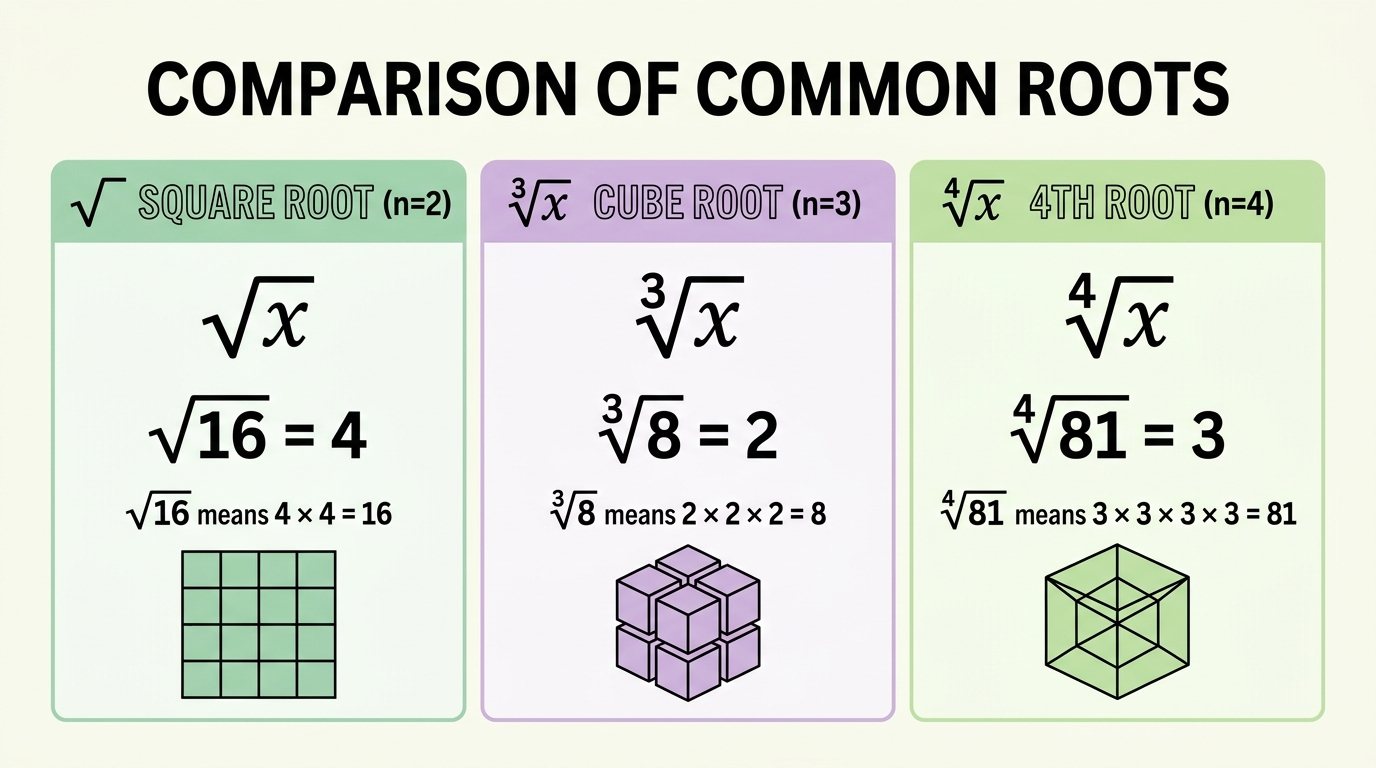
Comparative root degree chart comparing square root (n=2), cube root (n=3), and 4th root (n=4)
Comparison of different root degrees: Square, Cube, and 4th roots side by side
Key Rule

Even vs. Odd Index: The Rule for Negative Numbers

This is the single most important rule that makes nth roots different from square and cube roots on their own — because it depends entirely on whether your index is even or odd.

odd
Odd Index (n = 3, 5, 7...)
Negative radicand gives a real, negative answer

Example: ⁵√(−32) = −2, because (−2) × (−2) × (−2) × (−2) × (−2) = −32

even
Even Index (n = 2, 4, 6...)
Negative radicand has no real answer

Example: ⁴√(−16) has no real solution, because no real number multiplied by itself four times can produce a negative result.

Why the Pattern Works

Multiplying a negative number by itself an even number of times always lands on positive, while multiplying it an odd number of times keeps the negative sign. This one rule explains why cube roots (odd index) handle negatives just fine, while square roots and 4th roots (even indexes) don't.

Simplification

Simplifying Radicals with an Nth Index

Just like square root simplification and cube root simplification, nth roots can often be simplified by pulling out perfect-power factors.

Example: Simplify ⁴√32
  • Step 1 — Break 32 into factors that include a perfect 4th power: 32 = 16 × 2
  • Step 2 — Since 16 = 2⁴, pull it out of the radical: ⁴√32 = ⁴√(16 × 2) = 2 × ⁴√2 = 2⁴√2

The same logic that works for square and cube roots extends cleanly to any index — just look for the largest matching perfect power hiding inside your radicand.

Applications

Real-Life Applications of Nth Roots

Nth roots build on everything you know from square roots and cube roots, extending those concepts into fields that require higher-order calculations:

Finance & CAGR

Compound Annual Growth Rate (CAGR) is calculated using an nth root: CAGR = ⁿ√(End/Start) − 1. For a 5-year investment, that's a 5th root. For 10 years, a 10th root. This is the extension of the 3-year cube root method to any time horizon.

Statistics & Data Science

The geometric mean of n data points uses the nth root: ⁿ√(x₁·x₂·...xₙ). It's preferred over the arithmetic mean for growth rates, ratios, and normalized scores — anywhere multiplicative effects matter more than additive ones.

Engineering & Physics

Higher-dimensional scaling problems in aerodynamics, materials science, and signal processing use 4th, 5th, and higher roots. When a physical quantity depends on a variable raised to the nth power, the inverse operation requires the nth root.

Computer Science & Cryptography

RSA encryption uses modular exponentiation where the nth root operation (modular root extraction) is computationally hard — and that hardness is what makes the encryption secure. Algorithm complexity analysis also involves nth roots for certain bounds.

Reference Table

Reference Table: Nth Roots of Common Perfect Powers

A quick-reference table connecting radicands, indexes, and their exact whole-number roots.

Scroll →
ExpressionRadicandIndexAnswer
⁴√161642
⁵√323252
⁶√646462
⁴√818143
⁵√24324353
⁶√72972963
³√646434
²√646428
FAQs

Frequently Asked Questions

How do I use the Nth Root Calculator?

Enter your number (radicand) in the first box, enter your index (n) in the second box, and click Calculate. The tool returns your answer instantly, along with a simplified form where one exists.

What is the index of a root?

The index is the small number that shows how many times a value must be multiplied by itself to reach the radicand. For square roots the index is 2 (usually left unwritten), for cube roots it's 3, and for any other root it's written explicitly.

Can I find the nth root of a negative number?

It depends on whether your index is even or odd. Odd indexes (3, 5, 7...) give a real negative answer. Even indexes (2, 4, 6...) have no real answer for a negative radicand.

What's the nth root symbol?

It's the standard radical symbol (√) with a small number placed in the notch to indicate the index — for example, ⁴√ for a 4th root or ⁵√ for a 5th root.

How do I find a root on a physical calculator?

Most scientific calculators have a dedicated ˣ√y button, usually accessed through a shift or second-function key. If yours doesn't, you can raise your number to the power of (1 ÷ n) using the regular exponent button instead.

Does the nth root calculator work for square and cube roots too?

Yes — since square roots and cube roots are just the nth root with n = 2 and n = 3, this calculator works for those too. For dedicated tools, see our Racine Carrée Calculator and Racine Cubique Calculator.

Is this calculator free to use?

Yes — no sign-up, no downloads, no usage limits.

Summary

A Quick Recap

The Bottom Line

An nth root generalizes one simple question — what number, multiplied by itself n times, gives you this value — to work for any index, not just squares and cubes. Once you understand the index/radicand relationship and the even-vs-odd rule for negative numbers, you can work with roots of any size. Use the calculator above for a fast, exact answer, and come back here anytime you want a refresher on how it all works.