Kalkulator Kubus Sempurna
Periksa apakah suatu bilangan adalah kubus sempurna
Uji cepat
Masukkan bilangan bulat (positif atau negatif) untuk memeriksa apakah sama dengan bilangan bulat yang dikalikan dirinya 3 kali (k³ = n).
Periksa apakah bilangan positif atau negatif merupakan kubus sempurna. Dapatkan akar bilangan bulat, pangkat prima, dan batas terdekat.
Uji bilangan bulat apa pun dalam hitungan milidetik melalui 3 langkah mudah ini:
Ketik bilangan bulat positif atau negatif, atau pilih tombol pintas (-27, 216, 1331...).
Tekan Periksa atau Enter untuk menghitung akar kubik dan faktorisasi secara instan.
Cermati kesimpulan, faktorisasi prima, kubik pembatas, dan pengali aljabar.
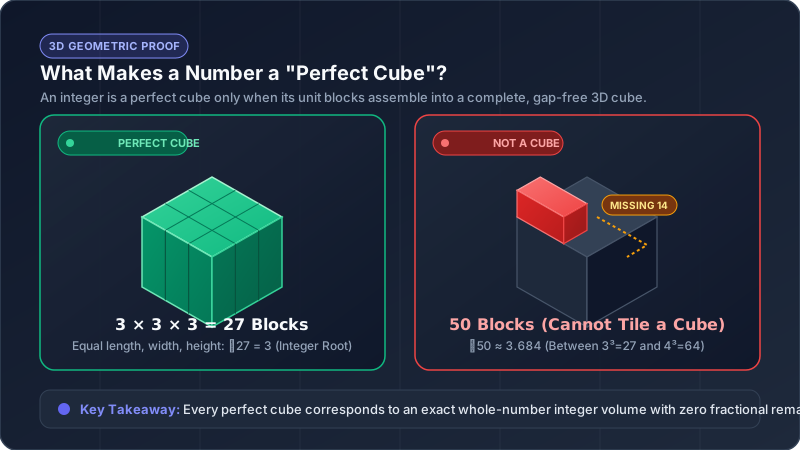
Kubik sempurna adalah bilangan bulat yang diperoleh dari perkalian suatu bilangan bulat dengan dirinya sendiri dua kali: n = k × k × k = k³. Bilangan k disebut akar pangkat tiga dari n (ditulis ∛n).
Misalnya, 27 adalah kubik sempurna karena 3 × 3 × 3 = 27 (jadi ∛27 = 3). Begitu pula 125 = 5³ dan -64 = (-4)³. Namun, 50 bukan kubik sempurna karena ∛50 ≈ 3,684.
Istilah ini berasal dari geometri 3D: dengan 27 balok satuan, Anda dapat membuat kubus padat 3×3×3 tanpa sisa.
Pangkat ganjil mempertahankan tanda: (-3)³ = -27. Bilangan bulat negatif bisa menjadi kubik sempurna riil.
0 dan 1 adalah kubik sempurna dasar: 0³ = 0 dan 1³ = 1. -1 juga kubik: (-1)³ = -1.
Kubik bilangan genap selalu genap (2³=8, 4³=64), dan bilangan ganjil selalu ganjil (3³=27, 5³=125).
Dalam faktorisasi prima, setiap eksponen prima harus merupakan kelipatan tepat dari 3.
Matematikawan menggunakan empat pengujian utama untuk memverifikasi kubik sempurna:
Hitung ∛n. Jika akar tidak memiliki nilai desimal, n adalah kubik sempurna.
Faktorkan ke bilangan prima. Jika setiap pangkat habis dibagi 3, itu adalah kubik.
Karena (-k)³ = -k³, bilangan negatif -n adalah kubik jika |n| juga kubik.
Jumlahkan digit-digitnya: akar digital dari kubik selalu 0, 1, 8, atau 9.
∛512 = 8 : 8 × 8 × 8 = 512. Prime factorization is 2⁹ with exponent 9 divisible by 3. Digital root: 5 + 1 + 2 = 8 (valid).
∛100 ≈ 4.642 : 100 sits strictly between 4³ = 64 and 5³ = 125. Prime factors are 2² × 5², neither exponent is divisible by 3.
∛(-216) = -6 : (-6) × (-6) × (-6) = 36 × (-6) = -216. Odd roots preserve negative signs, producing a valid real integer root.
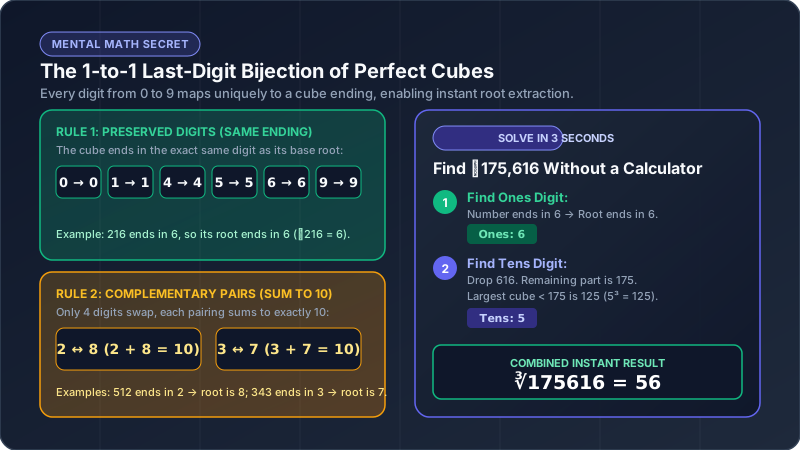
Unlike perfect squares (which can only end in 0, 1, 4, 5, 6, or 9), every digit from 0 to 9 can be the last digit of a perfect cube. In fact, there is a strict one-to-one bijection between the ones digit of a base integer and the ones digit of its cube:
| Base Last Digit (k) | Cube Calculation (k³ mod 10) | Cube Last Digit (k³) | Memory Rule |
|---|---|---|---|
| 0 | 0³ = 0 | 0 | Preserved (Same digit) |
| 1 | 1³ = 1 | 1 | Preserved (Same digit) |
| 2 | 2³ = 8 | 8 | Complements to 10 (2 + 8 = 10) |
| 3 | 3³ = 27 | 7 | Complements to 10 (3 + 7 = 10) |
| 4 | 4³ = 64 | 4 | Preserved (Same digit) |
| 5 | 5³ = 125 | 5 | Preserved (Same digit) |
| 6 | 6³ = 216 | 6 | Preserved (Same digit) |
| 7 | 7³ = 343 | 3 | Complements to 10 (7 + 3 = 10) |
| 8 | 8³ = 512 | 2 | Complements to 10 (8 + 2 = 10) |
| 9 | 9³ = 729 | 9 | Preserved (Same digit) |
To find the cube root of 175,616:
1. Ones Digit: The number ends in 6. Looking at our table, a cube ending in 6 must have a root ending in 6.
2. Tens Digit: Cross off the last three digits (616), leaving 175. The largest perfect cube below 175 is 125 (5³). So the tens digit is 5.
Result: ∛175616 = 56. Verified: 56 × 56 × 56 = 175,616!
Odd powers behave differently from even powers. Here is how special numeric sets are evaluated:
Yes. 0 is an integer, and 0 × 0 × 0 = 0 (0³ = 0). Its principal cube root is exactly 0.
Fully Real. Unlike square roots which require the imaginary unit i, odd roots preserve signs: (-k)³ = -k³. For example, ∛(-64) = -4.
A fraction is a cubic power if both its numerator and denominator are perfect cubes: 27/64 = (3/4)³.
Decimals are cubes if the significant digits form a cube and the number of decimal places is a multiple of 3: 0.027 = (0.3)³, 0.000125 = (0.05)³.
Comparing cubic numbers with square numbers? Test whether an integer is a perfect square →
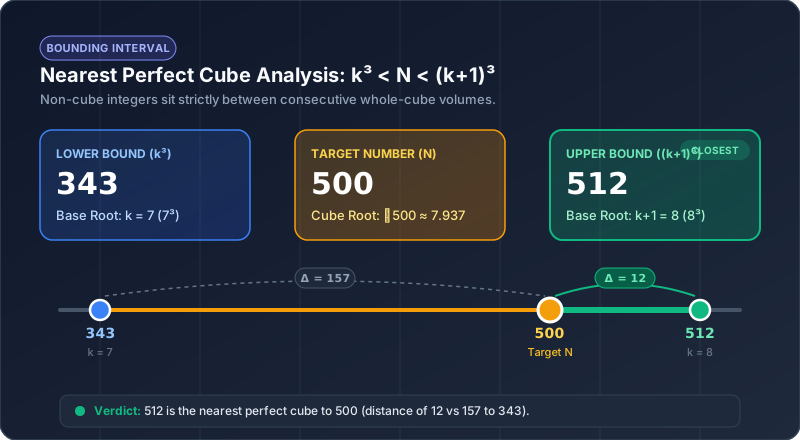
Setiap bilangan bukan kubik terletak di antara dua kubik berurutan: k³ < n < (k + 1)³.
Untuk 500, kubik pembatasnya adalah 343 (7³) dan 512 (8³). Jarak ke 512 hanya 12, maka 512 adalah yang terdekat.
| Target (N) | Cube Root (∛N) | Lower Cube (k³) | Upper Cube ((k+1)³) | Nearest Cube | Distance |
|---|---|---|---|---|---|
| 50 | 3.684 | 27 (3³) | 64 (4³) | 64 | 64 - 50 = 14 |
| 200 | 5.848 | 125 (5³) | 216 (6³) | 216 | 216 - 200 = 16 |
| 500 | 7.937 | 343 (7³) | 512 (8³) | 512 | 512 - 500 = 12 |
| 800 | 9.283 | 729 (9³) | 1000 (10³) | 729 | 800 - 729 = 71 |
When an integer is not a perfect cube, its root is an irrational decimal. Compute exact decimal cube roots with radical steps →
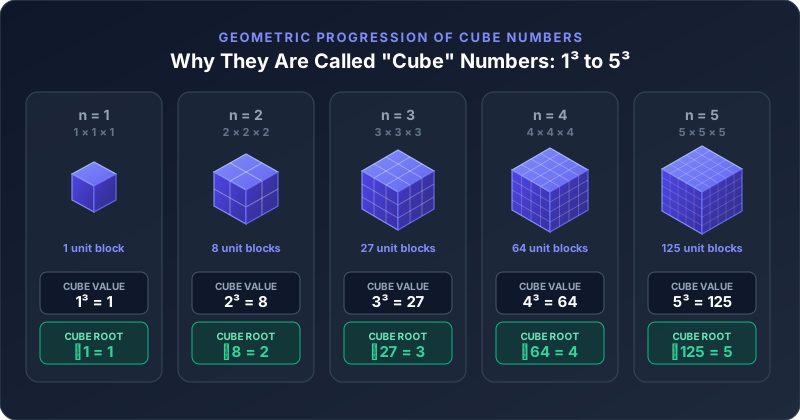
Between 1 and 1000 inclusive, there are exactly 10 perfect cubes:
| Base Root (k) | Formula (k × k × k) | Perfect Cube (k³) | Prime Factorization | ∛k³ |
|---|---|---|---|---|
| 1 | 1 × 1 × 1 | 1 | 1 | 1 |
| 2 | 2 × 2 × 2 | 8 | 2³ | 2 |
| 3 | 3 × 3 × 3 | 27 | 3³ | 3 |
| 4 | 4 × 4 × 4 | 64 | 2⁶ = (2²)³ | 4 |
| 5 | 5 × 5 × 5 | 125 | 5³ | 5 |
| 6 | 6 × 6 × 6 | 216 | 2³ × 3³ | 6 |
| 7 | 7 × 7 × 7 | 343 | 7³ | 7 |
| 8 | 8 × 8 × 8 | 512 | 2⁹ = (2³)³ | 8 |
| 9 | 9 × 9 × 9 | 729 | 3⁶ = (3²)³ | 9 |
| 10 | 10 × 10 × 10 | 1000 | 2³ × 5³ | 10 |
Between 1 and 10,000 inclusive, there are exactly 21 perfect cubes because 21³ = 9,261 and 22³ = 10,648.
| k | k³ | k | k³ | k | k³ |
|---|---|---|---|---|---|
| 1 | 1 | 8 | 512 | 15 | 3375 |
| 2 | 8 | 9 | 729 | 16 | 4096 |
| 3 | 27 | 10 | 1000 | 17 | 4913 |
| 4 | 64 | 11 | 1331 | 18 | 5832 |
| 5 | 125 | 12 | 1728 | 19 | 6859 |
| 6 | 216 | 13 | 2197 | 20 | 8000 |
| 7 | 343 | 14 | 2744 | 21 | 9261 |
Evaluating higher powers beyond the 3rd degree? Evaluate arbitrary nth degree radical roots →
Verify cube numbers automatically in Excel, Google Sheets, Python, and JavaScript:
=IF(ROUND(A2^(1/3), 0)^3 = A2, "Perfect Cube", "Not a Cube") def is_cube(n): return round(abs(n)**(1/3))**3 == abs(n) const isCube = n => Math.round(Math.cbrt(n))**3 === n; Terminology: Perfect Cube or Cube Number.
Terminology: Kubikzahlen (German) and Cubes parfaits (French).
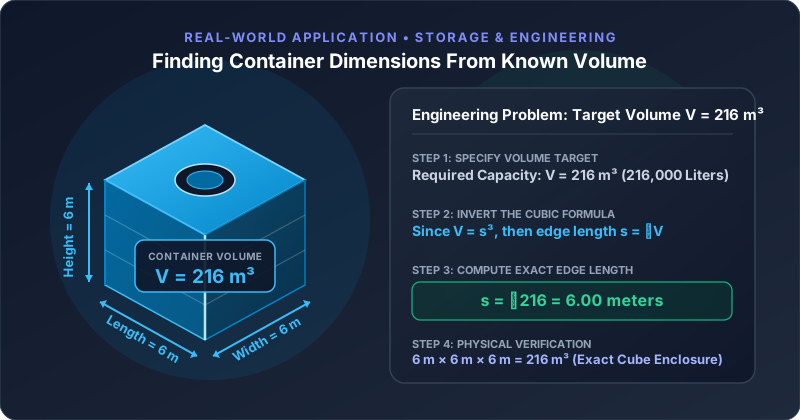
Dimensi kemasan kargo, tangki penyimpanan, dan kontainer 3D.
Hukum kuadrat-kubus yang mengatur rasio luas permukaan terhadap massa.
Pemodelan volumetrik berbasis voksel dalam mesin game seperti Minecraft.
Kurva eliptik dan teori bilangan analitis dalam keamanan siber.
Cubing a number means multiplying it by itself three times (4³ = 4 × 4 × 4 = 64), not multiplying it by three (4 × 3 = 12).
Unlike square roots, odd roots preserve negative signs. Multiplying three negative numbers gives a negative product: (-5) × (-5) × (-5) = -125.
Every digit from 0 to 9 can end a perfect cube. You cannot eliminate a candidate by its last digit alone; you must use prime factors or modulo 9 digital roots.
In computers, computing 125^(1/3) frequently yields 4.999999999999999. Naively checking if int(125^(1/3)) == 5 can fail without proper rounding logic.
Bilangan bulat hasil perkalian suatu bilangan bulat dengan dirinya sendiri tiga kali. Contohnya 27, karena 3 × 3 × 3 = 27.
Bisa! Hasil kali tiga bilangan negatif adalah negatif: (-4) × (-4) × (-4) = -64. Maka -64 adalah kubik sempurna dengan akar -4.
Ya, 0 adalah kubik sempurna karena 0 × 0 × 0 = 0 (0³ = 0).
Bisa, angka yang eksponen primanya kelipatan 6: 1, 64 (8² dan 4³), 729 (27² dan 9³), dan 4096 (64² dan 16³).
Ya, kalkulator kubik sempurna kami 100% gratis dengan fitur pembuktian langkah lengkap.

Memenuhi rumus n = k × k × k dengan k bilangan bulat.
Tidak seperti akar kuadrat, akar ganjil dari angka negatif bernilai riil.
Setiap faktor prima wajib mempunyai eksponen yang habis dibagi 3.
Periksa bilangan tanpa batas dengan pembuktian lengkap secara instan.