세제곱근 계산기
음수를 포함한 모든 수의 ∛x 계산
세제곱근을 구할 숫자를 입력하세요. 음수도 실수 해가 존재합니다.
∛
모든 양수 및 음수의 세제곱근을 즉시 계산합니다. 정확한 소수점 결과, 근호 단순화 및 단계별 풀이 과정을 100% 무료로 확인하세요.
세제곱근(프랑스어로 Racine Cubique, 영어로 Cube Root)은 3차원 공간의 부피와 치수를 다루는 가장 기본적인 수학 연산입니다. 상단의 온라인 계산기를 통해 어떤 숫자든 정확한 세제곱근을 즉시 구할 수 있습니다.
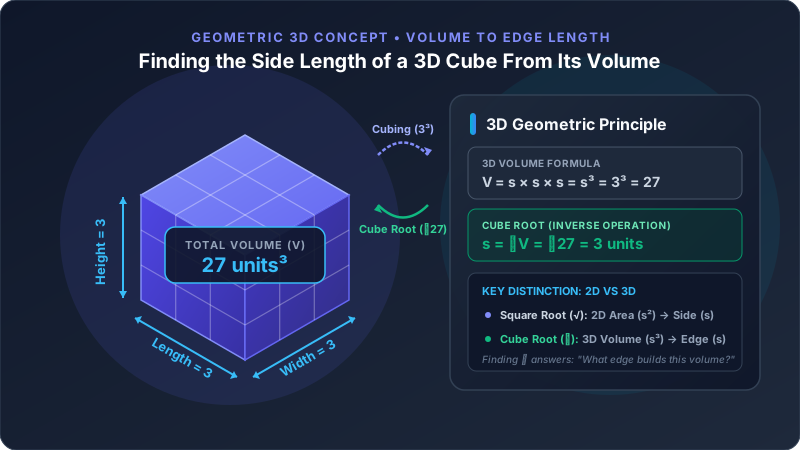
어떤 수의 세제곱근이란, 그 수를 세 번 곱했을 때 원래의 숫자가 되는 값을 의미합니다 (3 × 3 × 3 = 27이므로 ∛27 = 3).
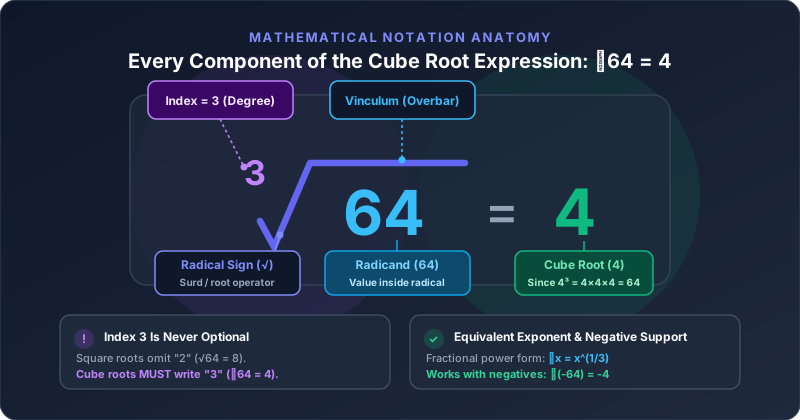
The small number 3 in the upper-left of the radical sign. It indicates you are finding the 3rd root (cube root) rather than a square root (index 2).
The mathematical sign ∛ denoting the extraction of the cube root. In Unicode, it is character U+221B.
The number underneath the radical sign whose cube root is being calculated. It can be positive, negative, or zero.
The real value that, when multiplied by itself three times (y × y × y), equals the radicand.
기하학적으로는 정육면체의 부피를 알 때 한 모서리의 길이를 구하는 것과 같습니다.
세 가지 간단한 단계로 결과를 확인하세요:
상단 입력창에 계산할 숫자를 입력합니다.
계산 버튼을 눌러 연산을 시작합니다.
정밀한 소수점 결과와 기약 근호 표현을 즉시 확인합니다.
복잡한 수식 없이 계산기가 모든 연산을 자동으로 처리합니다.
세제곱근은 근호의 좌측 상단에 거듭제곱근 지수 3을 붙여 ∛ 형태로 나타냅니다:
Standard mathematical radical notation using index 3 and radical sign.
Fractional power representation: raising any number to 1/3 equals its cube root.
Standard in JavaScript, Python (64 ** (1/3)), C, Java, and modern runtimes.
Excel and Google Sheets formula. Alternatively use =A1^(1/3).
LaTeX mathematical typesetting command for academic papers and documents.
On Windows: type 221B then press Alt+X. On Mac: Cmd+Ctrl+Space. HTML: ∛.
세제곱근은 분수 지수 형태로도 표기할 수 있습니다:
두 표현은 수학적으로 완전히 동일하며, 프로그래밍에서는 주로 x^(1/3) 형식을 사용합니다.
∛x와 x^(1/3)는 동일한 연산 결과를 반환합니다.
세제곱근은 세제곱(3승)의 역연산으로 정의됩니다:
모든 실수 x에 대하여, y³ = x를 만족하는 실수 y는 오직 하나만 존재합니다. 제곱근과 달리 음수에 대해서도 실수 범위에서 완벽하게 정의됩니다.
세제곱근 식을 단순화하고 계산할 때 유용한 기본 법칙들입니다:
예: ∛(8 × 27) = ∛8 × ∛27 = 2 × 3 = 6.
예: ∛(64 / 8) = ∛64 / ∛8 = 4 / 2 = 2.
예: ∛(2⁶) = 2^(6/3) = 2² = 4.
예: ∛(-8) = -∛8 = -2.
Working with higher degree root indices beyond 3? Compute 4th, 5th, and general nth roots online →
계산기 없이 세제곱근을 구하는 4가지 대표적 방법:
앞뒤 완전세제곱수를 찾아 범위를 좁히고 소수를 어림잡아 계산합니다.
완전세제곱수에 가장 효과적: 소인수분해 후 지수를 3으로 묶어냅니다.
완전세제곱수의 일의 자리와 앞자리 숫자로 두 자리 세제곱근을 암산하는 기법:
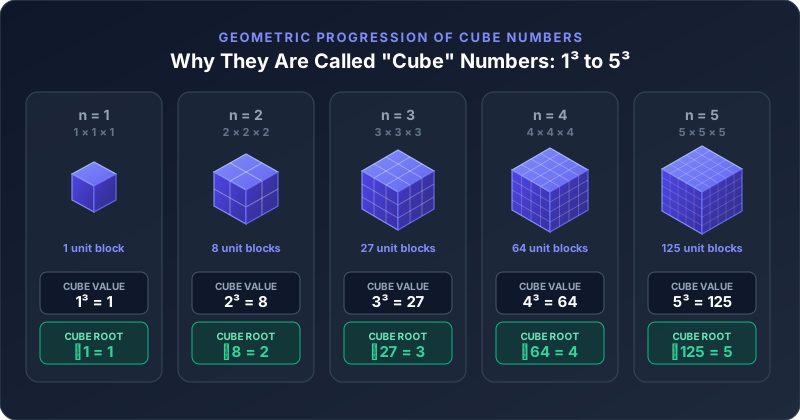
자주 쓰이는 세제곱근 값을 시각적으로 정리한 카드입니다.
표를 보려면 스크롤하세요 ↓
| Number (n) | Cube (n³) | Cube Root (∛n³) | Quick Test |
|---|---|---|---|
| 1 | 1 | 1 | |
| 2 | 8 | 2 | |
| 3 | 27 | 3 | |
| 4 | 64 | 4 | |
| 5 | 125 | 5 | |
| 6 | 216 | 6 | |
| 7 | 343 | 7 | |
| 8 | 512 | 8 | |
| 9 | 729 | 9 | |
| 10 | 1,000 | 10 | |
| 11 | 1,331 | 11 | |
| 12 | 1,728 | 12 | |
| 15 | 3,375 | 15 | |
| 20 | 8,000 | 20 | |
| 25 | 15,625 | 25 | |
| 50 | 125,000 | 50 | |
| 100 | 1,000,000 | 100 |
제곱근과 달리 음수의 세제곱근은 실수 범위에서 언제나 존재하며, 그 결과 역시 음의 실수가 됩니다.
음수를 세 번(홀수 번) 곱하면 항상 음수가 되기 때문입니다.
Requires the imaginary unit i (±4i) because squaring any real number produces a non-negative result.
100% Real solution! Multiplying three negative numbers gives a negative product: (-4) × (-4) × (-4) = -64.
(-3) × (-3) × (-3) = 9 × (-3) = -27 이므로 ∛(-27) = -3 입니다.
일반 공식: 모든 실수 x에 대해 ∛(-x) = -∛x 가 성립합니다.
음수의 실근 세제곱근을 구할 때는 허수 단위(i)가 필요하지 않습니다.
To find the cube root of a decimal, convert it into a fraction or power of ten, simplify, and evaluate the root.
Apply the quotient property by taking the cube root of the numerator and denominator separately: ∛(a/b) = ∛a / ∛b.
완전세제곱수가 아닌 경우, 완전세제곱인 인수를 밖으로 빼내어 단순화합니다:
| 원래 식 | 단순화된 형태 | 변형 과정 | Actions |
|---|---|---|---|
| ∛16 | 2∛2 | 16 = 2³ × 2 = 8 × 2 | |
| ∛24 | 2∛3 | 24 = 2³ × 3 = 8 × 3 | |
| ∛32 | 2∛4 | 32 = 2³ × 4 = 8 × 4 | |
| ∛40 | 2∛5 | 40 = 2³ × 5 = 8 × 5 | |
| ∛48 | 2∛6 | 48 = 2³ × 6 = 8 × 6 | |
| ∛54 | 3∛2 | 54 = 3³ × 2 = 27 × 2 | |
| ∛56 | 2∛7 | 56 = 2³ × 7 = 8 × 7 | |
| ∛72 | 2∛9 | 72 = 2³ × 9 = 8 × 9 | |
| ∛108 | 3∛4 | 108 = 3³ × 4 = 27 × 4 | |
| ∛128 | 4∛2 | 128 = 4³ × 2 = 64 × 2 | |
가장 큰 완전세제곱인 인수를 찾아 분리하는 것이 핵심입니다.
제곱근과 세제곱근의 결정적인 차이점을 한눈에 정리한 표입니다:
| Property / Feature | 세제곱근 (∛) | 제곱근 (√) |
|---|---|---|
| 기호 및 지수 | ∛ (Index 3) | √ (Index 2) |
| Exponent Form | x^(1/3) | x^(1/2) |
| 음수 처리 | 실수 범위에서 항상 정의됨 | 실수 범위에서 정의되지 않음 |
| 곱하는 횟수 | 3번 곱함 | 2번 곱함 |
| Number of Real Roots | Exactly 1 for all real numbers | 1 for positive / 0 for negative |
| Graph Symmetry | Odd function (symmetric about origin) | Defined only for x ≥ 0 |
| Output Sign | Always matches input sign (∛(-8) = -2) | Always non-negative (principal root) |
| 대표 예시 | ∛64 = 4 | √64 = 8 |
Need to evaluate square roots instead? Calculate square roots with exact decimals and simplified radicals →
1부터 100까지의 자연수에 대한 세제곱근 (소수점 넷째 자리까지 반올림):
필요 시 표를 가로로 스크롤하세요
| 숫자 (n) | 세제곱근 (∛n) | Simplified Radical | 유형 | Quick Test |
|---|---|---|---|---|
| 1 | 1 | 1 | 완전세제곱수 | |
| 2 | 1.2599 | ∛2 | 무리수 | |
| 3 | 1.4422 | ∛3 | 무리수 | |
| 4 | 1.5874 | ∛4 | 무리수 | |
| 5 | 1.7100 | ∛5 | 무리수 | |
| 6 | 1.8171 | ∛6 | 무리수 | |
| 7 | 1.9129 | ∛7 | 무리수 | |
| 8 | 2 | 2 | 완전세제곱수 | |
| 9 | 2.0801 | ∛9 | 무리수 | |
| 10 | 2.1544 | ∛10 | 무리수 | |
| 11 | 2.2240 | ∛11 | 무리수 | |
| 12 | 2.2894 | ∛12 | 무리수 | |
| 13 | 2.3513 | ∛13 | 무리수 | |
| 14 | 2.4101 | ∛14 | 무리수 | |
| 15 | 2.4662 | ∛15 | 무리수 | |
| 16 | 2.5198 | 2∛2 | 무리수 | |
| 17 | 2.5713 | ∛17 | 무리수 | |
| 18 | 2.6207 | ∛18 | 무리수 | |
| 19 | 2.6684 | ∛19 | 무리수 | |
| 20 | 2.7144 | ∛20 | 무리수 | |
| 21 | 2.7589 | ∛21 | 무리수 | |
| 22 | 2.8020 | ∛22 | 무리수 | |
| 23 | 2.8439 | ∛23 | 무리수 | |
| 24 | 2.8845 | 2∛3 | 무리수 | |
| 25 | 2.9240 | ∛25 | 무리수 | |
| 26 | 2.9625 | ∛26 | 무리수 | |
| 27 | 3 | 3 | 완전세제곱수 | |
| 28 | 3.0366 | ∛28 | 무리수 | |
| 29 | 3.0723 | ∛29 | 무리수 | |
| 30 | 3.1072 | ∛30 | 무리수 | |
| 31 | 3.1414 | ∛31 | 무리수 | |
| 32 | 3.1748 | 2∛4 | 무리수 | |
| 33 | 3.2075 | ∛33 | 무리수 | |
| 34 | 3.2396 | ∛34 | 무리수 | |
| 35 | 3.2711 | ∛35 | 무리수 | |
| 36 | 3.3019 | ∛36 | 무리수 | |
| 37 | 3.3322 | ∛37 | 무리수 | |
| 38 | 3.3620 | ∛38 | 무리수 | |
| 39 | 3.3912 | ∛39 | 무리수 | |
| 40 | 3.4200 | 2∛5 | 무리수 | |
| 41 | 3.4482 | ∛41 | 무리수 | |
| 42 | 3.4760 | ∛42 | 무리수 | |
| 43 | 3.5034 | ∛43 | 무리수 | |
| 44 | 3.5303 | ∛44 | 무리수 | |
| 45 | 3.5569 | ∛45 | 무리수 | |
| 46 | 3.5830 | ∛46 | 무리수 | |
| 47 | 3.6088 | ∛47 | 무리수 | |
| 48 | 3.6342 | 2∛6 | 무리수 | |
| 49 | 3.6593 | ∛49 | 무리수 | |
| 50 | 3.6840 | ∛50 | 무리수 | |
| 51 | 3.7084 | ∛51 | 무리수 | |
| 52 | 3.7325 | ∛52 | 무리수 | |
| 53 | 3.7563 | ∛53 | 무리수 | |
| 54 | 3.7798 | 3∛2 | 무리수 | |
| 55 | 3.8030 | ∛55 | 무리수 | |
| 56 | 3.8259 | 2∛7 | 무리수 | |
| 57 | 3.8485 | ∛57 | 무리수 | |
| 58 | 3.8709 | ∛58 | 무리수 | |
| 59 | 3.8930 | ∛59 | 무리수 | |
| 60 | 3.9149 | ∛60 | 무리수 | |
| 61 | 3.9365 | ∛61 | 무리수 | |
| 62 | 3.9579 | ∛62 | 무리수 | |
| 63 | 3.9791 | ∛63 | 무리수 | |
| 64 | 4 | 4 | 완전세제곱수 | |
| 65 | 4.0207 | ∛65 | 무리수 | |
| 66 | 4.0412 | ∛66 | 무리수 | |
| 67 | 4.0615 | ∛67 | 무리수 | |
| 68 | 4.0817 | ∛68 | 무리수 | |
| 69 | 4.1016 | ∛69 | 무리수 | |
| 70 | 4.1213 | ∛70 | 무리수 | |
| 71 | 4.1408 | ∛71 | 무리수 | |
| 72 | 4.1602 | 2∛9 | 무리수 | |
| 73 | 4.1793 | ∛73 | 무리수 | |
| 74 | 4.1983 | ∛74 | 무리수 | |
| 75 | 4.2172 | ∛75 | 무리수 | |
| 76 | 4.2358 | ∛76 | 무리수 | |
| 77 | 4.2543 | ∛77 | 무리수 | |
| 78 | 4.2727 | ∛78 | 무리수 | |
| 79 | 4.2908 | ∛79 | 무리수 | |
| 80 | 4.3089 | 2∛10 | 무리수 | |
| 81 | 4.3267 | 3∛3 | 무리수 | |
| 82 | 4.3445 | ∛82 | 무리수 | |
| 83 | 4.3621 | ∛83 | 무리수 | |
| 84 | 4.3795 | ∛84 | 무리수 | |
| 85 | 4.3968 | ∛85 | 무리수 | |
| 86 | 4.4140 | ∛86 | 무리수 | |
| 87 | 4.4310 | ∛87 | 무리수 | |
| 88 | 4.4480 | 2∛11 | 무리수 | |
| 89 | 4.4647 | ∛89 | 무리수 | |
| 90 | 4.4814 | ∛90 | 무리수 | |
| 91 | 4.4979 | ∛91 | 무리수 | |
| 92 | 4.5144 | ∛92 | 무리수 | |
| 93 | 4.5307 | ∛93 | 무리수 | |
| 94 | 4.5468 | ∛94 | 무리수 | |
| 95 | 4.5629 | ∛95 | 무리수 | |
| 96 | 4.5789 | 2∛12 | 무리수 | |
| 97 | 4.5947 | ∛97 | 무리수 | |
| 98 | 4.6104 | ∛98 | 무리수 | |
| 99 | 4.6261 | ∛99 | 무리수 | |
| 100 | 4.6416 | ∛100 | 무리수 |
Want to verify whether any specific integer is an exact cube? Test integers with our instant perfect cube checker →
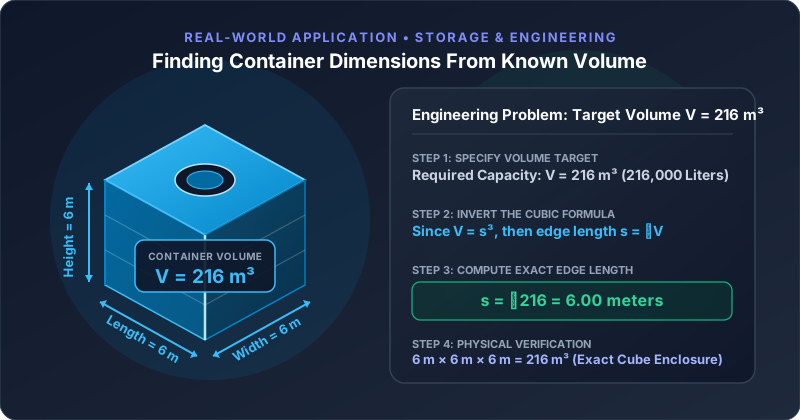
세제곱근은 다양한 공학 및 과학 분야에서 필수적으로 활용됩니다:
정해진 부피를 가진 정육면체 물탱크나 상자의 한 변 길이 산출.
행성의 공전 주기와 태양으로부터의 공전 궤도 반경 계산.
결정 구조에서 단위 격자의 부피로부터 원자간 거리 측정.
동물의 몸무게와 표면적, 대사율 사이의 비율 관계 규명.
All calculations execute directly in your browser with zero latency and 100% data privacy.
Instantly checks whether the radicand is a perfect cube and outputs exact integers without rounding drift.
Performs prime factorization in real time to extract triple factors, rendering exact forms like ∛24 = 2∛3.
Applies the mathematical odd symmetry rule ∛(-x) = -∛x, returning exact real solutions for negative inputs.
Provides clean decimal approximations and comprehensive step-by-step mathematical reasoning.
A cube root of a number is a value that, when multiplied by itself three times, produces the original number. In mathematical notation, the cube root of x is written as ∛x or x^(1/3). For example, the cube root of 27 is 3, because 3 × 3 × 3 = 27.
Yes! Unlike square roots, cube roots of negative numbers are real numbers because multiplying three negative numbers results in a negative product. The rule is ∛(-x) = -∛x. For example, ∛(-8) = -2, because (-2) × (-2) × (-2) = -8.
Cubing and taking the cube root are inverse operations. Cubing a number means raising it to the power of 3 (for example, 4³ = 64). Taking the cube root reverses this process to recover the original base value: ∛64 = 4.
A perfect cube is an integer that results from multiplying an integer by itself three times. Examples include 1, 8, 27, 64, 125, 216, 343, 512, 729, and 1000. The cube root of a perfect cube is always a whole number.
For perfect cubes, use prime factorization: break the number into prime factors, group identical factors into sets of three, and extract one from each group (e.g. 3375 = 3³ × 5³ = 15). For non-perfect cubes, use estimation between the two nearest known perfect cubes.
The cube root symbol is ∛ (Unicode character U+221B). It consists of a standard radical sign with a small index 3 in the upper-left notch. In software code it is written cbrt(x), and in LaTeX as \sqrt[3]{x}.
On Windows, type 221B then press Alt+X in supported apps, or use Character Map. On Mac, press Cmd+Ctrl+Space to open Character Viewer and search 'cube root'. In HTML, use the entity ∛ or copy and paste ∛ directly.
The cube root of 0 is exactly 0, because 0 × 0 × 0 = 0.
The cube root of 2 (∛2 ≈ 1.2599) is an irrational number. It cannot be expressed as an exact fraction of two integers, and its decimal expansion continues infinitely without repeating.
The real cube root of 1 is 1, since 1 × 1 × 1 = 1. (In complex mathematics, there are also two non-real complex cube roots of unity: e^(2πi/3) and e^(-2πi/3)).

세제곱근은 3제곱(x³)의 역연산이며, 양수뿐만 아니라 음수에 대해서도 항상 실수 범위에서 정의됩니다.