Calcolatore Radice Cubica
Trova ∛x per qualsiasi numero, anche negativi
Inserisci qualsiasi numero positivo o negativo per trovare la sua radice cubica.
∛
Calcola la radice cubica di qualsiasi numero — positivo o negativo — all'istante. Valori decimali esatti, forma semplificata e passaggi. 100% gratis.
La radice cubica è un'operazione matematica fondamentale per calcoli tridimensionali. Il nostro calcolatore online sopra ti offre la risposta con un solo clic.
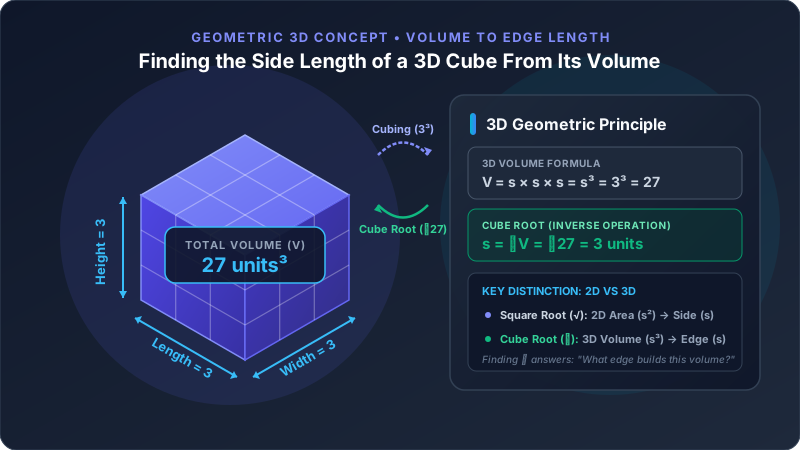
Una radice cubica è quel numero che, moltiplicato per se stesso 3 volte, restituisce il numero di partenza (3 × 3 × 3 = 27, quindi ∛27 = 3).
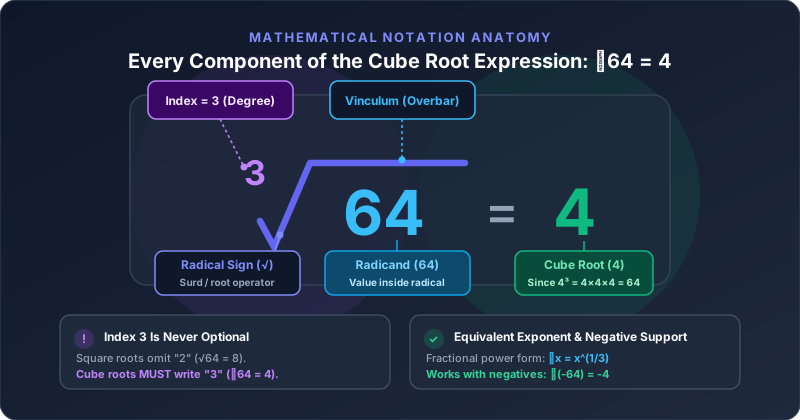
The small number 3 in the upper-left of the radical sign. It indicates you are finding the 3rd root (cube root) rather than a square root (index 2).
The mathematical sign ∛ denoting the extraction of the cube root. In Unicode, it is character U+221B.
The number underneath the radical sign whose cube root is being calculated. It can be positive, negative, or zero.
The real value that, when multiplied by itself three times (y × y × y), equals the radicand.
È il principio geometrico per risalire allo spigolo di un cubo dal suo volume.
Ottieni la soluzione in tre semplici passaggi:
Digita il valore nella casella di input sopra.
Premi il pulsante per avviare il calcolo.
Visualizza il valore esatto e la forma semplificata, inclusi i numeri negativi.
Nessuna formula da memorizzare: il calcolatore svolge ogni passaggio al posto tuo.
Il simbolo ∛ indica la radice cubica con l'indice 3 inserito nella radice.
Standard mathematical radical notation using index 3 and radical sign.
Fractional power representation: raising any number to 1/3 equals its cube root.
Standard in JavaScript, Python (64 ** (1/3)), C, Java, and modern runtimes.
Excel and Google Sheets formula. Alternatively use =A1^(1/3).
LaTeX mathematical typesetting command for academic papers and documents.
On Windows: type 221B then press Alt+X. On Mac: Cmd+Ctrl+Space. HTML: ∛.
Può essere espressa anche con esponente frazionario:
Entrambe le forme sono equivalenti. Nei linguaggi di programmazione si usa x^(1/3).
Sia ∛x che x^(1/3) denotano la medesima operazione algebrica.
La radice cubica è definita dalla sua operazione inversa:
Moltiplicato per se stesso tre volte, il risultato deve riprodurre il valore di partenza.
Regole utili per semplificare e svolgere calcoli con i radicali di 3° grado:
Permette di scomporre numeri cubici complessi.
Permette l'estrazione separata della radice nelle frazioni.
Valido per tutti i numeri reali, sia positivi che negativi!
Indispensabile per semplificare le equazioni radicali.
Punti fermi dell'analisi algebrica.
Working with higher degree root indices beyond 3? Compute 4th, 5th, and general nth roots online →
Quattro metodologie note:
Inserisci il numero e ottieni il valore esatto istantaneamente.
Ideale per cubi perfetti: raggruppa i fattori in triplette uguali.
Colloca il numero tra due cubi perfetti noti.
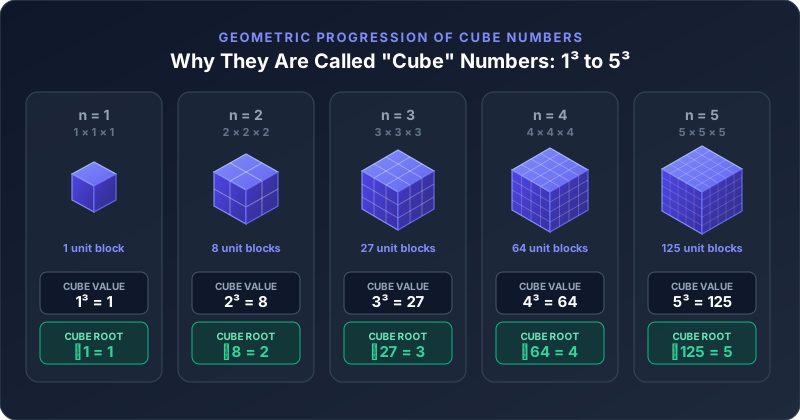
I cubi crescono molto velocemente. Ecco i primi 10 da memorizzare:
Scorri per esplorare la tabella ↓
| Number (n) | Cube (n³) | Cube Root (∛n³) | Quick Test |
|---|---|---|---|
| 1 | 1 | 1 | |
| 2 | 8 | 2 | |
| 3 | 27 | 3 | |
| 4 | 64 | 4 | |
| 5 | 125 | 5 | |
| 6 | 216 | 6 | |
| 7 | 343 | 7 | |
| 8 | 512 | 8 | |
| 9 | 729 | 9 | |
| 10 | 1,000 | 10 | |
| 11 | 1,331 | 11 | |
| 12 | 1,728 | 12 | |
| 15 | 3,375 | 15 | |
| 20 | 8,000 | 20 | |
| 25 | 15,625 | 25 | |
| 50 | 125,000 | 50 | |
| 100 | 1,000,000 | 100 |
La differenza fondamentale rispetto alla radice quadrata: la radice cubica di un numero negativo è un numero reale ordinario.
Il motivo: il prodotto di tre numeri negativi è negativo (meno per meno fa più, più per meno fa meno).
Requires the imaginary unit i (±4i) because squaring any real number produces a non-negative result.
100% Real solution! Multiplying three negative numbers gives a negative product: (-4) × (-4) × (-4) = -64.
∛(−64) = −4, poiché (−4) × (−4) × (−4) = −64
Nessun numero immaginario i necessario: il risultato è al 100% reale.
Le radici quadrate di numeri negativi richiedono l'unità immaginaria i, mentre le cubiche producono direttamente numeri reali.
To find the cube root of a decimal, convert it into a fraction or power of ten, simplify, and evaluate the root.
Apply the quotient property by taking the cube root of the numerator and denominator separately: ∛(a/b) = ∛a / ∛b.
Estrai cubi perfetti per semplificare la forma del radicale:
| Espressione | Forma Semplificata | Ragione | Actions |
|---|---|---|---|
| ∛16 | 2∛2 | 16 = 2³ × 2 = 8 × 2 | |
| ∛24 | 2∛3 | 24 = 2³ × 3 = 8 × 3 | |
| ∛32 | 2∛4 | 32 = 2³ × 4 = 8 × 4 | |
| ∛40 | 2∛5 | 40 = 2³ × 5 = 8 × 5 | |
| ∛48 | 2∛6 | 48 = 2³ × 6 = 8 × 6 | |
| ∛54 | 3∛2 | 54 = 3³ × 2 = 27 × 2 | |
| ∛56 | 2∛7 | 56 = 2³ × 7 = 8 × 7 | |
| ∛72 | 2∛9 | 72 = 2³ × 9 = 8 × 9 | |
| ∛108 | 3∛4 | 108 = 3³ × 4 = 27 × 4 | |
| ∛128 | 4∛2 | 128 = 4³ × 2 = 64 × 2 | |
Individua il più grande cubo perfetto divisore del radicando.
Confronto 3D vs 2D:
| Property / Feature | Radice Cubica | Radice Quadrata |
|---|---|---|
| Simbolo | ∛ (Index 3) | √ (Index 2) |
| Exponent Form | x^(1/3) | x^(1/2) |
| Numeri negativi | Soluzione reale (∛-64 = -4) | Nessuna soluzione reale (richiede i) |
| Moltiplicazioni | 3 (x × x × x) | 2 (x × x) |
| Number of Real Roots | Exactly 1 for all real numbers | 1 for positive / 0 for negative |
| Graph Symmetry | Odd function (symmetric about origin) | Defined only for x ≥ 0 |
| Output Sign | Always matches input sign (∛(-8) = -2) | Always non-negative (principal root) |
| Esempio | ∛64 = 4 (4³=64) | √64 = 8 (8²=64) |
Need to evaluate square roots instead? Calculate square roots with exact decimals and simplified radicals →
Elenco con 3 cifre decimali e badge distintivi per i cubi perfetti.
Scorri per visualizzare tutti i 100 valori ↓
| Numero (n) | Radice (∛n) | Simplified Radical | Tipo | Quick Test |
|---|---|---|---|---|
| 1 | 1 | 1 | Cubo Perfetto | |
| 2 | 1.2599 | ∛2 | Irrazionale | |
| 3 | 1.4422 | ∛3 | Irrazionale | |
| 4 | 1.5874 | ∛4 | Irrazionale | |
| 5 | 1.7100 | ∛5 | Irrazionale | |
| 6 | 1.8171 | ∛6 | Irrazionale | |
| 7 | 1.9129 | ∛7 | Irrazionale | |
| 8 | 2 | 2 | Cubo Perfetto | |
| 9 | 2.0801 | ∛9 | Irrazionale | |
| 10 | 2.1544 | ∛10 | Irrazionale | |
| 11 | 2.2240 | ∛11 | Irrazionale | |
| 12 | 2.2894 | ∛12 | Irrazionale | |
| 13 | 2.3513 | ∛13 | Irrazionale | |
| 14 | 2.4101 | ∛14 | Irrazionale | |
| 15 | 2.4662 | ∛15 | Irrazionale | |
| 16 | 2.5198 | 2∛2 | Irrazionale | |
| 17 | 2.5713 | ∛17 | Irrazionale | |
| 18 | 2.6207 | ∛18 | Irrazionale | |
| 19 | 2.6684 | ∛19 | Irrazionale | |
| 20 | 2.7144 | ∛20 | Irrazionale | |
| 21 | 2.7589 | ∛21 | Irrazionale | |
| 22 | 2.8020 | ∛22 | Irrazionale | |
| 23 | 2.8439 | ∛23 | Irrazionale | |
| 24 | 2.8845 | 2∛3 | Irrazionale | |
| 25 | 2.9240 | ∛25 | Irrazionale | |
| 26 | 2.9625 | ∛26 | Irrazionale | |
| 27 | 3 | 3 | Cubo Perfetto | |
| 28 | 3.0366 | ∛28 | Irrazionale | |
| 29 | 3.0723 | ∛29 | Irrazionale | |
| 30 | 3.1072 | ∛30 | Irrazionale | |
| 31 | 3.1414 | ∛31 | Irrazionale | |
| 32 | 3.1748 | 2∛4 | Irrazionale | |
| 33 | 3.2075 | ∛33 | Irrazionale | |
| 34 | 3.2396 | ∛34 | Irrazionale | |
| 35 | 3.2711 | ∛35 | Irrazionale | |
| 36 | 3.3019 | ∛36 | Irrazionale | |
| 37 | 3.3322 | ∛37 | Irrazionale | |
| 38 | 3.3620 | ∛38 | Irrazionale | |
| 39 | 3.3912 | ∛39 | Irrazionale | |
| 40 | 3.4200 | 2∛5 | Irrazionale | |
| 41 | 3.4482 | ∛41 | Irrazionale | |
| 42 | 3.4760 | ∛42 | Irrazionale | |
| 43 | 3.5034 | ∛43 | Irrazionale | |
| 44 | 3.5303 | ∛44 | Irrazionale | |
| 45 | 3.5569 | ∛45 | Irrazionale | |
| 46 | 3.5830 | ∛46 | Irrazionale | |
| 47 | 3.6088 | ∛47 | Irrazionale | |
| 48 | 3.6342 | 2∛6 | Irrazionale | |
| 49 | 3.6593 | ∛49 | Irrazionale | |
| 50 | 3.6840 | ∛50 | Irrazionale | |
| 51 | 3.7084 | ∛51 | Irrazionale | |
| 52 | 3.7325 | ∛52 | Irrazionale | |
| 53 | 3.7563 | ∛53 | Irrazionale | |
| 54 | 3.7798 | 3∛2 | Irrazionale | |
| 55 | 3.8030 | ∛55 | Irrazionale | |
| 56 | 3.8259 | 2∛7 | Irrazionale | |
| 57 | 3.8485 | ∛57 | Irrazionale | |
| 58 | 3.8709 | ∛58 | Irrazionale | |
| 59 | 3.8930 | ∛59 | Irrazionale | |
| 60 | 3.9149 | ∛60 | Irrazionale | |
| 61 | 3.9365 | ∛61 | Irrazionale | |
| 62 | 3.9579 | ∛62 | Irrazionale | |
| 63 | 3.9791 | ∛63 | Irrazionale | |
| 64 | 4 | 4 | Cubo Perfetto | |
| 65 | 4.0207 | ∛65 | Irrazionale | |
| 66 | 4.0412 | ∛66 | Irrazionale | |
| 67 | 4.0615 | ∛67 | Irrazionale | |
| 68 | 4.0817 | ∛68 | Irrazionale | |
| 69 | 4.1016 | ∛69 | Irrazionale | |
| 70 | 4.1213 | ∛70 | Irrazionale | |
| 71 | 4.1408 | ∛71 | Irrazionale | |
| 72 | 4.1602 | 2∛9 | Irrazionale | |
| 73 | 4.1793 | ∛73 | Irrazionale | |
| 74 | 4.1983 | ∛74 | Irrazionale | |
| 75 | 4.2172 | ∛75 | Irrazionale | |
| 76 | 4.2358 | ∛76 | Irrazionale | |
| 77 | 4.2543 | ∛77 | Irrazionale | |
| 78 | 4.2727 | ∛78 | Irrazionale | |
| 79 | 4.2908 | ∛79 | Irrazionale | |
| 80 | 4.3089 | 2∛10 | Irrazionale | |
| 81 | 4.3267 | 3∛3 | Irrazionale | |
| 82 | 4.3445 | ∛82 | Irrazionale | |
| 83 | 4.3621 | ∛83 | Irrazionale | |
| 84 | 4.3795 | ∛84 | Irrazionale | |
| 85 | 4.3968 | ∛85 | Irrazionale | |
| 86 | 4.4140 | ∛86 | Irrazionale | |
| 87 | 4.4310 | ∛87 | Irrazionale | |
| 88 | 4.4480 | 2∛11 | Irrazionale | |
| 89 | 4.4647 | ∛89 | Irrazionale | |
| 90 | 4.4814 | ∛90 | Irrazionale | |
| 91 | 4.4979 | ∛91 | Irrazionale | |
| 92 | 4.5144 | ∛92 | Irrazionale | |
| 93 | 4.5307 | ∛93 | Irrazionale | |
| 94 | 4.5468 | ∛94 | Irrazionale | |
| 95 | 4.5629 | ∛95 | Irrazionale | |
| 96 | 4.5789 | 2∛12 | Irrazionale | |
| 97 | 4.5947 | ∛97 | Irrazionale | |
| 98 | 4.6104 | ∛98 | Irrazionale | |
| 99 | 4.6261 | ∛99 | Irrazionale | |
| 100 | 4.6416 | ∛100 | Irrazionale |
Want to verify whether any specific integer is an exact cube? Test integers with our instant perfect cube checker →
La radice cubica è fondamentale nello spazio tridimensionale:
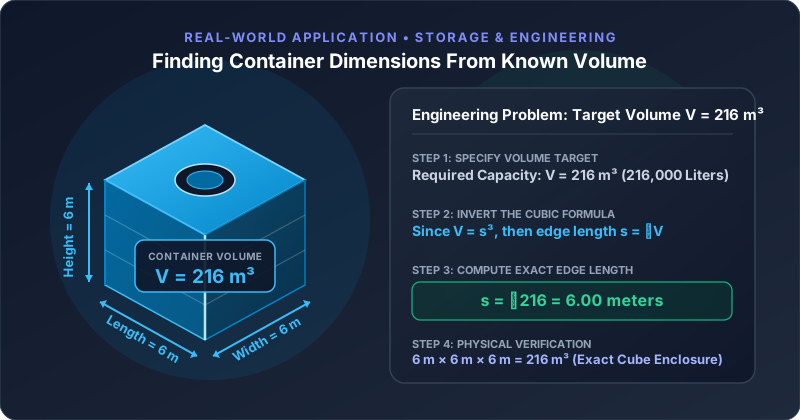
Calcolare lo spigolo di una stanza cubica di 64 m³: ∛64 = 4 m per lato.
Dimensioni ottimali dei pacchi e calcolo del peso volumetrico.
Raggio di una sfera dal volume e dinamica dei fluidi.
Tasso di crescita composto a 3 anni: r = ∛(Finale / Iniziale) - 1.
Spigolo di serbatoi e contenitori d'acqua (es. 27 litri = 30 cm).
All calculations execute directly in your browser with zero latency and 100% data privacy.
Instantly checks whether the radicand is a perfect cube and outputs exact integers without rounding drift.
Performs prime factorization in real time to extract triple factors, rendering exact forms like ∛24 = 2∛3.
Applies the mathematical odd symmetry rule ∛(-x) = -∛x, returning exact real solutions for negative inputs.
Provides clean decimal approximations and comprehensive step-by-step mathematical reasoning.
A cube root of a number is a value that, when multiplied by itself three times, produces the original number. In mathematical notation, the cube root of x is written as ∛x or x^(1/3). For example, the cube root of 27 is 3, because 3 × 3 × 3 = 27.
Yes! Unlike square roots, cube roots of negative numbers are real numbers because multiplying three negative numbers results in a negative product. The rule is ∛(-x) = -∛x. For example, ∛(-8) = -2, because (-2) × (-2) × (-2) = -8.
Cubing and taking the cube root are inverse operations. Cubing a number means raising it to the power of 3 (for example, 4³ = 64). Taking the cube root reverses this process to recover the original base value: ∛64 = 4.
A perfect cube is an integer that results from multiplying an integer by itself three times. Examples include 1, 8, 27, 64, 125, 216, 343, 512, 729, and 1000. The cube root of a perfect cube is always a whole number.
For perfect cubes, use prime factorization: break the number into prime factors, group identical factors into sets of three, and extract one from each group (e.g. 3375 = 3³ × 5³ = 15). For non-perfect cubes, use estimation between the two nearest known perfect cubes.
The cube root symbol is ∛ (Unicode character U+221B). It consists of a standard radical sign with a small index 3 in the upper-left notch. In software code it is written cbrt(x), and in LaTeX as \sqrt[3]{x}.
On Windows, type 221B then press Alt+X in supported apps, or use Character Map. On Mac, press Cmd+Ctrl+Space to open Character Viewer and search 'cube root'. In HTML, use the entity ∛ or copy and paste ∛ directly.
The cube root of 0 is exactly 0, because 0 × 0 × 0 = 0.
The cube root of 2 (∛2 ≈ 1.2599) is an irrational number. It cannot be expressed as an exact fraction of two integers, and its decimal expansion continues infinitely without repeating.
The real cube root of 1 is 1, since 1 × 1 × 1 = 1. (In complex mathematics, there are also two non-real complex cube roots of unity: e^(2πi/3) and e^(-2πi/3)).

La radice cubica risponde a una domanda chiara: quale numero moltiplicato per se stesso 3 volte dà questo valore? Usa il calcolatore sopra per una risposta immediata.