Kalkulator Pierwiastka Sześciennego
Znajdź ∛x dla dowolnej liczby, także ujemnej
Wpisz liczbę, aby obliczyć jej pierwiastek sześcienny.
∛
Oblicz pierwiastek sześcienny z dowolnej liczby dodatniej lub ujemnej. Dokładny wynik, postać uproszczona i kroki obliczeń. 100% za darmo.
Pierwiastek sześcienny (trzeciego stopnia) to kluczowe działanie w przestrzeni 3D. Nasz kalkulator powyżej wyznacza wynik natychmiastowo.
Pierwiastek sześcienny to liczba, która pomnożona przez samą siebie 3 razy daje liczbę wyjściową (3 × 3 × 3 = 27, zatem ∛27 = 3).
The small number 3 in the upper-left of the radical sign. It indicates you are finding the 3rd root (cube root) rather than a square root (index 2).
The mathematical sign ∛ denoting the extraction of the cube root. In Unicode, it is character U+221B.
The number underneath the radical sign whose cube root is being calculated. It can be positive, negative, or zero.
The real value that, when multiplied by itself three times (y × y × y), equals the radicand.
Odpowiada on krawędzi sześcianu o danej objętości.
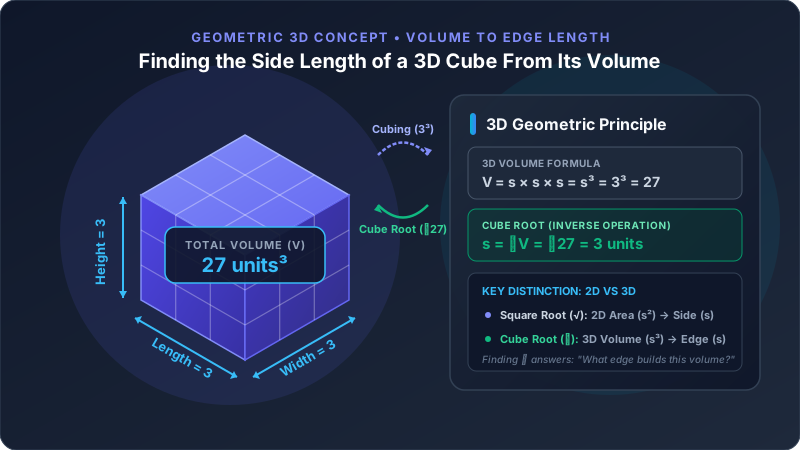
Trzy proste kroki do wyniku:
Wprowadź liczbę w polu powyżej.
Uruchom kalkulator przyciskiem.
Zobacz dokładną wartość dziesiętną i uproszczony pierwiastek, także dla liczb ujemnych.
Narzędzie rozwiązuje wszystkie etapy obliczeń automatycznie.
Symbol ∛ oznacza pierwiastek sześcienny z indeksem 3 w karbie radykału.
Standard mathematical radical notation using index 3 and radical sign.
Fractional power representation: raising any number to 1/3 equals its cube root.
Standard in JavaScript, Python (64 ** (1/3)), C, Java, and modern runtimes.
Excel and Google Sheets formula. Alternatively use =A1^(1/3).
LaTeX mathematical typesetting command for academic papers and documents.
On Windows: type 221B then press Alt+X. On Mac: Cmd+Ctrl+Space. HTML: ∛.
Można go również zapisać z wykładnikiem ułamkowym:
Obie formy są tożsame. W programowaniu używa się x^(1/3).
Zarówno ∛x jak i x^(1/3) określają dokładnie to samo działanie.
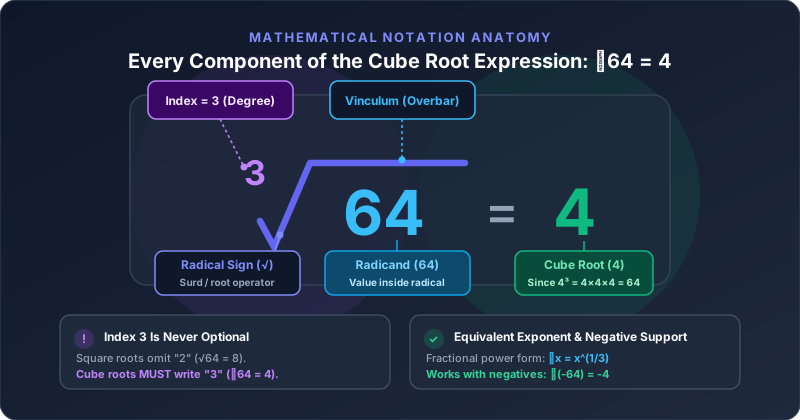
Pierwiastek sześcienny definiuje się przez operację odwrotną do sześcianu:
Liczba pomnożona trzykrotnie przez siebie musi odtworzyć wartość początkową.
Reguły ułatwiające operacje na pierwiastkach 3. stopnia:
Ułatwia wyciąganie czynników przed znak pierwiastka.
Umożliwia dzielenie pierwiastków licznika i mianownika.
Działa dla wszystkich liczb rzeczywistych, dodatnich i ujemnych!
Niezbędne w równaniach algebraicznych.
Stałe punkty odniesienia.
Working with higher degree root indices beyond 3? Compute 4th, 5th, and general nth roots online →
Cztery powszechne metody:
Wpisz liczbę i natychmiast uzyskaj dokładne rozwiązanie.
Grupa czynników po 3 identyczne liczby.
Porównanie z dwoma sąsiednimi sześcianami.
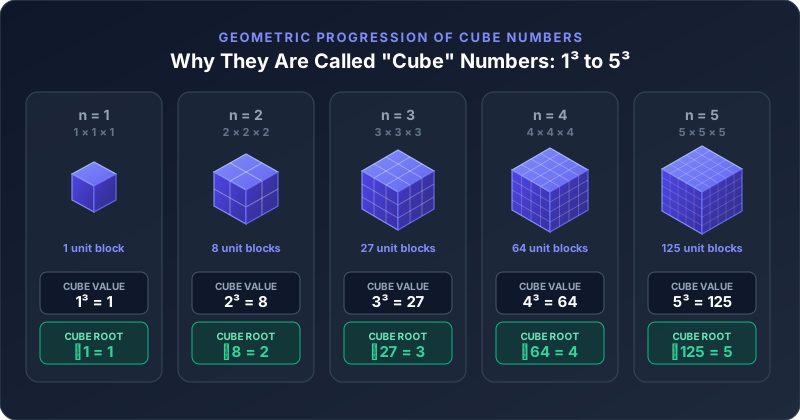
Sześciany rosną bardzo szybko. Oto pierwsze 10:
Przewiń, aby przeglądać tabelę ↓
| Number (n) | Cube (n³) | Cube Root (∛n³) | Quick Test |
|---|---|---|---|
| 1 | 1 | 1 | |
| 2 | 8 | 2 | |
| 3 | 27 | 3 | |
| 4 | 64 | 4 | |
| 5 | 125 | 5 | |
| 6 | 216 | 6 | |
| 7 | 343 | 7 | |
| 8 | 512 | 8 | |
| 9 | 729 | 9 | |
| 10 | 1,000 | 10 | |
| 11 | 1,331 | 11 | |
| 12 | 1,728 | 12 | |
| 15 | 3,375 | 15 | |
| 20 | 8,000 | 20 | |
| 25 | 15,625 | 25 | |
| 50 | 125,000 | 50 | |
| 100 | 1,000,000 | 100 |
Najważniejsza cecha pierwiastka sześciennego: z liczby ujemnej otrzymujemy zwykłą liczbę rzeczywistą.
Iloczyn trzech liczb ujemnych daje minus: minus × minus = plus, plus × minus = minus.
Requires the imaginary unit i (±4i) because squaring any real number produces a non-negative result.
100% Real solution! Multiplying three negative numbers gives a negative product: (-4) × (-4) × (-4) = -64.
∛(−64) = −4, bo (−4) × (−4) × (−4) = −64
Niepotrzebne są liczby urojone i: wynik jest w 100% rzeczywisty.
Pierwiastek kwadratowy z liczby ujemnej wymaga jednostki urojonej i, natomiast sześcienny daje liczbę rzeczywistą.
To find the cube root of a decimal, convert it into a fraction or power of ten, simplify, and evaluate the root.
Apply the quotient property by taking the cube root of the numerator and denominator separately: ∛(a/b) = ∛a / ∛b.
Wyłączanie sześcianów doskonałych przed znak pierwiastka:
| Wyrażenie | Postać uproszczona | Powód | Actions |
|---|---|---|---|
| ∛16 | 2∛2 | 16 = 2³ × 2 = 8 × 2 | |
| ∛24 | 2∛3 | 24 = 2³ × 3 = 8 × 3 | |
| ∛32 | 2∛4 | 32 = 2³ × 4 = 8 × 4 | |
| ∛40 | 2∛5 | 40 = 2³ × 5 = 8 × 5 | |
| ∛48 | 2∛6 | 48 = 2³ × 6 = 8 × 6 | |
| ∛54 | 3∛2 | 54 = 3³ × 2 = 27 × 2 | |
| ∛56 | 2∛7 | 56 = 2³ × 7 = 8 × 7 | |
| ∛72 | 2∛9 | 72 = 2³ × 9 = 8 × 9 | |
| ∛108 | 3∛4 | 108 = 3³ × 4 = 27 × 4 | |
| ∛128 | 4∛2 | 128 = 4³ × 2 = 64 × 2 | |
Znajdź największy sześcian doskonały dzielący liczbę.
Porównanie 3D vs 2D:
| Property / Feature | Pierwiastek sześcienny | Pierwiastek kwadratowy |
|---|---|---|
| Symbol | ∛ (Index 3) | √ (Index 2) |
| Exponent Form | x^(1/3) | x^(1/2) |
| Liczby ujemne | Wynik rzeczywisty (∛-64 = -4) | Brak wyniku rzeczywistego (wymaga i) |
| Liczba mnożeń | 3 (x × x × x) | 2 (x × x) |
| Number of Real Roots | Exactly 1 for all real numbers | 1 for positive / 0 for negative |
| Graph Symmetry | Odd function (symmetric about origin) | Defined only for x ≥ 0 |
| Output Sign | Always matches input sign (∛(-8) = -2) | Always non-negative (principal root) |
| Przykład | ∛64 = 4 (4³=64) | √64 = 8 (8²=64) |
Need to evaluate square roots instead? Calculate square roots with exact decimals and simplified radicals →
Wartości zaokrąglone do 3 miejsc po przecinku z wyróżnieniem sześcianów.
Przewiń, aby zobaczyć wszystkie 100 wartości ↓
| Liczba (n) | Pierwiastek (∛n) | Simplified Radical | Typ | Quick Test |
|---|---|---|---|---|
| 1 | 1 | 1 | Sześcian doskonały | |
| 2 | 1.2599 | ∛2 | Niewymierna | |
| 3 | 1.4422 | ∛3 | Niewymierna | |
| 4 | 1.5874 | ∛4 | Niewymierna | |
| 5 | 1.7100 | ∛5 | Niewymierna | |
| 6 | 1.8171 | ∛6 | Niewymierna | |
| 7 | 1.9129 | ∛7 | Niewymierna | |
| 8 | 2 | 2 | Sześcian doskonały | |
| 9 | 2.0801 | ∛9 | Niewymierna | |
| 10 | 2.1544 | ∛10 | Niewymierna | |
| 11 | 2.2240 | ∛11 | Niewymierna | |
| 12 | 2.2894 | ∛12 | Niewymierna | |
| 13 | 2.3513 | ∛13 | Niewymierna | |
| 14 | 2.4101 | ∛14 | Niewymierna | |
| 15 | 2.4662 | ∛15 | Niewymierna | |
| 16 | 2.5198 | 2∛2 | Niewymierna | |
| 17 | 2.5713 | ∛17 | Niewymierna | |
| 18 | 2.6207 | ∛18 | Niewymierna | |
| 19 | 2.6684 | ∛19 | Niewymierna | |
| 20 | 2.7144 | ∛20 | Niewymierna | |
| 21 | 2.7589 | ∛21 | Niewymierna | |
| 22 | 2.8020 | ∛22 | Niewymierna | |
| 23 | 2.8439 | ∛23 | Niewymierna | |
| 24 | 2.8845 | 2∛3 | Niewymierna | |
| 25 | 2.9240 | ∛25 | Niewymierna | |
| 26 | 2.9625 | ∛26 | Niewymierna | |
| 27 | 3 | 3 | Sześcian doskonały | |
| 28 | 3.0366 | ∛28 | Niewymierna | |
| 29 | 3.0723 | ∛29 | Niewymierna | |
| 30 | 3.1072 | ∛30 | Niewymierna | |
| 31 | 3.1414 | ∛31 | Niewymierna | |
| 32 | 3.1748 | 2∛4 | Niewymierna | |
| 33 | 3.2075 | ∛33 | Niewymierna | |
| 34 | 3.2396 | ∛34 | Niewymierna | |
| 35 | 3.2711 | ∛35 | Niewymierna | |
| 36 | 3.3019 | ∛36 | Niewymierna | |
| 37 | 3.3322 | ∛37 | Niewymierna | |
| 38 | 3.3620 | ∛38 | Niewymierna | |
| 39 | 3.3912 | ∛39 | Niewymierna | |
| 40 | 3.4200 | 2∛5 | Niewymierna | |
| 41 | 3.4482 | ∛41 | Niewymierna | |
| 42 | 3.4760 | ∛42 | Niewymierna | |
| 43 | 3.5034 | ∛43 | Niewymierna | |
| 44 | 3.5303 | ∛44 | Niewymierna | |
| 45 | 3.5569 | ∛45 | Niewymierna | |
| 46 | 3.5830 | ∛46 | Niewymierna | |
| 47 | 3.6088 | ∛47 | Niewymierna | |
| 48 | 3.6342 | 2∛6 | Niewymierna | |
| 49 | 3.6593 | ∛49 | Niewymierna | |
| 50 | 3.6840 | ∛50 | Niewymierna | |
| 51 | 3.7084 | ∛51 | Niewymierna | |
| 52 | 3.7325 | ∛52 | Niewymierna | |
| 53 | 3.7563 | ∛53 | Niewymierna | |
| 54 | 3.7798 | 3∛2 | Niewymierna | |
| 55 | 3.8030 | ∛55 | Niewymierna | |
| 56 | 3.8259 | 2∛7 | Niewymierna | |
| 57 | 3.8485 | ∛57 | Niewymierna | |
| 58 | 3.8709 | ∛58 | Niewymierna | |
| 59 | 3.8930 | ∛59 | Niewymierna | |
| 60 | 3.9149 | ∛60 | Niewymierna | |
| 61 | 3.9365 | ∛61 | Niewymierna | |
| 62 | 3.9579 | ∛62 | Niewymierna | |
| 63 | 3.9791 | ∛63 | Niewymierna | |
| 64 | 4 | 4 | Sześcian doskonały | |
| 65 | 4.0207 | ∛65 | Niewymierna | |
| 66 | 4.0412 | ∛66 | Niewymierna | |
| 67 | 4.0615 | ∛67 | Niewymierna | |
| 68 | 4.0817 | ∛68 | Niewymierna | |
| 69 | 4.1016 | ∛69 | Niewymierna | |
| 70 | 4.1213 | ∛70 | Niewymierna | |
| 71 | 4.1408 | ∛71 | Niewymierna | |
| 72 | 4.1602 | 2∛9 | Niewymierna | |
| 73 | 4.1793 | ∛73 | Niewymierna | |
| 74 | 4.1983 | ∛74 | Niewymierna | |
| 75 | 4.2172 | ∛75 | Niewymierna | |
| 76 | 4.2358 | ∛76 | Niewymierna | |
| 77 | 4.2543 | ∛77 | Niewymierna | |
| 78 | 4.2727 | ∛78 | Niewymierna | |
| 79 | 4.2908 | ∛79 | Niewymierna | |
| 80 | 4.3089 | 2∛10 | Niewymierna | |
| 81 | 4.3267 | 3∛3 | Niewymierna | |
| 82 | 4.3445 | ∛82 | Niewymierna | |
| 83 | 4.3621 | ∛83 | Niewymierna | |
| 84 | 4.3795 | ∛84 | Niewymierna | |
| 85 | 4.3968 | ∛85 | Niewymierna | |
| 86 | 4.4140 | ∛86 | Niewymierna | |
| 87 | 4.4310 | ∛87 | Niewymierna | |
| 88 | 4.4480 | 2∛11 | Niewymierna | |
| 89 | 4.4647 | ∛89 | Niewymierna | |
| 90 | 4.4814 | ∛90 | Niewymierna | |
| 91 | 4.4979 | ∛91 | Niewymierna | |
| 92 | 4.5144 | ∛92 | Niewymierna | |
| 93 | 4.5307 | ∛93 | Niewymierna | |
| 94 | 4.5468 | ∛94 | Niewymierna | |
| 95 | 4.5629 | ∛95 | Niewymierna | |
| 96 | 4.5789 | 2∛12 | Niewymierna | |
| 97 | 4.5947 | ∛97 | Niewymierna | |
| 98 | 4.6104 | ∛98 | Niewymierna | |
| 99 | 4.6261 | ∛99 | Niewymierna | |
| 100 | 4.6416 | ∛100 | Niewymierna |
Want to verify whether any specific integer is an exact cube? Test integers with our instant perfect cube checker →
Pierwiastek sześcienny jest nieodzowny w 3 wymiarach:
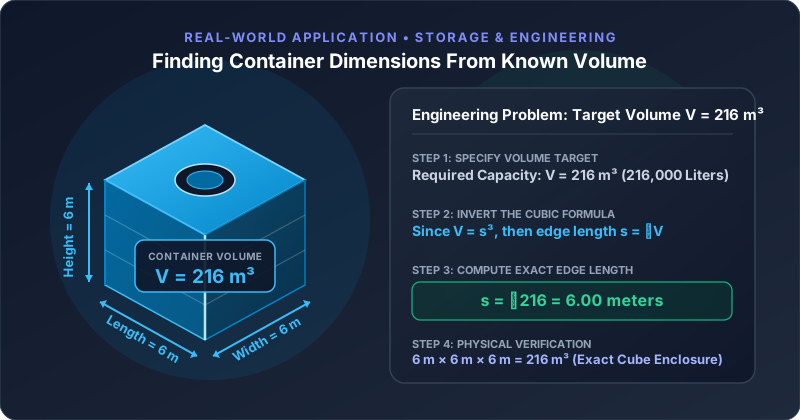
Obliczanie krawędzi kubatury: pomieszczenie 64 m³ ma ∛64 = 4 m długości ścian.
Optymalizacja opakowań i waga gabarytowa przesyłek.
Promień kuli z jej objętości oraz termodynamika.
Średnioroczna stopa wzrostu za 3 lata: r = ∛(Końcowa / Początkowa) - 1.
Wymiary sześciennego zbiornika o pojemności 27 litrów (30 cm krawędzi).
All calculations execute directly in your browser with zero latency and 100% data privacy.
Instantly checks whether the radicand is a perfect cube and outputs exact integers without rounding drift.
Performs prime factorization in real time to extract triple factors, rendering exact forms like ∛24 = 2∛3.
Applies the mathematical odd symmetry rule ∛(-x) = -∛x, returning exact real solutions for negative inputs.
Provides clean decimal approximations and comprehensive step-by-step mathematical reasoning.
A cube root of a number is a value that, when multiplied by itself three times, produces the original number. In mathematical notation, the cube root of x is written as ∛x or x^(1/3). For example, the cube root of 27 is 3, because 3 × 3 × 3 = 27.
Yes! Unlike square roots, cube roots of negative numbers are real numbers because multiplying three negative numbers results in a negative product. The rule is ∛(-x) = -∛x. For example, ∛(-8) = -2, because (-2) × (-2) × (-2) = -8.
Cubing and taking the cube root are inverse operations. Cubing a number means raising it to the power of 3 (for example, 4³ = 64). Taking the cube root reverses this process to recover the original base value: ∛64 = 4.
A perfect cube is an integer that results from multiplying an integer by itself three times. Examples include 1, 8, 27, 64, 125, 216, 343, 512, 729, and 1000. The cube root of a perfect cube is always a whole number.
For perfect cubes, use prime factorization: break the number into prime factors, group identical factors into sets of three, and extract one from each group (e.g. 3375 = 3³ × 5³ = 15). For non-perfect cubes, use estimation between the two nearest known perfect cubes.
The cube root symbol is ∛ (Unicode character U+221B). It consists of a standard radical sign with a small index 3 in the upper-left notch. In software code it is written cbrt(x), and in LaTeX as \sqrt[3]{x}.
On Windows, type 221B then press Alt+X in supported apps, or use Character Map. On Mac, press Cmd+Ctrl+Space to open Character Viewer and search 'cube root'. In HTML, use the entity ∛ or copy and paste ∛ directly.
The cube root of 0 is exactly 0, because 0 × 0 × 0 = 0.
The cube root of 2 (∛2 ≈ 1.2599) is an irrational number. It cannot be expressed as an exact fraction of two integers, and its decimal expansion continues infinitely without repeating.
The real cube root of 1 is 1, since 1 × 1 × 1 = 1. (In complex mathematics, there are also two non-real complex cube roots of unity: e^(2πi/3) and e^(-2πi/3)).

Pierwiastek sześcienny odpowiada na pytanie: jaka liczba pomnożona przez siebie 3 razy daje tę wartość? Obliczaj natychmiast za pomocą naszego kalkulatora.