Calculadora de Cubo Perfecto
Comprueba si un número es un cubo perfecto
Prueba rápida
Introduce cualquier entero positivo o negativo para comprobar si equivale a un entero multiplicado por sí mismo 3 veces (k³ = n).
Comprueba si un número — positivo o negativo — es un cubo perfecto. Raíces exactas, potencias primas y cubos encuadrantes.
Comprueba cualquier número en milisegundos siguiendo estos 3 pasos:
Escribe un entero positivo o negativo, o pulsa un botón rápido (-27, 216, 1331...).
Haz clic en comprobar o presiona Enter para calcular al instante la raíz y divisibilidad.
Examina el veredicto, factores primos, cubos delimitadores y el multiplicador necesario.
Un cubo perfecto (o número cúbico) es un entero obtenido al multiplicar un número entero por sí mismo tres veces: n = k³ = k × k × k.
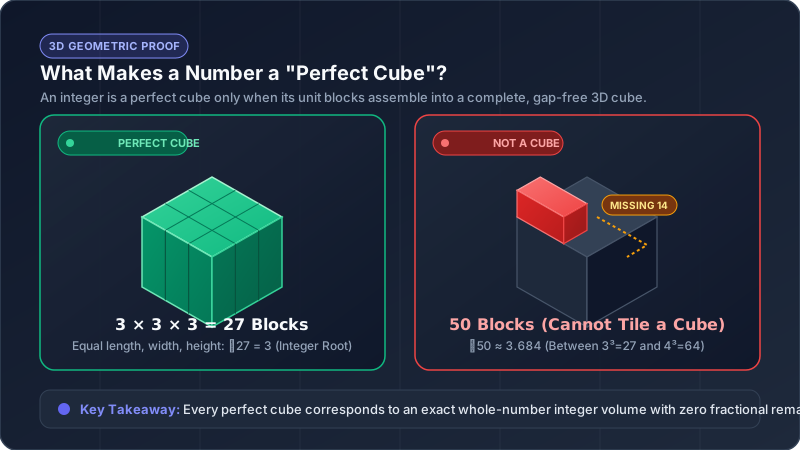
Por ejemplo, 27 es un cubo perfecto porque 3 × 3 × 3 = 27. Igualmente, 125 es un cubo perfecto porque 5 × 5 × 5 = 125. En cambio, 50 no lo es porque su raíz cúbica es 3.684 aproximadamente.
El término proviene de la geometría 3D: con 27 bloques unitarios puedes formar un cubo sólido perfecto de 3×3×3. Con 50 bloques nunca podrás armar un cubo completo.
Las raíces impares conservan el signo: (-3)³ = -27. Por lo tanto, los números negativos pueden ser legítimos cubos perfectos reales.
0 y 1 son cubos perfectos básicos: 0³ = 0 y 1³ = 1. Menos uno también lo es: (-1)³ = -1.
El cubo de un número par siempre es par (2³=8, 4³=64) y el de un impar siempre es impar (3³=27, 5³=125).
En su descomposición prima, todos los exponentes deben ser múltiplos exactos de 3.
Los matemáticos aplican cuatro criterios fundamentales para verificar cubos perfectos:
Halla ∛n. Si el resultado no tiene decimales, n es un cubo perfecto.
Descompón en primos. Si cada exponente divide entre 3, es un cubo perfecto.
Como (-k)³ = -k³, un número negativo -n es cubo si |n| lo es.
Suma los dígitos sucesivamente: la raíz digital de un cubo siempre es 0, 1, 8 o 9.
∛512 = 8 : 8 × 8 × 8 = 512. Prime factorization is 2⁹ with exponent 9 divisible by 3. Digital root: 5 + 1 + 2 = 8 (valid).
∛100 ≈ 4.642 : 100 sits strictly between 4³ = 64 and 5³ = 125. Prime factors are 2² × 5², neither exponent is divisible by 3.
∛(-216) = -6 : (-6) × (-6) × (-6) = 36 × (-6) = -216. Odd roots preserve negative signs, producing a valid real integer root.
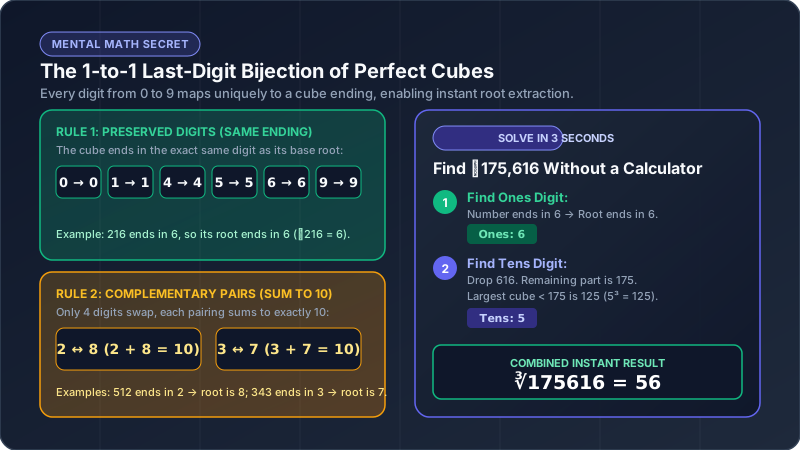
Unlike perfect squares (which can only end in 0, 1, 4, 5, 6, or 9), every digit from 0 to 9 can be the last digit of a perfect cube. In fact, there is a strict one-to-one bijection between the ones digit of a base integer and the ones digit of its cube:
| Base Last Digit (k) | Cube Calculation (k³ mod 10) | Cube Last Digit (k³) | Memory Rule |
|---|---|---|---|
| 0 | 0³ = 0 | 0 | Preserved (Same digit) |
| 1 | 1³ = 1 | 1 | Preserved (Same digit) |
| 2 | 2³ = 8 | 8 | Complements to 10 (2 + 8 = 10) |
| 3 | 3³ = 27 | 7 | Complements to 10 (3 + 7 = 10) |
| 4 | 4³ = 64 | 4 | Preserved (Same digit) |
| 5 | 5³ = 125 | 5 | Preserved (Same digit) |
| 6 | 6³ = 216 | 6 | Preserved (Same digit) |
| 7 | 7³ = 343 | 3 | Complements to 10 (7 + 3 = 10) |
| 8 | 8³ = 512 | 2 | Complements to 10 (8 + 2 = 10) |
| 9 | 9³ = 729 | 9 | Preserved (Same digit) |
To find the cube root of 175,616:
1. Ones Digit: The number ends in 6. Looking at our table, a cube ending in 6 must have a root ending in 6.
2. Tens Digit: Cross off the last three digits (616), leaving 175. The largest perfect cube below 175 is 125 (5³). So the tens digit is 5.
Result: ∛175616 = 56. Verified: 56 × 56 × 56 = 175,616!
Odd powers behave differently from even powers. Here is how special numeric sets are evaluated:
Yes. 0 is an integer, and 0 × 0 × 0 = 0 (0³ = 0). Its principal cube root is exactly 0.
Fully Real. Unlike square roots which require the imaginary unit i, odd roots preserve signs: (-k)³ = -k³. For example, ∛(-64) = -4.
A fraction is a cubic power if both its numerator and denominator are perfect cubes: 27/64 = (3/4)³.
Decimals are cubes if the significant digits form a cube and the number of decimal places is a multiple of 3: 0.027 = (0.3)³, 0.000125 = (0.05)³.
Comparing cubic numbers with square numbers? Test whether an integer is a perfect square →
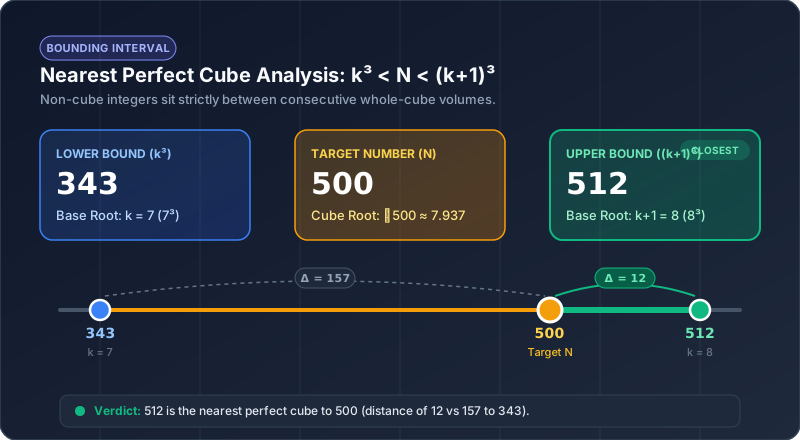
Cualquier no-cubo se encuentra entre dos cubos consecutivos: k³ < n < (k + 1)³.
Por ejemplo, para 500 los cubos vecinos son 343 (7³) y 512 (8³). Como la distancia a 512 es solo 12, 512 es el más cercano.
| Target (N) | Cube Root (∛N) | Lower Cube (k³) | Upper Cube ((k+1)³) | Nearest Cube | Distance |
|---|---|---|---|---|---|
| 50 | 3.684 | 27 (3³) | 64 (4³) | 64 | 64 - 50 = 14 |
| 200 | 5.848 | 125 (5³) | 216 (6³) | 216 | 216 - 200 = 16 |
| 500 | 7.937 | 343 (7³) | 512 (8³) | 512 | 512 - 500 = 12 |
| 800 | 9.283 | 729 (9³) | 1000 (10³) | 729 | 800 - 729 = 71 |
When an integer is not a perfect cube, its root is an irrational decimal. Compute exact decimal cube roots with radical steps →
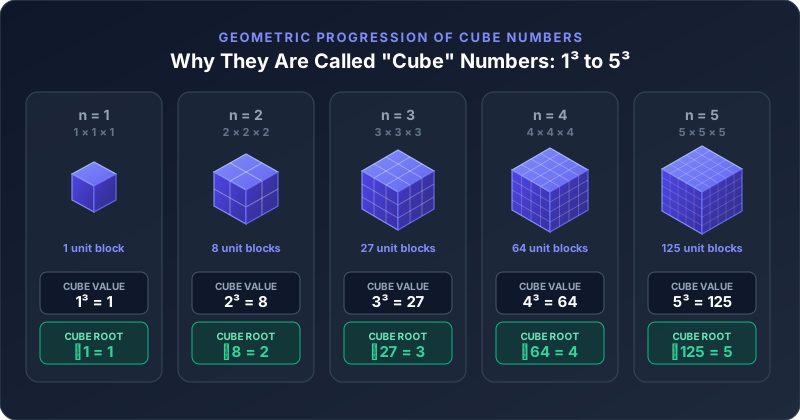
Between 1 and 1000 inclusive, there are exactly 10 perfect cubes:
| Base Root (k) | Formula (k × k × k) | Perfect Cube (k³) | Prime Factorization | ∛k³ |
|---|---|---|---|---|
| 1 | 1 × 1 × 1 | 1 | 1 | 1 |
| 2 | 2 × 2 × 2 | 8 | 2³ | 2 |
| 3 | 3 × 3 × 3 | 27 | 3³ | 3 |
| 4 | 4 × 4 × 4 | 64 | 2⁶ = (2²)³ | 4 |
| 5 | 5 × 5 × 5 | 125 | 5³ | 5 |
| 6 | 6 × 6 × 6 | 216 | 2³ × 3³ | 6 |
| 7 | 7 × 7 × 7 | 343 | 7³ | 7 |
| 8 | 8 × 8 × 8 | 512 | 2⁹ = (2³)³ | 8 |
| 9 | 9 × 9 × 9 | 729 | 3⁶ = (3²)³ | 9 |
| 10 | 10 × 10 × 10 | 1000 | 2³ × 5³ | 10 |
Between 1 and 10,000 inclusive, there are exactly 21 perfect cubes because 21³ = 9,261 and 22³ = 10,648.
| k | k³ | k | k³ | k | k³ |
|---|---|---|---|---|---|
| 1 | 1 | 8 | 512 | 15 | 3375 |
| 2 | 8 | 9 | 729 | 16 | 4096 |
| 3 | 27 | 10 | 1000 | 17 | 4913 |
| 4 | 64 | 11 | 1331 | 18 | 5832 |
| 5 | 125 | 12 | 1728 | 19 | 6859 |
| 6 | 216 | 13 | 2197 | 20 | 8000 |
| 7 | 343 | 14 | 2744 | 21 | 9261 |
Evaluating higher powers beyond the 3rd degree? Evaluate arbitrary nth degree radical roots →
Verify cube numbers automatically in Excel, Google Sheets, Python, and JavaScript:
=IF(ROUND(A2^(1/3), 0)^3 = A2, "Perfect Cube", "Not a Cube") def is_cube(n): return round(abs(n)**(1/3))**3 == abs(n) const isCube = n => Math.round(Math.cbrt(n))**3 === n; Terminology: Perfect Cube or Cube Number.
Terminology: Kubikzahlen (German) and Cubes parfaits (French).
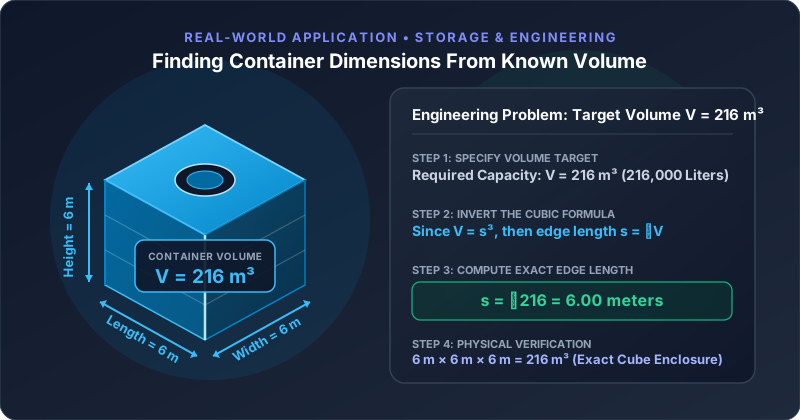
Dimensiones de cajas, depósitos y empaques en transporte y almacenamiento.
Ley cuadrático-cúbica que relaciona superficie y masa en seres vivos y aviación.
Modelado tridimensional en cuadrículas de vóxeles (estilo Minecraft).
Curvas elípticas y teoría analítica de números en seguridad informática.
Cubing a number means multiplying it by itself three times (4³ = 4 × 4 × 4 = 64), not multiplying it by three (4 × 3 = 12).
Unlike square roots, odd roots preserve negative signs. Multiplying three negative numbers gives a negative product: (-5) × (-5) × (-5) = -125.
Every digit from 0 to 9 can end a perfect cube. You cannot eliminate a candidate by its last digit alone; you must use prime factors or modulo 9 digital roots.
In computers, computing 125^(1/3) frequently yields 4.999999999999999. Naively checking if int(125^(1/3)) == 5 can fail without proper rounding logic.
Es un número entero que resulta de multiplicar un número por sí mismo tres veces. Por ejemplo, 27 es un cubo perfecto porque 3 × 3 × 3 = 27.
¡Sí! El producto de tres negativos es negativo: (-4) × (-4) × (-4) = -64. Por tanto, -64 es un cubo perfecto con raíz -4.
Sí, 0 es un cubo perfecto porque 0 × 0 × 0 = 0 (0³ = 0).
Sí, números cuyos exponentes primos son múltiplos de 6: 1, 64 (8² y 4³), 729 (27² y 9³) y 4096 (64² y 16³).
Sí, nuestra calculadora de cubos perfectos es 100% gratuita con comprobaciones ilimitadas y demostraciones completas.

Cumple la fórmula n = k × k × k con k entero.
A diferencia de las raíces cuadradas, los cubos de negativos son reales.
Cada factor primo debe tener un exponente divisible entre 3.
Comprueba números ilimitados con pasos y análisis al instante.